
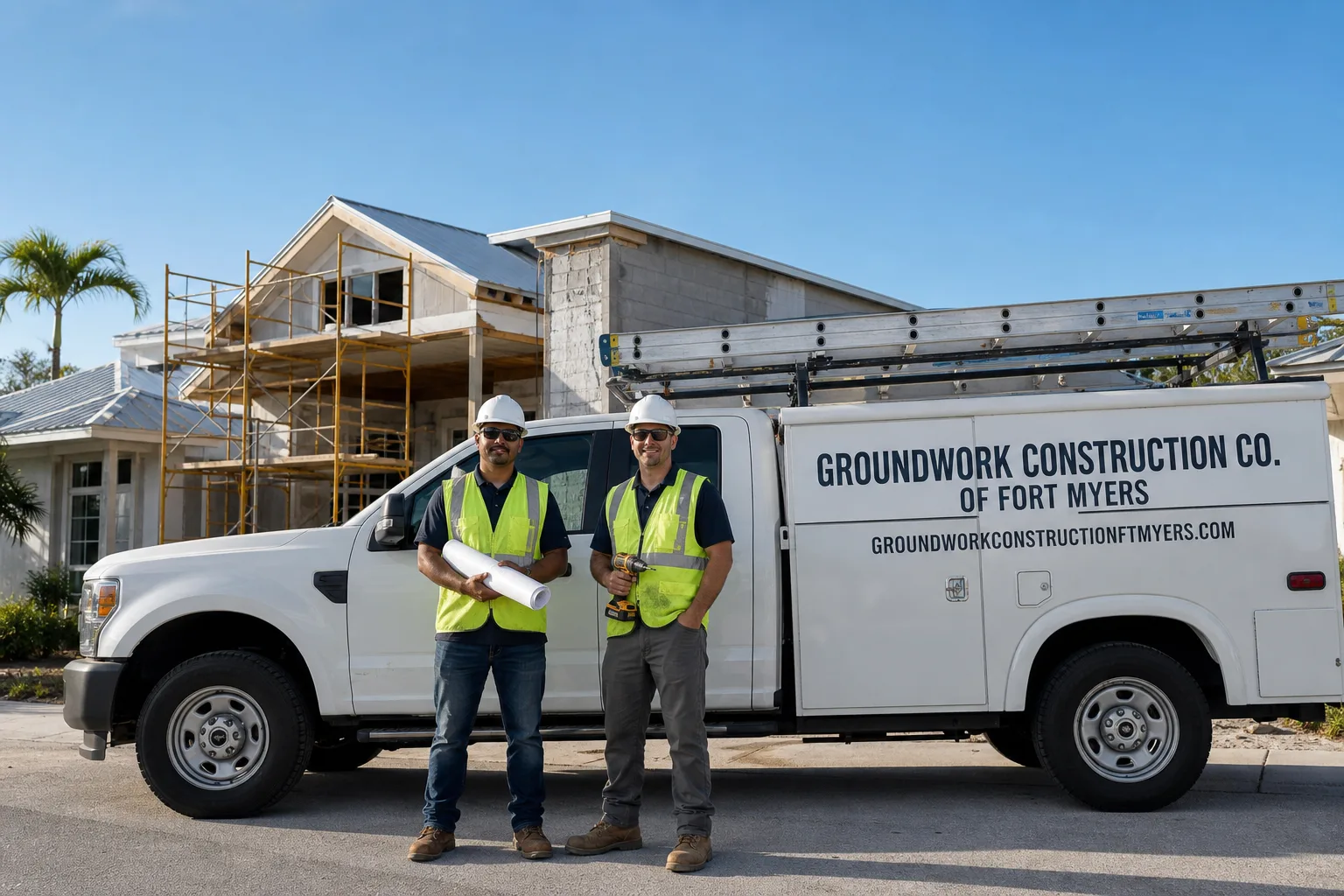
What Paver Driveways in San Carlos Park Actually Cost and How Long They Take
A paver driveway installation in San Carlos Park typically runs between $7,000 and $18,000, with most single-car driveways falling in the $9,000 to $13,000 range. A full tear-out of old concrete, base prep, and standard Belgard or Tremron paver installation on a two-car driveway usually takes our crew 5 to 8 working days from first cut to final compaction. Call us at (844) 638-7249 for a written, line-item quote on your specific driveway - estimates are free and there’s zero pressure.
How We Build a Paver Driveway That Stays Flat in Florida Soil
Paver driveways live or die by what’s underneath them. In San Carlos Park, the sandy, low-bearing soil gets absolutely saturated during rainy season, and a driveway that isn’t excavated and compacted correctly will be a washboard within two years. Here’s the actual sequence we follow on every job.
Day 1 - Demolition and rough grading. If there’s an existing concrete slab, we saw-cut and remove it. The old base material almost never meets current compaction standards, so it all comes out. We excavate to a minimum of 8 inches below finished grade - deeper if the soil turns up organic material or loose fill, which happens regularly in older San Carlos Park lots built on unengineered fill from the 1970s and 1980s. This is the stage where the homeowner confirms the final driveway footprint and edge layout.
Days 2-3 - Base installation and compaction. We bring in crushed concrete or limerock base in 4-inch lifts, compacting each lift with a plate compactor until it refuses to settle further. In San Carlos Park, we pay extra attention to the crown and cross-slope because the flat terrain here means water will pool against the house foundation if the driveway isn’t pitched correctly. A geotextile fabric goes under the base on softer soils to keep the stone from migrating into the sand over time - cheap bids skip this, and those driveways sink.
Day 4 - Edge restraint and bedding sand. We install concrete edge restraints along the entire perimeter, pinned with 12-inch steel spikes. Without solid edge restraint, pavers walk outward under vehicle load. A 1-inch screeded layer of coarse bedding sand goes down, and this is the only sand layer - more than an inch and the pavers shift. The homeowner confirms the paver pattern (herringbone, running bond, or basketweave) by this point, because the laying pattern affects the cut count and waste factor.
Days 5-7 - Paver laying and cutting. Pavers go down starting from a straight edge or a chalked baseline, not from the house outward - starting from the house is the most common shortcut we see on failed driveways. All cuts are done with a wet saw, not a splitter, so the edges are clean and tight. We set the pavers, sweep polymeric sand into the joints, and run the plate compactor over the surface to lock everything together. This is the stage where the homeowner walks the layout before final sand and sees any pattern adjustments.
Day 8 - Final sand and seal (optional). A second round of polymeric sand goes into any low joints, the surface gets a final compaction pass, and if the homeowner opted for sealing, we apply a penetrating sealer that keeps the sand in the joints and resists staining. The driveway is fully usable the same day the final compaction is done. Every paver driveway we install is backed by our 730-Day Done Right Promise - if something settles or shifts, we make it right.
The Paver Choices You’ll Actually Have to Make
You’re not just picking a color. For paver driveways in San Carlos Park, there are three real decisions that change the price, the look, and how the surface holds up against Florida sun and summer downpours.
- Paver thickness: 60mm vs 80mm. A standard residential paver is 60mm (roughly 2-3/8 inches) thick and handles passenger vehicles fine. If you park a heavy pickup, boat trailer, or RV on the driveway regularly, we recommend 80mm pavers - they’re rated for heavier point loads and resist cracking at the edges. The upgrade adds about $2 to $4 per square foot, but replacing cracked pavers two years in costs more.
- Surface texture: smooth vs tumbled. Smooth-finished pavers give a cleaner, more modern look and are easier to sweep clean. Tumbled or antiqued pavers have a worn, textured surface that hides tire marks and staining better - a real consideration on San Carlos Park driveways where afternoon thunderstorms leave standing puddles that deposit silt and leaves. Tumbled pavers from brands like Belgard typically run 10-15% more than their smooth equivalents.
- Pattern complexity. A running-bond pattern is the fastest to lay and wastes the least material (about 5% cuts). Herringbone costs more in labor - it requires roughly 30% more cuts - but it’s the strongest pattern for vehicle traffic because the interlock runs in two directions. For a two-car driveway, the pattern choice alone can swing the price by $800 to $1,500 depending on the paver size.
We work with Belgard, Unilock, and Tremron pavers and can show you full-size samples in your actual driveway light before you commit. That matters more than it sounds - a paver that looks warm beige in a showroom under fluorescent light can read flat gray outside a San Carlos Park home at 2 p.m. We bring the samples to you.
What Moves the Price on a San Carlos Park Paver Driveway
The $7,000 to $18,000 range we quoted up top covers most residential paver driveway installations in San Carlos Park. Where your job lands inside that range comes down to five variables you can actually control.
Square footage is the biggest lever. A single-car driveway (roughly 300 to 400 square feet) at $12 to $18 per square foot lands at the low end. A two-car driveway with a turnaround or an extended approach apron to the street can hit 800 to 1,000 square feet and push into the $14,000 to $18,000 zone. We measure every job ourselves and price from actual dimensions, not satellite imagery.
Demolition and haul-off. If you’re starting with bare dirt, you save $800 to $1,500. If there’s an old concrete slab - and most San Carlos Park homes built from the 1970s through the 1990s have one - we have to saw-cut, break, load, and truck it away. Thicker slabs or slabs with wire mesh reinforcement take longer and cost more to demo.
Base depth and soil conditions. The standard 8-inch base works on most lots, but if we encounter mucky or organic soil (common on lower-lying parcels in the southeast part of San Carlos Park that held water during Ian), we go deeper and add geotextile fabric. That’s an extra $1 to $2 per square foot for the additional stone and fabric, and we’ll tell you the moment we see the soil, before we proceed.
Paver selection. Basic Tremron concrete pavers start around $4 to $6 per square foot for the material alone. Belgard and Unilock options with blended colors, tumbled finishes, or larger format sizes run $7 to $11 per square foot. The material cost is roughly a third of the total job, so the paver you choose moves the final number substantially.
Permitting. Most paver driveway replacements in Lee County do not require a permit if we’re not changing the footprint or the drainage pattern, but if we’re expanding the driveway or adding an approach apron that connects to the county right-of-way, a permit is required. We pull it, we schedule the inspections, and the cost ($200 to $600 depending on scope) is a line item on your estimate - never a surprise buried in the total. Our upfront pricing means the number you see is the number you pay.
What San Carlos Park Specifically Does to a Paver Driveway
San Carlos Park wasn’t a flood zone in most people’s minds before September 2022. After Hurricane Ian’s storm surge pushed miles inland through Lee County’s drainage corridors and sat water on streets for days, everything changed - including how we engineer something as seemingly straightforward as a driveway. The number of homes here classified as substantially damaged by FEMA changed the compliance math: if a property’s cumulative improvements since Ian cross the 50% threshold of the pre-storm assessed value, the entire structure - driveway included - must meet current floodplain management standards. That means base elevation requirements and engineered drainage plans can become part of a paver driveway project that, in any other Lee County community, would be a simple swap. We navigate this with you from the first walkthrough.
The 1970s-to-1990s CBS slab-on-grade tract homes that dominate San Carlos Park were built on compacted fill that’s now four or five decades old. We routinely find the original driveway sub-base is nothing more than a couple inches of sand over undisturbed soil - totally inadequate by modern standards. And because so many of these homes sit on flat lots with minimal natural drainage, the driveway often doubles as the primary path for stormwater moving away from the house. We design the cross-slope and edge drainage so water moves to the street or to a yard drain, never toward the garage slab or the front door. Homeowners in neighborhoods like Three Oaks and the streets running off Sanibel Boulevard regularly pair a full driveway rebuild with our Driveway & Pavers in San Carlos Park scope that includes patio tie-ins, because getting the grading right across the entire hardscape in one shot saves tearing things up twice.
Our Driveway & Pavers crew has been on enough post-Ian rebuilds here to know that what’s underground dictates what stays flat up top. We also see homeowners combining driveway work with larger property upgrades - some are adding an Garage Conversion ADU in San Carlos Park and reworking the entire driveway approach at the same time, while others use the excavation window to plan for ADU Design & Permitting in San Carlos Park down the line. We’re based right here, serving San Carlos Park and the surrounding communities, so we know the Lee County inspection timeline and the specific base-prep standards that keep a driveway intact through a summer of daily thunderstorms and saturated ground.
Serving San Carlos Park, FL - Our Local Coverage Area
We’re based in the San Carlos Park area and know this community well. Use the map below to see our service coverage - if you’re nearby, we can almost certainly help.
Frequently Asked Questions About Paver Driveways in San Carlos Park
Most paver driveway jobs take 5 to 8 working days from demolition to final compaction. Rain delays are the biggest variable - during Southwest Florida’s June-through-September rainy season, we may lose a day or two to weather, but we protect exposed base material with tarps and don’t lay pavers on saturated bedding sand. We’ll give you a firm schedule at the estimate and update you if anything shifts.
Not if we’re replacing an existing driveway of the same size and not altering the drainage pattern toward the street or neighboring properties. If we’re expanding the footprint, adding an apron onto the county right-of-way, or installing the driveway as part of a larger project that crosses the 50% substantial-improvement threshold under FEMA’s post-Ian rules, a permit is required. We handle the determination and pull the permit when needed - you won’t be left guessing about your compliance status. Call (844) 638-7249 and we’ll check your specific property during the estimate.
Not if the base is done right. The sandy soil here drains fast, which is actually an advantage - it doesn’t hold water and expand like clay. The risk is settlement if the base isn’t compacted in lifts or if organic material gets left under the stone. We compact every lift until it refuses, use geotextile fabric on softer soils, and back the whole thing with our 730-Day Done Right Promise. If something moves, we fix it.
Concrete pavers are individual units that interlock - if one cracks, you replace one paver. Stamped concrete is a single slab with a pattern pressed into the surface, and if it cracks, you’re looking at a saw-cut patch that rarely matches. Pavers also handle Florida’s soil movement better because the joints let the surface flex instead of fracture. Stamped concrete typically costs less upfront, but paver driveways are easier to repair and tend to hold their appearance longer in our climate. We install paver driveways, not stamped concrete - that’s what we do best.
Yes, once the final compaction pass is complete and the polymeric sand is swept and activated - typically by the end of the last workday. If we apply a sealer, we recommend keeping vehicles off for 24 hours to let it cure fully. No multi-day curing wait like poured concrete requires.
Get a Written Estimate for Your Paver Driveway in San Carlos Park
We’ll come to your home in San Carlos Park, measure the driveway, talk through paver options with samples in hand, and hand you a line-item quote that breaks down every dollar - no vague numbers, no change-order surprises. The estimate is free and the conversation is straightforward. Call (844) 638-7249 to schedule yours, and you’ll talk to a live person who can answer questions right then.
Written by Derek Hollenbeck, Owner at Groundwork Construction Co., bringing upfront pricing and the 730-Day Done Right Promise to paver driveway projects across San Carlos Park.