
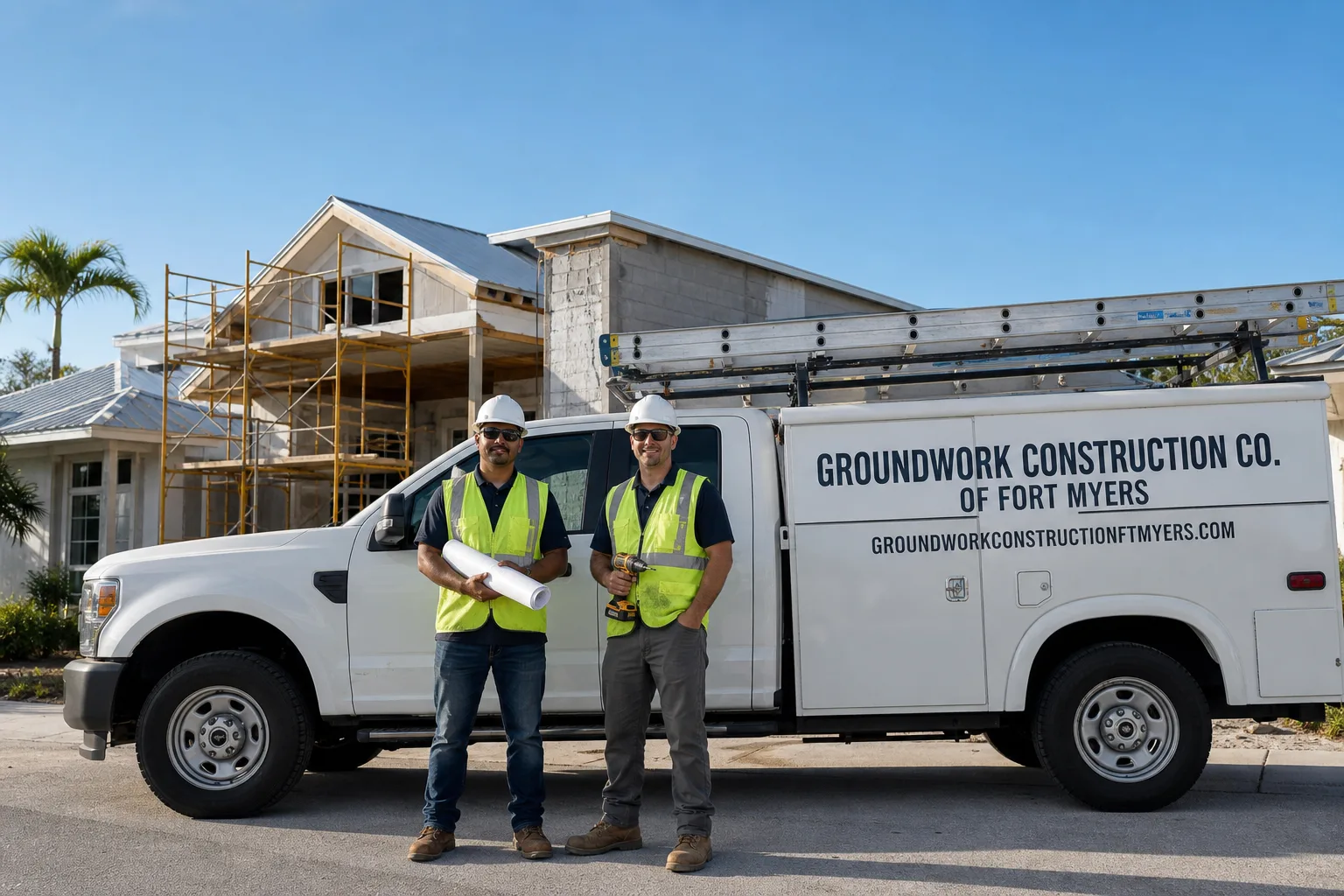
What ADU Site Prep & Utilities Actually Involves in Fort Myers Beach, FL
ADU site prep and utilities in Fort Myers Beach, FL typically costs $45,000 to $130,000 and, all-in, runs about 6 to 10 weeks before the actual building starts. On Estero Island, this job is different from anywhere else in Lee County because you’re almost certainly building on pilings above the FEMA VE flood zone, which means the site work, the temporary power pedestal, the lift station for sewer, and the deep pile foundations all have to be engineered together. Call us at (844) 638-7249 and we’ll walk you through what your specific lot on or near Estero Boulevard will need. The scope breaks into five real-world stages: clearing and demolition, temporary site services, deep foundations and stem walls, wet and dry utility trenching and terminations, and the final stormwater and rough grade before framing starts.
How We Carry Out ADU Site Prep & Utilities in Fort Myers Beach
This is a process that is ordered mostly by Lee County’s building department sequencing requirements and only partly by what makes logical sense logistically. With a single access road feeding the entire island via the Matanzas Pass bridge, we plan every delivery and inspection around bridge traffic, high tide, and tourist-season gridlock along Estero Boulevard. Here is the actual stage-by-stage sequence an ADU site prep in Fort Myers Beach follows.
1. Clearing, demolition, and existing-utility cut-and-cap
Week 1. Any slab-on-grade remnants, old buried septic tanks, or hurricane-damaged debris left by Ian get removed. We cut and cap the existing sanitary lateral at the property line, disconnect the FPL service loop, and kill the buried water supply back at the main. Fort Myers Beach requires a separate demolition permit even for partial structures, and Lee County Solid Waste has specific rules for transporting hurricane debris that still appear on many post-Ian lots. This stage ends with a blank, graded pad ready for piling layout.
2. Temporary site services and access staging
Day 2 through day 10. We drop a temporary power pole (or a diesel tow-behind if FPL’s lead time runs long during peak rebuild season), a portable restroom, and a lockable material storage container – all placed outside the setback lines your surveyor staked. On tight Fort Myers Beach lots where homes sit close together, we often coordinate with neighbors for an access easement if the container needs to sit partially across a lot line. You decide whether we stage materials street-side on Myriad Lane or tucked back near the future ADU footprint, depending on how you feel about curb appeal during the build.
3. Deep foundations, stem walls, and grade-beam forms
Week 2 through 4. Pilings get vibrated or augered to the depth specified by your geotechnical report (typically 25 to 45 feet on Estero Island given the sandy, storm-disturbed soils). Pressure-treated or concrete piles are set, cut to elevation, and capped, then we form and pour the grade beams and reinforced stem walls that tie the pier system together. The homeowner’s big decision here: whether to enclose the lower level with breakaway walls for storage (which adds $9,000-$18,000) or leave it open. Lee County’s 160-mph wind design requirements dictate the specific Simpson Strong-Tie or comparable connectors at every pile-to-beam juncture, so there’s no “value engineering” these connections downward.
4. Wet and dry utility trenching and terminations
Week 4 through 7. This is the part of ADU site prep and utilities that catches people off guard. Because Fort Myers Beach structures sit elevated on pilings, your sewer lateral either needs a lift station to pump effluent up to the gravity main on Estero Boulevard, or – if you are lucky enough to have an uphill lot – a deep gravity line sleeved through the grade beam. Water lateral is simpler, tapping the LCU line at the street with a backflow preventer and a meter yoke. Electric is a new FPL service drop to a meter/main combo with a disconnect, sized for whatever the future ADU’s panel will draw. We trench all of it at once to avoid re-mobilizing the excavator, then call all three utility rough-in inspections back-to-back to reduce the inspector trip count, which matters when Lee County building officials are driving over from downtown Fort Myers. Trench backfill on island sand is quick, but you will need to decide where you want the hose bibs, the outdoor outlet for the ground-level area, and whether to stub out a future outdoor kitchen rough-in now – because breaking into the grade beam later is expensive.
5. Stormwater management and final rough grade
Week 7 through 10. Given Fort Myers Beach’s VE flood zone designation, stormwater has to be managed so it does not pond under the elevated structure and does not sheet-flow onto the neighbor’s slab. We typically install a combination of perforated under-slab drain tile, graded swales, and, on smaller lots, a buried dry well or exfiltration trench. Lee County DCD accepts this as part of the site development permit package and the final rough-grade inspection. Once it passes, the site is ready for the framing crew.
This full sequence is part of a larger Home Additions & ADU in Fort Myers Beach project – the site prep wraps just as vertical construction starts. Many homeowners pair the ADU work with a Full Bathroom Remodeling in Fort Myers Beach inside the main house while both permits are open and crews are already mobilized.
The Options You’ll Choose Between During ADU Site Prep in Fort Myers Beach
Site prep for an ADU is not a one-size process. You will make a handful of real decisions that push the cost one direction or the other. Here are the major branch points.
- Piling material: pressure-treated timber versus precast concrete. Pressure-treated is the standard on Estero Island, typically saving $4,000-$7,000 on an average two-bedroom ADU compared to concrete, and it handles salt spray well. Precast concrete piles last longer in direct saltwater contact and eliminate termite risk, but they cost more, they are heavier to ship over the Sanibel Causeway, and the vibratory hammer needs more clearance – a problem on narrow 50-foot-wide lots near the Gulf Cove Mobile Home Park area. We default to pressure-treated for most projects; we recommend concrete on the bay side where groundwater is more aggressive.
- Lift station versus gravity sanitary. If your ADU’s finished floor elevation sits below the sewer main on Myriad Lane or McGregor Boulevard, Lee County requires a grinder pump and lift station (typically an E/One or equivalent). That adds $8,000-$14,000 to the site utility cost depending on the rise and distance. It also adds an annual maintenance consideration. A gravity lateral is cheaper upfront, but only around 20% of Fort Myers Beach lots have enough natural grade to make one work without burying the line six feet deep through sand.
- Underslab conduit for future electrification. We recommend running a 2-inch PVC spare conduit from the meter/main combo to the ground-floor storage area and to a future outdoor kitchen pad while the trench is open. The material is cheap – maybe $400 in pipe and pull boxes – but the future labor of trenching it in later, after the grade beam is poured and the patio pavers like Belgard or Tremron are down, makes it a very high-value decision right now.
- Breakaway ground-floor walls or open-air lower level. Fort Myers Beach’s floodplain rules say the area below the base flood elevation cannot be habitable and must either be open or enclosed with breakaway walls that will wash out under surge pressure without damaging the pilings. We can form a clean concrete stem wall and leave it open for parking and storage, or we can frame breakaway walls that give you a ground-floor storage room. The wall option adds cost, but it also keeps your beach gear and tools out of the salt air.
What ADU Site Prep & Utilities Costs in Fort Myers Beach, FL
ADU site prep and utilities in Fort Myers Beach run $45,000 to $130,000. The spread depends almost entirely on five variables. First, whether the lot already has an active FPL service drop and a functional sewer lateral stub (most post-Ian lots do not). Second, the pile depth required – if your geotechnical report calls for 45-foot piles instead of 25-foot piles, the cost jumps noticeably. Third, whether the ADU floor elevation triggers a lift station requirement for sewer. Fourth, whether we are demolishing and carting off hurricane-damaged slab remnants or working with a cleared lot. Fifth, whether you choose the breakaway-wall lower enclosure. A written estimate from us includes a line-item breakdown so you can see exactly what moves the number – it is not a single unlabeled figure. A typical estimate includes clearing and demo, piling and grade beams, the lift station or gravity connection, the FPL meter/main and service disconnect, the water lateral and backflow, the site drainage package, and the final rough grade. Itemized estimates separate site prep from vertical construction so you know what each phase costs before framing begins. If you are also considering a Garage Conversion ADU in Fort Myers Beach, the site utility scope is typically smaller, which lowers this portion of the total. And for homeowners tackling a full property overhaul, we frequently coordinate with another Small & Partial Kitchen Remodel in Fort Myers Beach to keep the disruption contained to one stretch instead of two.
What Fort Myers Beach Homes Specifically Do to This Job
No two pages on this site will say the same thing here. Fort Myers Beach was ground-zero for Hurricane Ian’s 2022 landfall, leaving the vast majority of structures on Estero Island either destroyed or substantially damaged under FEMA’s 50% rule. What that means for ADU site prep is that nearly every lot we work on here is either a complete teardown or an elevated-rebuild situation. You cannot do a site-prep job on this island without a piling plan stamped by a Florida-licensed structural engineer, a VE-zone flood elevation certificate, and Lee County DCD approval for the foundation elevation relative to base flood. It is a post-disaster rebuilding scale that no neighboring mainland community like Cape Coral or Bonita Springs faces.
Add the single-access logistics – every concrete truck, every FPL bucket truck, and every pile-driving rig has to come across the Matanzas Pass bridge and navigate Estero Boulevard, which is also the main tourist artery to the beach. During snowbird season, a pour scheduled at 10 a.m. can see the truck stuck at the base of the bridge for an hour, so we schedule pours early morning and stage materials days in advance in the storage container on site. The soil is not dirt; it is mostly sand over limestone caprock, meaning trenching goes fast but trench-wall collapse is a real thing we shore constantly. If your property is near Sanibel Tower or anywhere along the bay side, the groundwater table sits higher, which changes both the dewatering plan during grade-beam pours and the lift-station configuration for the sewer lateral. None of this applies to a slab-on-grade build inland – it is unique to a barrier-island ADU in Fort Myers Beach. Our home additions & ADU crew has worked through every stage of the post-Ian rebuild here.
Serving Fort Myers Beach, FL - Our Local Coverage Area
We’re based in the Fort Myers Beach area and know this community well. Use the map below to see our service coverage - if you’re nearby, we can almost certainly help.
Frequently Asked Questions: ADU Site Prep & Utilities in Fort Myers Beach
Six to ten weeks from the day we mobilize the excavator to the day the final rough-grade inspection passes. The biggest variable is Lee County inspection lead times during peak building season, plus FPL’s service-drop scheduling, which can add two to three weeks if the utility is backlogged with post-Ian reconnects along the Estero Boulevard corridor. Call (844) 638-7249 for a schedule estimate specific to your lot.
Yes. You need at minimum a site development permit from Lee County DCD, a separate demolition permit if any existing slab or foundation is being removed, and an FPL disconnect/reconnect work order. Any lot in the VE flood zone also requires a FEMA elevation certificate sealed by a Florida surveyor before the foundation inspection can close. We pull all of these as part of the project scope.
Rarely on Estero Island. If your existing lateral was on a slab-on-grade home that was destroyed or substantially damaged by Ian, that lateral is likely shattered, buried under debris, or both. Even if it survived, it was set at grade level, not elevated. A new ADU built on pilings at the required flood elevation nearly always needs a new sanitary lateral stubbed out at the raised elevation, which means fresh trenching from the grade beam to the main. We never recommend reusing a buried lateral from a destroyed structure.
Even with an active FPL service drop and a known-good sewer stub, plan on $45,000 to $80,000 to cover the clearing, deep foundations, stormwater, and utility reconnection work for a typical two-bedroom ADU in Fort Myers Beach. The piling and grade-beam package alone accounts for roughly half of that range on a standard 600-800-square-foot footprint. A written estimate from us will break out the line items so you see exactly what you’re paying for.
All of our ADU site prep and utility work in Fort Myers Beach is covered under Groundwork Construction Co.’s 730-Day Done Right Promise: if it is not done right, we make it right. That applies to the pile foundation, the utility connections, the stormwater drainage, and the rough grade. It is one of the longest workmanship guarantees in the residential construction space, and we put it in writing on every estimate.
Get a Free On-Site Estimate for ADU Site Prep in Fort Myers Beach
If you are planning an ADU on Estero Island and need the site work quoted accurately, call us at (844) 638-7249. We will come out, walk the lot with you, identify what existing utilities are salvageable, and price the full site-prep scope in a line-item written estimate with no obligation and no vague numbers. We serve all of Fort Myers Beach’s ZIPs – 33908 and 33931 – and we answer the phone live, 24/7, even on weekends. Upfront pricing, no surprises.
Written by Derek Hollenbeck, Owner at Groundwork Construction Co.