
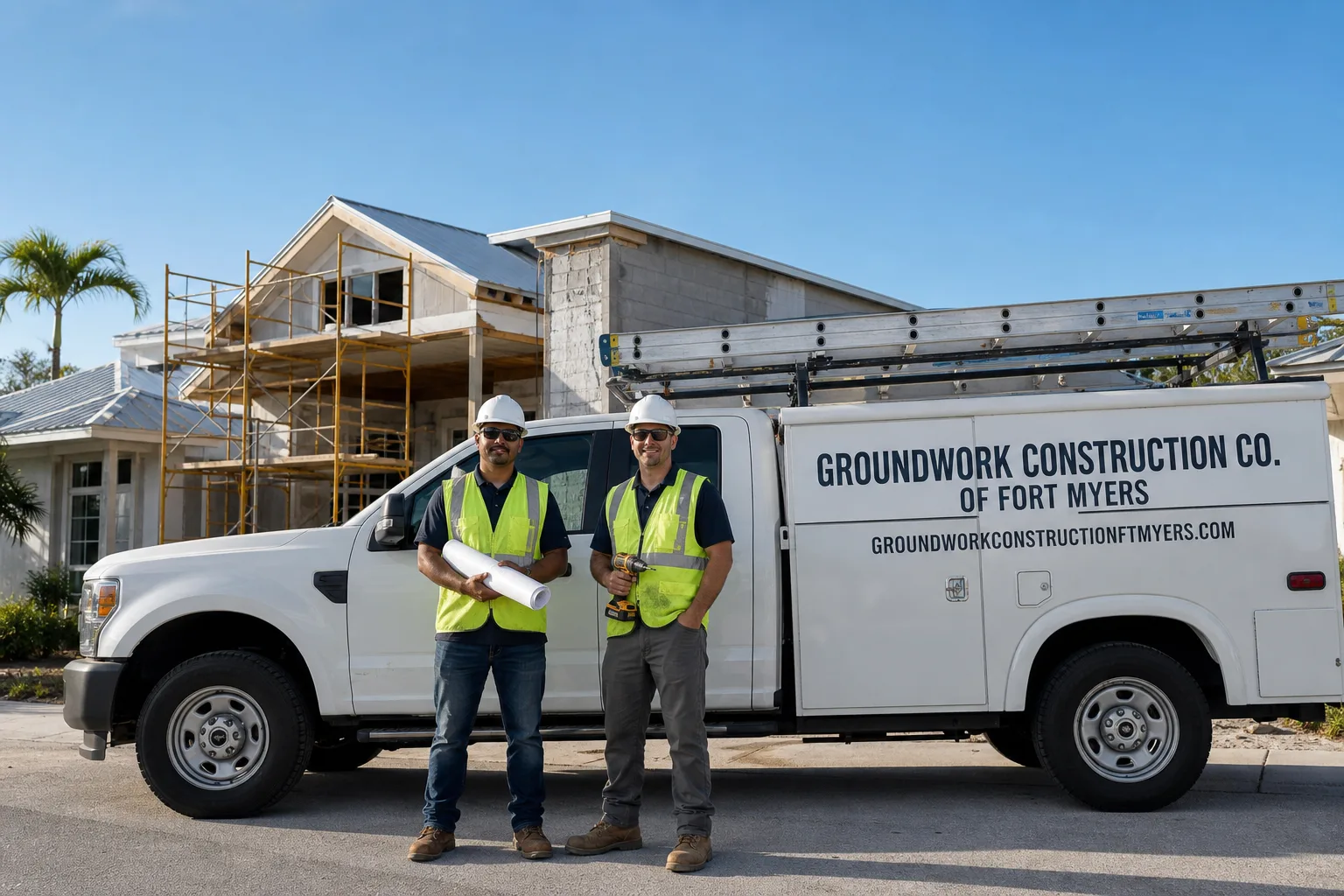
What a New Detached ADU in Punta Rassa Actually Takes
A new detached ADU in Punta Rassa typically runs $90,000 to $220,000 and takes five to eight months from permit submission to final inspection. That range isn’t vague, it reflects what we see on this narrow peninsula: foundation elevation requirements, coastal corrosion standards, and the reality that almost every site here is a post-Ian rebuild on VE-zone ground. Call (844) 638-7249 and we’ll give you a line-by-line estimate built for your specific lot, not a square-footage guess.
Most detached ADUs in this community are built as stand-alone guest quarters, in-law suites, or rental units on waterfront properties where the main home was already substantially rebuilt after 2022. The work involves new foundation, framing or reinforced CBS walls, all rough-ins, impact-rated windows and doors, full interior finishes, and a separate utility connection or sub-panel: a complete home, just smaller. We’ll walk you through every decision, because in Punta Rassa there is no “standard” build.
How We Build a Detached ADU, Stage by Stage
The real sequence matters. Here’s what happens on the ground from the day you sign until the day you walk into the finished unit.
Stage 1 - Site survey, soils report, and permit set (weeks 1-4). Before a shovel hits dirt, we pull a boundary and topographic survey of your lot, order a geotechnical soils report, and submit the full architectural and structural set to Lee County. In Punta Rassa, the VE-zone designation means floodplain management review is mandatory, and base flood elevation compliance adds roughly two to three weeks to standard permit timelines. We’ll tell you during this stage exactly where the new slab or stem-wall elevation must sit relative to your existing dock, seawall, and main house, because the county won’t budge on that number.
Stage 2 - Foundation and under-slab rough-ins (weeks 5-8). Most detached ADUs here go onto elevated concrete slabs or short stem walls with deep footers designed for storm-surge loads. During excavation, we trench for water supply, sewer lateral, and electrical conduit. If your property connects to an existing seawall or marina bulkhead, we coordinate with a marine contractor to avoid undermining that structure, which is a Punta Rassa-specific coordination step that catches first-time builders off guard.
Stage 3 - Shell: walls, roof trusses, windows, and doors (weeks 9-14). Concrete block with full tie-beam reinforcement is the standard we recommend: it stands up to salt spray and wind loads better than stick framing in this location. Roof trusses go on, strapped with stainless-steel hurricane ties. Windows and exterior doors are impact-rated, submitted with product-approval documentation to the county. This is when you’ll finalize the exterior finish (stucco color, lap siding if preferred, soffit and fascia material) so we don’t lose time waiting on material lead times.
Stage 4 - Interior rough-ins and dry-in (weeks 15-19). Electrical wiring, plumbing supply and drain lines, mini-split HVAC rough-in, and low-voltage runs for data and security happen here. After the two rough-in inspections pass (structural and MEP), insulation goes in and drywall follows. In Punta Rassa’s salt environment, we spec closed-cell spray foam wherever possible, not because it’s an upgrade, but because it doubles as a vapor barrier and helps keep the dew point out of the wall cavity: a practical choice for a peninsula surrounded by San Carlos Bay.
Stage 5 - Finishes, fixtures, and final inspections (weeks 20-26). Flooring, trim, paint, kitchenette and bath fixtures, door hardware, lighting, and any smart-home integrations go in during this final push. Our electrician sets the sub-panel or separate meter, and the county sends electrical, plumbing, building, and floodplain compliance inspectors for final sign-off. We walk the unit with you before that last inspection, so there are no surprises. Every detached ADU we build carries our 730-Day Done Right Promise: if something isn’t correct, we make it right, no qualifiers.
Throughout the process, homeowners often ask us about interior finishing trades, which we handle through the same crew that does Backsplash, Tile & Flooring in Punta Rassa. Keeping those finish details consistent across the main home and the ADU matters on high-end properties.
The Choices That Shape Your Detached ADU
You’ll make hundreds of decisions during a build this size. These are the ones that most affect cost, durability, and how the unit lives day to day.
- Foundation type: elevated slab vs. stem-wall on footers. An elevated concrete slab, finished at or above base flood elevation, is the most common solution in this VE-zone and generally the lower-cost option. Stem walls with crawlspace access cost more up front but make future plumbing and electrical modifications far easier. On lots with existing seawall tie-backs, stem walls sometimes give us more flexibility in placement.
- Wall assembly: reinforced CBS vs. engineered wood frame. Concrete block stands up better to salt air and hurricane wind loads and requires less maintenance over 30 years. Engineered wood framing costs 10 to 15 percent less in materials but demands more frequent exterior repainting this close to the water. For an ADU that’s meant to last, we almost always recommend block.
- Roofing: standing-seam metal vs. architectural shingle. Metal handles the salt-spray environment with far less degradation than asphalt shingles, and the 26-gauge standing-seam panels we install carry manufacturer warranties that actually hold up in coastal exposure. Architectural shingles are roughly 30 percent less expensive but will weather faster on a Punta Rassa lot with no windbreak between the roof and San Carlos Bay.
- Climate control: ductless mini-split vs. tied to main home’s HVAC. A separate high-SEER mini-split system gives the ADU independent temperature zones and removes the need to trench refrigerant lines across the property. Tying into an existing system saves on equipment cost but often creates uneven cooling and higher long-term energy bills. Most owners here choose the standalone system.
- Interior finish level: builder-grade vs. custom. This single variable can move the final number by $25,000 or more. Cabinetry (flat-pack vs. custom-built), countertops (quartz vs. laminate), flooring (engineered hardwood vs. luxury vinyl plank), and trim profiles all stack up quickly. We’ll show you the numbers for both paths before you commit, because our upfront pricing means you see the line items.
What a New Detached ADU Costs in Punta Rassa, FL
A detached ADU in Punta Rassa, FL lands between $90,000 and $220,000. The low end represents a compact studio layout (roughly 400 square feet) on an accessible lot with no seawall conflicts, builder-grade finishes, and straightforward utility connections. The high end covers a two-bedroom unit near 750 to 900 square feet with a full kitchen, custom cabinetry, stone counters, impact sliders opening to a small patio, and the foundation complexity that comes with tight waterfront lots.
Five factors push the number one direction or the other. Foundation elevation and lot access: if your required pad height sits four feet or more above existing grade, material and labor costs climb fast. Utility distance and capacity: running a new sewer lateral 80 feet across a developed lot costs more than a 20-foot tie-in; same logic applies to electrical service upgrades if your existing panel lacks capacity. Seawall and dock proximity: building within ten feet of existing marine infrastructure triggers additional engineering review and sometimes shoring requirements that don’t apply to interior lots. Material grades: the jump from stock cabinets to custom millwork and from standard windows to high-end impact units can add $15,000 to $30,000. Permit and impact fee scope: Lee County school and transportation impact fees, plus floodplain review charges, vary by square footage and location, and they’re line items you’ll see in our estimate, not buried in a lump sum.
Our written estimate for new detached ADU work in Punta Rassa breaks out every line: site prep, foundation, shell, rough-ins, finishes, fixtures, and the permit fee schedule. Nothing is rounded to a convenient number. When the total shows $90,000 to $220,000, you’ll know exactly what each dollar buys.
If part of a larger property overhaul, this build often fits within a full Home Additions & ADU in Punta Rassa scope, where we sequence the main home and the ADU together to avoid re-mobilizing crews twice.
What Punta Rassa Specifically Does to This Job
Punta Rassa sits at the exact point where Hurricane Ian’s surge funneled into the Caloosahatchee estuary in 2022. Nearly every habitable structure here was either destroyed or tagged as substantially damaged by Lee County, which triggered mandatory rebuilds to current FEMA VE-zone base flood elevations, numbers that now sit three to five feet higher than pre-Ian footprints. For a detached ADU, that means the foundation elevation isn’t negotiable. We design from that number outward, because the permit desk will not approve anything below it.
The housing stock in Punta Rassa is extremely limited: a small collection of luxury waterfront single-family homes and elevated marina-adjacent condominiums. Every new build, including an ADU, goes in as reinforced concrete block or heavy-gauge engineered framing, and every exterior fastener, strap, and connector must be stainless steel or hot-dipped galvanized. Salt spray off San Carlos Bay does not wait. We’ve opened walls on homes here that used standard hardware, and the corrosion was measurable within three years. That’s not a scare tactic, it’s what the air does.
One complication unique to Punta Rassa: matching an elevated ADU foundation to existing seawall and dock infrastructure that survived the storm. That coordination typically requires a marine contractor, a South Florida Water Management District review, and a foundation engineer all on the same page. It’s technical, and it’s not a factor on inland lots in Punta Rassa‘s neighboring communities, but here it’s routine. We’ve worked through it enough times to know the sequence and the people to call.
Homeowners who add a detached ADU often want the new unit’s kitchen to match the quality of the main home. When that’s the case, we bring in our Kitchen Design & Layout in Punta Rassa team to handle the ADU kitchenette or full kitchen, using the same cabinet lines and countertop slab families so the two structures feel part of one property.
Serving Punta Rassa, FL - Our Local Coverage Area
We’re based in the Punta Rassa area and know this community well. Use the map below to see our service coverage - if you’re nearby, we can almost certainly help.
Frequently Asked Questions About New Detached ADU in Punta Rassa
Plan on five to eight months from permit submission to final inspection. The VE-zone floodplain review adds two to three weeks to the permit phase, and any seawall-adjacent foundation coordination can add another two weeks during engineering. Material lead times for impact-rated windows and custom cabinetry are the other common variable: we’ll lock your order during the permit stage so nothing sits idle waiting on glass.
Yes, and it’s a full building permit set. Lee County requires architectural and structural plans, a floodplain development permit for VE-zone lots, a site plan showing setbacks and finished floor elevation relative to base flood elevation, and separate MEP (mechanical, electrical, plumbing) sub-permits. We handle the drawings and the submissions. You won’t chase paper.
Often yes, if the new unit’s location works with your existing sewer lateral depth and fall. On Punta Rassa lots where the main home’s plumbing runs toward the street and the ADU sits closer to the water, we may need to run a separate lateral or install a lift station. We’ll know that during Stage 1 when we map the existing lines, and you’ll have that cost on paper before we break ground.
In this market, $90,000 to $220,000. A compact studio with builder finishes sits at the lower end. A two-bedroom unit with a full kitchen, impact sliders, and the foundation complexity of a Punta Rassa waterfront lot climbs toward the upper end. We’ll price your specific scope line by line, so the only number you see is the one attached to your project. Estimates are free: call (844) 638-7249.
Every detached ADU we build is covered by our 730-Day Done Right Promise. If something isn’t done right within two full years of completion, we make it right, at our expense. That covers workmanship across all trades: foundation, framing, roofing, windows, doors, electrical, plumbing, drywall, paint, tile, and finish carpentry. Manufacturer warranties on materials (windows, roofing, appliances, HVAC equipment) run separately and we’ll register every one in your name at close-out.
We build these units the same way we build full-scale Home Additions & ADU projects: same crews, same standards, same guarantee. The only difference is square footage.
Start Your Detached ADU in Punta Rassa With a Real Number
You’ll get a written, line-by-line estimate for your new detached ADU, built from your lot’s elevation certificate, your finish choices, and the local Punta Rassa conditions we know cold. No square-footage ballpark, no surprise change orders. Call (844) 638-7249 to schedule your free on-site estimate. We’ll walk the property, talk through layout and foundation options, and hand you a number you can make a real decision on.
Written by Derek Hollenbeck, Owner at Groundwork Construction Co., serving communities across Southwest Florida since 2014.