
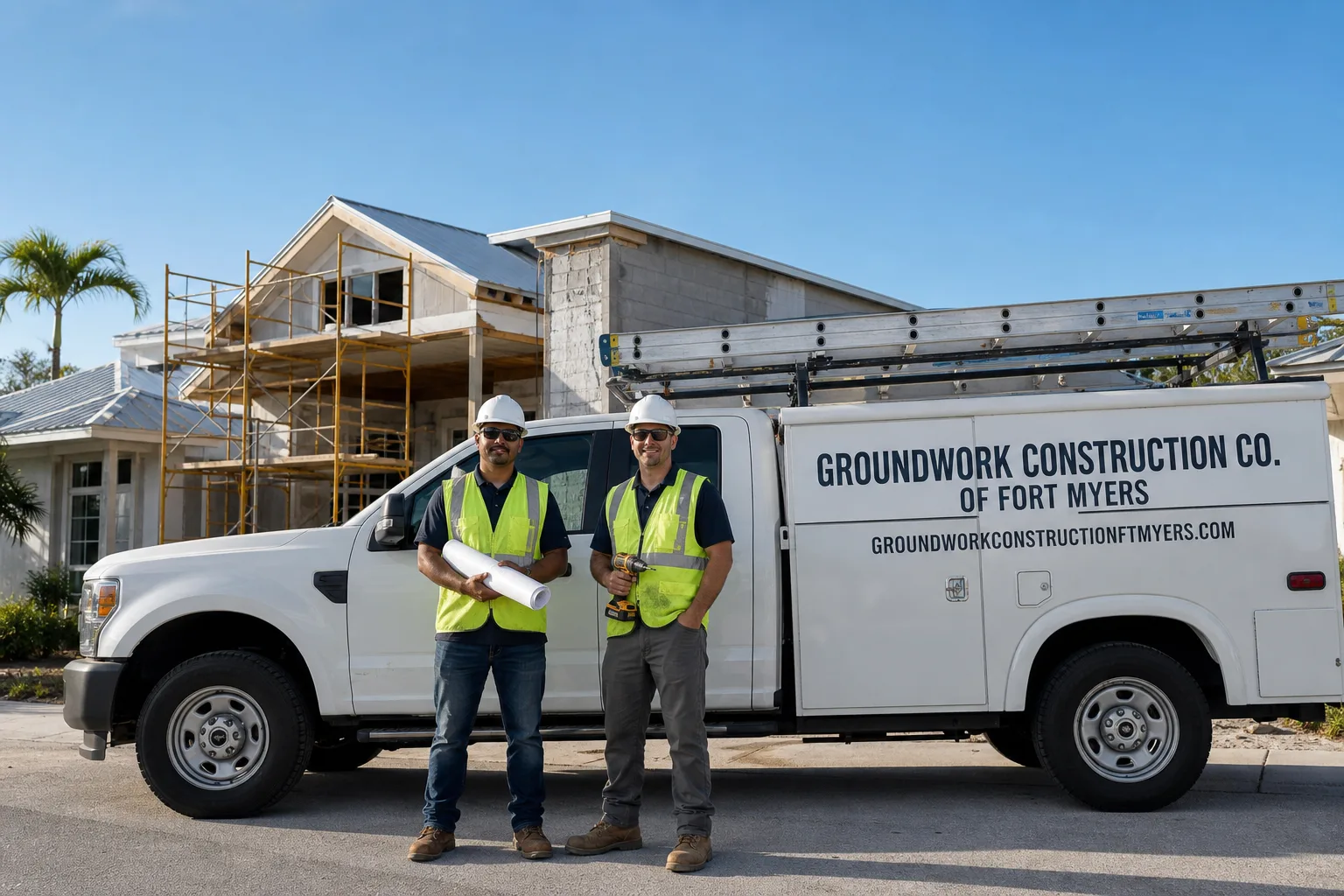
What Tile Roofing Costs and How Long It Takes in Burnt Store Marina
Tile roof repair in Burnt Store Marina, FL typically runs between $600 and $2,500, with full reroofs on concrete-tile homes here starting around $18,000 and climbing past $40,000 depending on underlayment condition and whether your home needs structural upgrades to meet post-Ian elevation requirements. Most tile roofing jobs in the marina wrap up in 3 to 7 working days, though permit scheduling with Charlotte County can push the full timeline out a few weeks. Call (844) 638-7249 for a line-item estimate built around your specific roof - we do not do vague bids.
How we handle tile roofing work along Charlotte Harbor
Tile roofing in a salt-air environment demands a different sequence than inland work. We have learned, through hundreds of post-Ian rebuilds here, that skipping the corrosion audit on day one creates problems that hide for years and then cascade. Here is the process we follow on every Roofing project in Burnt Store Marina.
Stage 1: The corrosion and decking inspection (day one, 2-3 hours). We pull back tile in at least six test locations across the roof - ridge, eave, valley, and three field spots - and inspect the underlayment, fasteners, and decking below. In Burnt Store Marina specifically, we are looking for salt-driven nail rust, rotted felt at fastener penetrations, and OSB decking that has started delaminating from trapped moisture around the tile overlap joints. If the decking is sound and the underlayment is intact, we can move to repair-only scope. If we find soft decking or fastener failure, we walk you through what a partial vs. full reroof looks like before we touch another tile. You decide the scope at this point, not after we open things up.
Stage 2: Underlayment replacement and fastener upgrade (days 1-3). Once the scope is locked, we strip tile to the decking in the work zone and remove the old underlayment. On homes directly facing Charlotte Harbor, we spec a high-tensile synthetic underlayment with a 110+ mph wind rating and mechanically fasten it with hot-dipped galvanized cap nails - not staples, which pull through in a storm-surge wind event. The tile that comes off gets stacked and sorted; salvageable tile goes back on, and we order matching replacements for any cracked or spalled pieces. If we are doing a full reroof as part of a larger Roofing in Burnt Store Marina project, this stage overlaps with any structural work needed to bring the roof deck into compliance with current wind-load codes.
Stage 3: Tile reinstallation and pattern matching (days 2-5). Reinstalling tile on a coastal home is not just about setting tile back where it came from. We walk the roof with you (or send photos if you prefer to stay on the ground) to confirm the tile profile, color blend, and edge detailing. Burnt Store Marina homes from the 1980s and 1990s often have discontinued barrel profiles, so we maintain relationships with three salvage yards in Southwest Florida to source period-matched tile. Field tile goes down first, then ridge and hip caps, then any custom-cut pieces around skylights or vent stacks. We install stainless-steel fasteners at every wind-vulnerable perimeter and ridge tile, regardless of what the original builder used.
Stage 4: Flashing, valley metal, and penetration sealing (day 4-6). This stage matters more here than anywhere else. We replace all flashing at chimneys, walls, skylights, and pipe boots with .032-gauge aluminum or 26-gauge galvanized steel - never the thin flashing stock that rusts through in three seasons of harbor spray. Valleys get new metal with a full 24-inch width, and every penetration gets a two-layer seal: a mechanical flashing base plus a marine-grade urethane sealant bead. If your roof has a tile-to-wall transition - common on the zero-lot-line villas along the canals - we install a full step-flashing and counterflashing assembly, not a caulk joint that fails in 18 months.
Stage 5: Final inspection, cleanup, and the walk-off list (day 5-7). We walk the roof with a punch list, photograph every detail, and send you a digital closeout packet with photos, a scope-of-work summary, and our 730-Day Done Right Promise documentation. The site is cleaned daily - magnetic sweeper for fasteners, tarps kept tight in the wind, no debris left in the swales or canal-edge landscaping. If Charlotte County’s building inspector flags anything on the final, we handle the correction and reinspection without charging you a penny beyond the original estimate.
The tile roofing decisions you will weigh before we start
Every tile roofing job in Burnt Store Marina involves a handful of real choices. The right call depends on how long you plan to stay in the home, your budget, and how much wind-safety headroom you want beyond the code minimum.
- Repair vs. partial reroof vs. full reroof. A repair addresses isolated cracked tile and leaking flashings and runs $600-$2,500. A partial reroof replaces the underlayment on one slope or section and runs $4,000-$9,000. A full reroof strips everything to decking, replaces underlayment and all fasteners, and reinstalls or replaces tile - $18,000-$40,000+ depending on tile type and decking condition. If the underlayment is original to a 1985-era home, a patch job buys time, not permanence.
- Synthetic vs. traditional felt underlayment. We almost always recommend a high-grade synthetic in this climate. It handles UV exposure during tile-off delays better, resists tearing in high wind, and does not absorb salt moisture the way organic felt can. The cost difference on an average marina roof is around $600-$1,200. Felt is still code-compliant, but we will not warranty it as long in this environment.
- Fastener material - galvanized vs. stainless. For homes within a half-mile of Charlotte Harbor, stainless-steel ring-shank fasteners add roughly $400-$900 to the total and effectively eliminate the rust-out failure we see on galvanized fasteners after 15-20 years. If you are replacing a roof you intend to live under for 20 more years, this is one of the highest-value upgrades we can recommend.
- Tile profile and color match. Burnt Store Marina’s original builds used a mix of flat concrete tile and low-profile barrel tile in terracotta, sand, and driftwood tones. Exact profile matching sometimes means sourcing from salvage, which adds 10-20% to material cost but preserves the original architectural look. New tile from current production runs is faster and sometimes cheaper, but color variation between old and new can be noticeable on sun-facing slopes.
What tile roofing costs in Burnt Store Marina, FL
Tile roof repair here runs $600-$2,500. A partial reroof of one slope lands between $4,000 and $9,000. A full concrete-tile reroof with synthetic underlayment and upgraded fasteners spans $18,000-$40,000+, with the upper end reflecting homes that need decking replacement, structural tie-down upgrades, or extensive flashing rebuilds. These numbers are built from actual jobs we have run in the marina and reflect the cost of working on coastal homes with real wind-exposure requirements.
Five factors push a tile roofing quote toward the high or low end of these ranges. First, roof size and complexity - a simple gable over 1,800 square feet costs less than a 3,200-square-foot roof with hips, valleys, dormers, and a tile-to-wall condition on every side. Second, underlayment and decking condition - if we open the roof and find the OSB is spongy from years of salt-laden condensation trapped under cracked tile, decking replacement adds $3-$6 per square foot and changes the timeline. Third, tile salvage rate - the more original tile we can clean and reuse, the lower the material cost; if half the tile is cracked or spalled from storm impact, replacement tile (and the hunt to match it) drives the number up. Fourth, structural requirements - if your home sits in a post-Ian flood zone that now requires roof-deck tie-down upgrades or a raised finished floor elevation that changes the eave height, the engineering scope enters the picture. Fifth, the Charlotte County vs. Lee County permit split - we discussed the jurisdiction trap earlier; if your canal-front lot straddles the county line, a second permit and separate inspection round adds administrative cost that does not exist on a single-county project.
Every written estimate we give in Burnt Store Marina is a fixed-price, line-item document. It includes material, labor, permit fees, fasteners, underlayment, flashing, debris removal, and final cleanup. It does not include hidden structural work discovered mid-job without your sign-off, and it does not change unless the scope changes - upfront pricing, no surprises, in writing. If you are pairing tile roofing with Impact Windows & Doors in Burnt Store Marina, we can bundle the estimate and often reduce mobilization costs.
What Burnt Store Marina homes specifically do to a tile roofing job
The tile roofs we work on here share a failure pattern we almost never see 20 miles inland: fastener rust-through and underlayment saturation driven by year-round salt-air exposure off Charlotte Harbor. The original galvanized fasteners on 1980s-era concrete-tile roofs in the marina are typically showing advanced corrosion by year 20, and by year 30 the nail heads are gone entirely - the tile is held in place by gravity and hope. We see this most often on the windward-facing east and southeast slopes, where morning onshore breezes deposit salt spray directly onto the roof surface, and the moisture works its way through every fastener penetration over thousands of wet-dry cycles. Our standard spec on any tile roofing job within a mile of the harbor includes stainless or hot-dipped-galvanized fasteners and a synthetic underlayment rated for prolonged moisture exposure - it is not an upsell, it is what the location demands.
The post-Ian permit reality is the other thing that makes tile roofing different here. Charlotte County’s building department has been running a backlog since the storm, and any roof that touches the structural deck - which a tile reroof almost always does - now triggers a review against the updated FEMA Base Flood Elevation maps and the Florida Building Code’s revised wind-speed requirements for coastal exposure categories. If your home’s finished floor is below the new BFE, a roof project can become a combined roof-and-elevation project faster than most homeowners expect. We have navigated this on dozens of Burnt Store Marina homes, including canal-front properties along Islamorada Drive and Punta Gorda Circle, where the county line splits the lot and both jurisdictions want a say. If you are also updating Sliding & Patio Doors in Burnt Store Marina as part of a broader storm-hardening package, the permit coordination becomes even more critical - we handle all of it under one plan set and one project manager.
The housing stock itself shapes the work. The majority of homes here are concrete-block single-story ranches with hip-and-valley roof configurations, built between 1982 and 2005. The roof pitches are generally moderate - 4:12 to 6:12 - which makes tile work accessible without scaffolding on most sections. The HOAs in the marina - particularly around the golf course and the deep-water canal sections - enforce strict architectural guidelines that often require specific tile profiles and color ranges. We pull HOA submittal packages as a standard part of our pre-construction process, and we have never had an application rejected because we know what each association requires before we spec materials.
Serving Burnt Store Marina, FL - Our Local Coverage Area
We’re based in the Burnt Store Marina area and know this community well. Use the map below to see our service coverage - if you’re nearby, we can almost certainly help.
Frequently asked - Tile Roofing in Burnt Store Marina
Yes. Charlotte County requires a building permit for any roofing work beyond very minor spot repairs, and tile reroofs always trigger a structural review because of the weight of concrete tile and the wind-uplift requirements in the coastal exposure zone. If your property sits on the Lee County side of the marina, a separate permit may be required. We pull all permits on your behalf and the cost is included in the estimate.
The concrete tile itself can last 50 years or more with proper maintenance - the tile is surprisingly resilient to salt. What fails earlier is the underlayment and the fasteners. We typically see underlayment needing replacement at 25-30 years and fasteners showing significant corrosion by year 20, sometimes sooner on homes with direct harbor exposure. If your roof is original to a 1980s home, you are likely due for at least a partial underlayment and fastener overhaul even if the tile looks fine from the ground.
Almost certainly yes. Most of the sub-associations within the marina have architectural review boards that govern roofing materials, colors, and profiles. We handle the HOA submittal as part of the pre-construction process, and we spec to whatever guidelines your particular association enforces. We have worked with every major HOA board in the marina and know what they will and will not approve. Call (844) 638-7249 before you buy tile on your own - we have seen homeowners order the wrong profile and have to return a full pallet.
If anything related to the work we performed fails due to our workmanship or materials we installed within two years of project completion, we fix it at our cost - no deductibles, no proration, no argument. It does not cover damage from new storm events, impact from falling debris, or normal wear and tear, but it does cover every fastener, every flashing, every shingle or tile we set, and every linear foot of underlayment we installed. That is one of the longest workmanship warranties in residential construction, and we put it in writing before we pick up a single tile.
In most cases, yes. We maintain relationships with three architectural salvage yards in Southwest Florida that stock discontinued concrete tile profiles, and we have successfully matched tile on dozens of Burnt Store Marina homes built in the 1980s and 1990s. The match is not always exact on color - 30 years of sun fade changes tile - but we can typically get within a shade and the difference blends over the first wet season. If salvage is not an option, we can source new tile in a complementary profile and discuss whether a full reroof makes more financial sense than trying to patch an orphaned material.
Get a free tile roofing estimate in Burnt Store Marina
If your tile roof is showing cracked caps, rust-stained flashing, or damp ceilings after a hard rain, do not wait for a small leak to become a decking replacement. Call (844) 638-7249 to schedule a free on-site estimate. We will walk your roof, show you exactly what we find, and leave you a fixed-price written quote - no pressure, no change orders, no surprises. A live person answers 24/7, and Derek Hollenbeck or a senior project manager will be the one standing on your roof, not a sales rep with a clipboard.
Written by Derek Hollenbeck, Owner at Groundwork Construction Co., serving Burnt Store Marina and Southwest Florida’s coastal communities since 2014.