
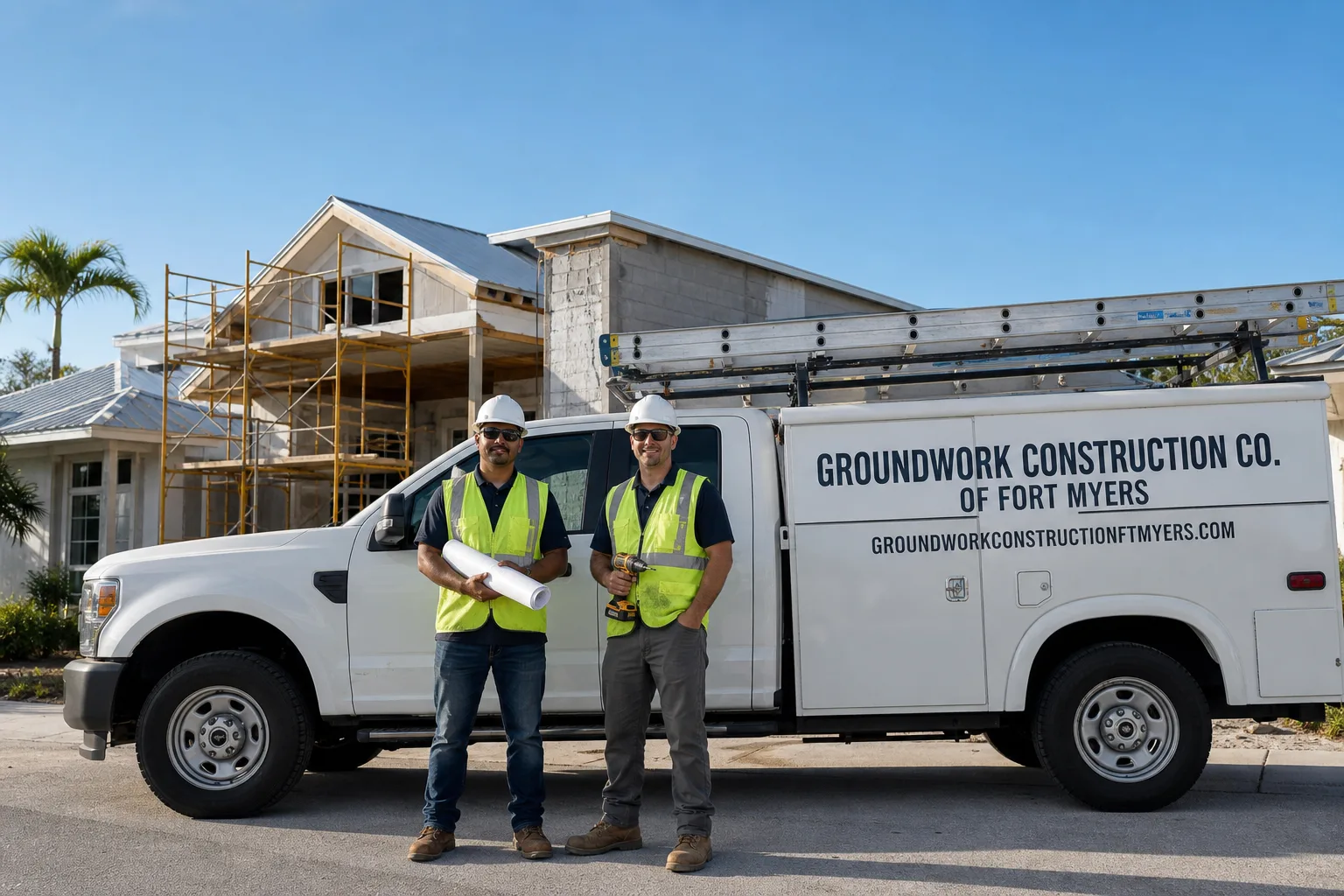
What Emergency Storm Damage Work Actually Looks Like in Burnt Store Marina Right Now
Emergency and storm damage work in Burnt Store Marina almost always starts the same way since Hurricane Ian: a tarp goes up first, then the real conversation begins. Most post-storm projects in this community now involve structural remediation, flood-zone compliance upgrades, and marine-grade material replacements, not simple shingle patches. A full emergency response (temporary stabilization, water mitigation, and permanent repair plan) in Burnt Store Marina typically costs $8,000-$20,000 on a single-family home, with the final number driven by how far the saltwater intrusion traveled into the framing and whether the structure needs to be lifted to meet current FEMA Base Flood Elevations. Call (844) 638-7249 the moment you spot damage. We answer live, and we will have a crew at your property to assess and tarp within hours.
How We Move From Emergency Call to Finished Repair in Burnt Store Marina
There is a sequence that works here, and skipping steps in a coastal salt environment is what turns a manageable insurance claim into a years-long headache. Here is how we approach emergency and storm damage work on Burnt Store Marina homes.
Stage 1: Immediate stabilization (hours 0-4). The call comes in, we dispatch a background-checked crew in uniform trucks to your Burnt Store Marina property. The first job is always the same: stop water from entering the envelope. We tarp the roof, board up broken windows, and if storm surge breached the structure, we set commercial dehumidifiers and air movers inside to arrest mold growth before it starts. This stage is about damage containment, not repair, and we document everything photographically for your insurance carrier before we touch a single piece of framing.
Stage 2: Damage assessment and scope writing (days 1-3). Once the property is dry and stable, we perform a forensic walkthrough with you. In Burnt Store Marina, this assessment is very different from inland. We check every fastener, exterior bracket, and piece of embedded hardware for chloride-driven corrosion because saltwater surge leaves deposits that keep eating steel for years after the water recedes. We open select wall cavities to trace how high the water wicked, test for moisture content in sill plates and bottom chords, and note every area where marine-grade replacement components will be required. You receive a written, line-item scope of work with exact pricing by day three, and more importantly, we flag anything that will likely trigger the Charlotte County post-Ian flood-compliance requirements before you commit.
Stage 3: Permitting and compliance coordination (days 3-14). Burnt Store Marina straddles the Charlotte/Lee county line, and we have learned the hard way that a canal-front home with a Charlotte County address can have a seawall or dock segment that falls under Lee County jurisdiction. We pull the correct permits from the correct jurisdiction on the first try, including any separate coastal construction permits required for work within the setback zone. If your home’s finished floor elevation is now below the updated FEMA AE or VE zone requirement (and most BSM homes built before Ian are), we advise at this stage whether a partial lift or stem-wall reinforcement is required, what it costs, and how it changes the timeline. You make the call with real numbers in front of you.
Stage 4: Structural and envelope repair (typically 2-4 weeks). This is the heavy phase. We replace compromised roof decking and sheathing, install new Roofing in Burnt Store Marina to GAF or CertainTeed specifications, swap damaged windows for impact-rated units, and address any framing members that show salt corrosion or saturation. Every fastener in contact with exterior or once-flooded framing goes in as hot-dipped galvanized or stainless. No electroplated hardware. No shortcuts. Our Roofing crew coordinates directly with our carpentry team so the envelope gets closed in one continuous push before the afternoon thunderstorm cycle becomes a daily problem.
Stage 5: Interior restoration and final walkthrough (weeks 4-6). Once the building is weathertight, we turn to drywall, trim, paint, and any flooring or cabinet work required. This is also when we pull our final moisture-content readings and submit the closeout documentation to Charlotte County for inspection signoff. You walk the property with your project lead, we hand you the warranty packet including our 730-Day Done Right Promise in writing, and we do not consider the job closed until you sign off. Every Burnt Store Marina project we finish gets a corrosion-inspection recommendation at the 12-month mark. Salt air does not stop working just because the repair is done.
The Material Decisions You Will Make During Emergency Storm Damage Repair
Emergency repair forces quick decisions, but we make sure you understand what you are choosing and why it matters in Burnt Store Marina’s salt-exposure environment. Here are the key options:
- Roof underlayment: synthetic versus standard felt. Synthetic underlayment (like GAF Tiger Paw or similar) costs more but resists tearing during installation and provides a secondary water barrier that buys time if the roof covering fails in the next storm. In a hurricane-exposed marina community, we recommend synthetic on every project. Standard 15-pound felt is the lower-cost option but we see it degrade faster in the humid-salt conditions ringing Charlotte Harbor.
- Fasteners and connectors: galvanized versus stainless steel. This is the single most important material spec for a Burnt Store Marina repair. Hot-dipped galvanized meets code minimums in most of Florida, but homes within a half-mile of the harbor mouth see accelerated corrosion that can pit standard galvanized hardware in under a decade. Stainless steel fasteners and Simpson ZMAX or stainless connectors cost more upfront, roughly 20-30% over galvanized, but they are the only choice we recommend for any fastener that will be embedded in a wall that previously took saltwater surge.
- Window and door flashing: tape versus liquid-applied. Butyl-based flashing tape works and is what most production crews use. In Burnt Store Marina, where wind-driven rain penetrates at higher pressures than inland, we typically upgrade to a fluid-applied flashing system around window and door openings. The cost difference is modest, usually $300-$600 on a whole-house scope, and it dramatically reduces the chance of a slow leak that does not show itself for two or three wet seasons.
- Sheathing: OSB versus plywood versus ZIP system. Oriented strand board (OSB) is the standard choice on budget-conscious repairs. CDX plywood holds fasteners better and swells less when wetted. A ZIP system sheathing panel with integrated water-resistive barrier is the top-tier option and eliminates a separate housewrap step, which also speeds installation during the narrow weather windows we get between summer storms in Southwest Florida. Most Burnt Store Marina homeowners we work with land on either plywood or ZIP, given how close they live to the water.
What Emergency and Storm Damage Work Costs in Burnt Store Marina, FL
Budget $8,000-$20,000 for a complete emergency storm damage repair on a single-family home in Burnt Store Marina. A smaller condo unit or a damage event limited to a single roof plane and no interior water intrusion lands near the low end. A canal-front CBS home with surge damage to multiple wall assemblies, corroded framing hardware, and a required elevation compliance upgrade pushes into the upper range and sometimes beyond if a full Custom Windows & Doors in Burnt Store Marina package is added to meet impact-code requirements.
The variables that move the price:
- Saltwater intrusion depth and framing damage. Surge that stopped at the baseboard is a very different job from surge that wicked 24 inches up the wall cavity. Once saltwater hits sill plates and bottom chords, the repair scope includes selective framing replacement, which adds $2,500-$6,000 depending on how many linear feet of wall are affected.
- Current floor elevation versus FEMA Base Flood Elevation. If your finished floor is below the updated BFE, your repair may require an engineered lift or stem-wall reinforcement. This is a structural job, not a cosmetic one, and it adds $5,000-$15,000 to the base repair cost depending on the home’s footprint and foundation type.
- Roof deck condition. A roof that lost shingles but has sound decking costs far less than a roof where water penetrated the sheathing. Rotten or delaminated OSB replacement runs roughly $2-$4 per square foot of affected deck area.
- Material grade. The jump from code-minimum galvanized fasteners to full stainless hardware and fluid-applied flashing adds roughly 10-15% to the envelope portion of the job. It is the right call near Charlotte Harbor, and we factor it into our upfront pricing so there are no change orders later.
Our estimates are written as fixed-price, line-item scopes. You see exactly what each phase costs before we start. The things that are typically not included in the base emergency repair price but may come up: seawall or dock repairs if the damage crosses into Lee County jurisdiction, full HVAC replacement if the condenser sat in saltwater, and any elective upgrades like a full window package. We flag every one of those at the assessment stage and price them separately so you control the scope.
Why Burnt Store Marina Homes Make Storm Damage Different
Burnt Store Marina was among the hardest-hit communities in Southwest Florida during Hurricane Ian. Surge levels exceeded 10 feet along Charlotte Harbor, and the saltwater did not just flood homes, it permanently changed what a compliant repair looks like. Most of the community’s 1980s-2000s concrete block homes sat at finished floor elevations that are now below the updated FEMA AE and VE flood zone requirements. That means a storm damage repair here is rarely a straightforward patch-and-paint job. It is a rebuild that must account for Charlotte County’s revised Base Flood Elevations and mandatory freeboard, often requiring the structure to be raised on reinforced stem walls or pilings.
The salt-air corrosion cycle compounds everything. Living directly on one of Florida’s largest estuaries means fasteners, brackets, window tracks, and even the steel in concrete block tie beams corrode years faster than they do 20 miles inland in Fort Myers. We see garage-door hardware, exterior light fixtures, and roof flashing components fail first on Burnt Store Marina homes, sometimes within five to seven years if they were not spec’d as stainless or hot-dipped galvanized from day one. Our post-storm repairs in this community spec every piece of hardware as if it will spend its life in a salt-fog chamber, because functionally, it will. We also schedule around the afternoon thunderstorm cycle and the ongoing Charlotte County permit backlog. Between June and October, we typically get a four-to-five-hour morning work window before the storms roll in off the Harbor. The construction calendar here is a real constraint, and out-of-area crews who try to work a standard eight-hour day lose afternoons to weather constantly. We stage materials and prioritize envelope closure around those windows because we have been doing it in this community long enough to know the rhythm. Homeowners in the Burnt Store Marina area sometimes pair storm repairs with a Wood Fence in Burnt Store Marina replacement if the original fencing was lost to surge or wind, and we coordinate both scopes under one permit set to avoid double mobilizations.
Serving Burnt Store Marina, FL - Our Local Coverage Area
We’re based in the Burnt Store Marina area and know this community well. Use the map below to see our service coverage - if you’re nearby, we can almost certainly help.
Frequently Asked Emergency and Storm Damage Questions for Burnt Store Marina Homeowners
Same day, every time. Call (844) 638-7249 and a live person answers. We dispatch a crew to your Burnt Store Marina property within hours to tarp the roof, board up broken windows, and set drying equipment if water entered the structure. We have crews staged in Southwest Florida during hurricane season specifically so we are not driving in from another market while your home sits exposed.
Yes, virtually every storm repair beyond a minor shingle patch requires a permit in Charlotte County, and Burnt Store Marina jobs have the added complication of the Lee County jurisdictional line along the canal edges. We pull all required permits, including any coastal construction permits, and we flag at the assessment stage whether your home’s elevation triggers FEMA compliance upgrades that require an engineer’s stamp. No permit gets skipped. Our 730-Day Done Right Promise means we do not leave you with unpermitted work that becomes a problem at resale.
Most homeowner policies in Florida cover storm-related envelope damage (roof, windows, siding) minus your hurricane deductible, which is typically 2-5% of the dwelling coverage limit. Flood damage from storm surge is a separate NFIP or private flood policy question and does not fall under standard homeowners coverage. We provide full photographic documentation, moisture readings, and a line-item scope formatted for insurance adjuster review. We cannot guarantee what your carrier will pay, but we give you the paperwork to maximize your claim.
Roof edges, soffits, and window flashing fail first. The wind coming off Charlotte Harbor gets under the drip edge and peels shingles from the eaves inward. Soffit panels get ripped out, and once they are gone, wind-driven rain enters the attic space and travels down interior wall cavities. Window flashing that was not fluid-applied or properly lapped is the other common entry point. On homes that took surge, the garage doors and entry doors are almost always compromised because the water pressure buckles the panels and corrodes the tracks within days if saltwater is not rinsed and dried immediately.
Six to eight weeks is a realistic timeline for a complete envelope and interior repair on a Burnt Store Marina single-family home. Temporary stabilization (tarp, board-up, drying equipment) happens day one. The assessment and written estimate come by day three. Permitting in Charlotte County currently runs one to two weeks depending on whether an elevation review is required. The active construction phase takes two to four weeks, and interior finishes wrap up in the final two weeks. Weather, material lead times, and inspection scheduling can push the back end, but we set a start-to-finish schedule at the outset and update you weekly.
Start With a Free Emergency Assessment in Burnt Store Marina
If your home took storm damage, do not wait for the next rain to find the gap. Call (844) 638-7249 and we will have a uniformed crew at your Burnt Store Marina property to assess the damage, tarp what needs tarping, and hand you a written scope with upfront pricing. The estimate is free. The call is answered by a live person, 24/7. Derek Hollenbeck and the Groundwork Construction Co. team have been doing this work long enough to know what salt air and storm surge do to a home on Charlotte Harbor, and we back every repair with our 730-Day Done Right Promise in writing.
Written by Derek Hollenbeck, Owner at Groundwork Construction Co., serving Burnt Store Marina and Southwest Florida with storm-rated, marine-environment construction since 2014.