
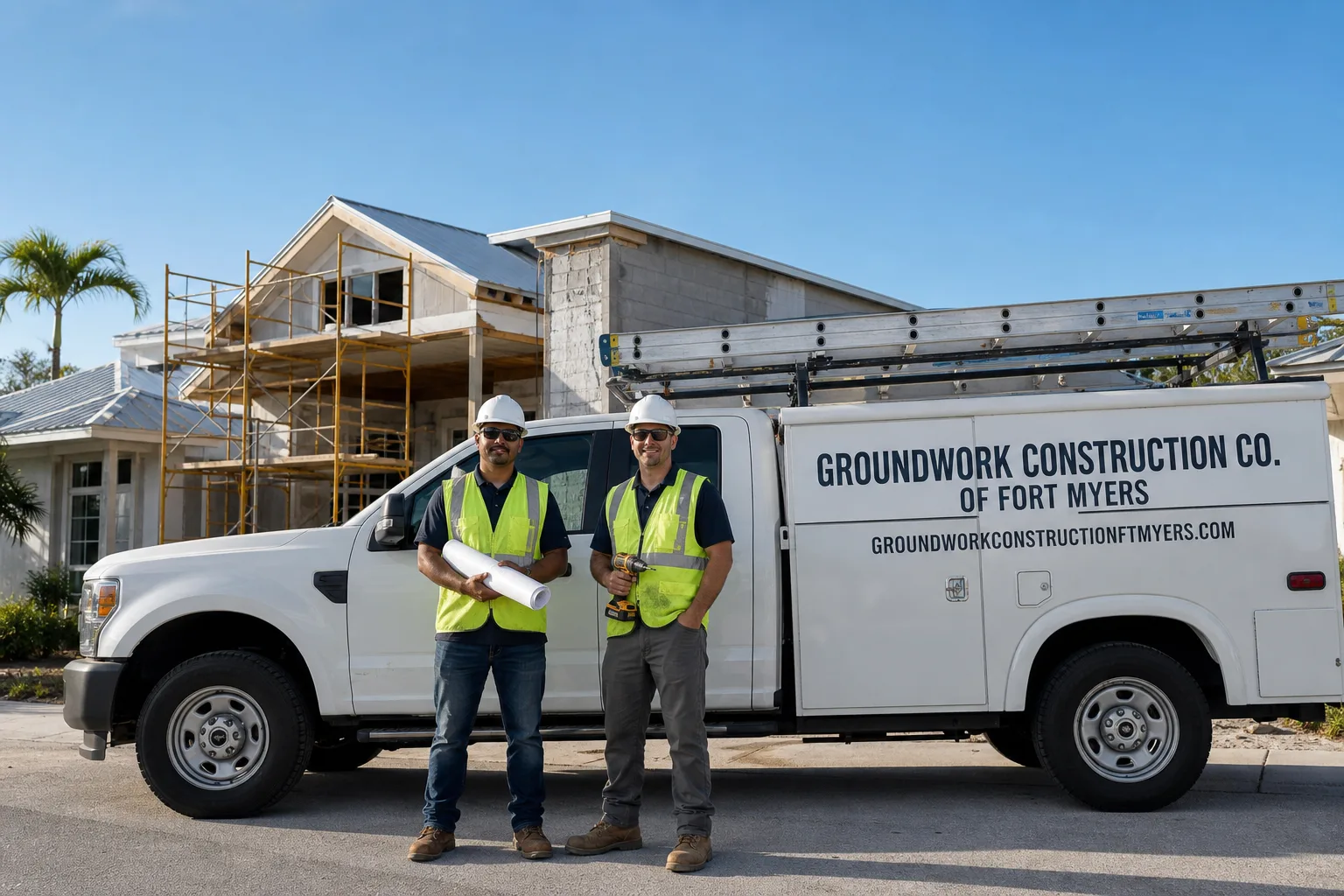
What Driveway Repair & Replacement Actually Costs and Takes in Sanibel
Driveway repair and replacement in Sanibel runs $3,000 to $14,000 for most homes, with a full tear-out-and-repour landing between $5,000 and $14,000 depending on square footage, substrate condition, and whether you’re raising the finished elevation to meet current flood-zone requirements. A straightforward repair - cracked slab sections, spalled surface patches, or sunken panels that can be mudjacked - stays on the lower end, while post-Ian rebuilds requiring demolition of storm-surge-compromised base rock, recompaction, and pour-back on grade beams tied to new pilings push toward the top of that range. Realistic timeline: three to seven working days for a full replacement, accounting for Sanibel’s causeway-coordinated concrete delivery and the City’s own inspection hold points. Call (844) 638-7249 for a line-item estimate built specifically for your property - no ballpark guesswork.
What Happens Once You Decide to Move Forward
Every Sanibel driveway job follows a sequence that’s predictable enough to plan around, but specific enough that skipping any step guarantees trouble six months later. Here’s how we actually run it, from first walkthrough to the day you’re parking on it again.
Stage 1: Site assessment and subsurface check. We don’t price a replacement from the curb. We core or probe to see what’s under the slab - shell-rock base, washout from Ian’s surge, organic muck that never got properly cut out after the storm, or old asphalt millings someone topped with two inches of concrete in 1987. That subsurface condition is the single biggest variable in a Sanibel estimate, more than square footage, because recompacting saturated base with select fill and geotextile fabric separates a driveway that lasts 20 years from one that heaves and cracks in three. We also flag existing drainage: if the original slab was poured flat against the house with no fall, we’ll address that now because replacing a driveway that channels runoff toward your elevated living space is a repeat of a problem you already lived through. This takes about an hour, and you get a written scope with a fixed number at the end of it.
Stage 2: Demolition, haul-off, and base prep. Day one of physical work is demolition. On a typical 400- to 600-square-foot single-wide driveway, we saw-cut the slab into manageable sections, break it out with a skid steer, and load dumpsters. In Sanibel, dumpster swaps mean another truck crossing the causeway, so we plan the haul-off in one trip when the schedule allows - fewer empty trailers idling in the toll lane, fewer chances for a backup to delay the pour. Once the slab is out, we cut down to clean, competent bearing material, grade for positive drainage, and compact in lifts with plate compactors or a vibratory roller depending on access. On lots where Ian’s surge saturated the existing base for days, we almost always over-excavate 6 to 8 inches and bring in clean crushed stone - compacted to 95% Proctor density - before forming.
Stage 3: Forming, reinforcement, and any elevation tie-ins. This is where Sanibel’s post-Ian reality shows up in the forms. If your home is now an elevated structure on pilings, the driveway approach often needs a thickened-edge beam or a poured transition slab that ties into the new grade without creating a trip hazard or a drainage trap. We set forms and lay reinforcement - typically #3 or #4 rebar on 18-inch centers, sometimes upgraded to fiber-reinforced mix in smaller driveways where that makes more sense than a full mat. The City of Sanibel’s building inspector signs off on the form and steel before any concrete leaves the batch plant. That inspection is its own calendar event, not a drive-by; we build the schedule around it.
Stage 4: Pour, finish, and cure. On pour day, the timing is simple: the concrete truck crosses the causeway early, before the mid-morning backup, and arrives when the crew is ready - not earlier, not later. We pour, screed, bull-float, and edge. A broom finish is standard for driveways (slip resistance matters on the island, where afternoon storms leave standing water in five minutes), but we’ll do a light exposed-aggregate finish if you want it, at a modest upcharge. Control joints get tooled or saw-cut within 24 hours to direct cracking where you won’t see it. Curing takes a full seven days before you drive a sedan on it, and we recommend keeping heavier pickups or delivery trucks off for 14 days - standard concrete cure rates in southwest Florida humidity, nothing unusual, but we’ll put it in writing so nobody’s tempted to test it early.
Stage 5: Final grade, cleanup, and walkthrough. Once the slab is cured enough for light traffic, we backfill edges, remove forms, grade the surrounding yard back to the slab edge, and do a final sweep with a magnet bar to catch any stray tie wire or nails. Derek walks every completed driveway in Sanibel himself or reviews the site photos the same day, because the edge that looks fine from the street sometimes catches water at the property line, and that’s exactly the kind of thing the 730-Day Done Right Promise is designed to catch before it becomes your problem. You then have a driveway that drains correctly, takes the load it was designed for, and won’t crack apart the first time a tropical storm sits over the island for 36 hours.
When the scope is a full Driveway & Pavers in Sanibel overhaul - say the driveway, walkway, and pool deck all need to be re-poured as one graded system - the sequence stretches slightly but the same subsurface rules apply. Our Driveway & Pavers crew handles the entire sequence in-house, so there’s no handoff between a demolition sub and a finishing team.
The Options You’ll Choose Between
Most Sanibel homeowners end up deciding between three material paths, and the differences are straightforward - it’s really about initial budget, long-term appearance, and how the driveway interacts with an elevated house.
- Standard broom-finished concrete. The workhorse. Runs $8 to $14 per square foot installed in Sanibel, depending on base prep. Takes a broom finish well, handles tire traffic without showing wear, and costs the least to repair if a section ever settles. The trade-off is aesthetic - it’s plain gray unless you opt for integral color or a stain, and it won’t match a high-end paver patio if that’s the look you’re after elsewhere on the property.
- Colored or stamped concrete. Adds $3 to $7 per square foot over standard gray. Integral color mixed at the batch plant (we typically use Quikrete or Sakrete color packs spec’d to the same plant’s mix design) gives a consistent, fade-resistant tone through the full slab depth. Stamping adds a slate, cobblestone, or ashlar pattern that photographs well but requires resealing every three to five years - salt air and UV on Sanibel accelerate sealer breakdown faster than inland homes see. If you’re not committed to that maintenance rhythm, stick with color and skip the stamp.
- Reinforced slab with coastal-grade steel. On lots within a block of the Gulf or backing up to a canal, we step up the reinforcement schedule. That means epoxy-coated rebar or stainless mesh instead of standard black steel, per the Florida Building Code’s corrosion-zone requirements. The material upcharge is real - roughly $2 to $4 per square foot - but replacing a driveway in salt-spray exposure without it means chasing spalled concrete and rust-jacked cracks inside of a decade. This is not an upsell; it’s what the Sanibel building department expects to see on the plans for coastal-adjacent parcels.
- Elevation-matched approach slab. If your home is now on pilings with the finished floor eight or ten feet above grade, the driveway-to-stair transition matters more than most people realize. We pour a thickened landing pad at the base of the stairs that doubles as the driveway terminus, sloped so stormwater sheets away from the structure, and keyed into the main driveway slab with dowels. This detail alone can add $800 to $1,800 depending on width and reinforcement, but without it you get a disjointed slope that holds water against the pilings every afternoon in rainy season.
Some homeowners pair a full driveway replacement with interior living-space work they’ve been putting off - we see this on Sanibel more than you’d expect, because the same crew mobilization that makes sense for the driveway can overlap with an ADU Site Prep & Utilities in Sanibel project or the foundation prep for a Junior ADU & Interior Conversion in Sanibel. It’s not always cheaper to bundle them, but it’s almost always faster than sequencing them separately through the City’s permit queue.
What Driveway Repair & Replacement Costs in Sanibel, FL
A driveway replacement in Sanibel runs $5,000 to $14,000 for a standard single-wide residential driveway, with repair work on isolated sections starting around $1,200. That spread doesn’t mean the pricing is vague - it means every job has four or five real cost drivers, and once we know them, the number locks in.
Square footage and configuration. A straight 10-by-40-foot driveway is one thing. A curved drive that flares to 30 feet at the street, wraps around a pool cage, and terminates at a three-car garage on pilings is another. Concrete is priced by the square foot, but curves and tapered sections waste form material and slow the pour, so per-square-foot cost climbs slightly on irregular layouts.
Subsurface condition. If we can demo the old slab, scab off a few inches of organics, and pour on existing compacted base, the base-prep cost is minimal. If we find a layer of storm-deposited silt and shell hash that goes down a foot before we hit anything solid, that over-excavation and stone backfill adds $1,500 to $3,000 to a typical residential driveway. This is the variable that’s hardest to know before we open it up, which is why we probe when we first walk the site.
Permit and inspection fees. Sanibel’s building department operates independently of Lee County. A driveway permit here runs several hundred dollars on its own, more if it’s part of a larger scope, and the required form-and-rebar inspection before the pour adds a scheduling step that doesn’t exist in unincorporated parts of the county. We carry that cost in the estimate - there’s no “surprise permit fee” added later.
Elevation and flood-plane compliance. If your rebuild agreement with FEMA or your flood-insurance rating depends on maintaining a specific finished-floor-to-grade relationship, the driveway elevation becomes part of that compliance picture. Raising the driveway surface to match a newly elevated home - even by 4 to 6 inches - changes the approach angle, the form height, and sometimes the property-line drainage plan. It’s not free, but it’s essential for insurability on a barrier island.
Material-grade decisions. Standard 3,000-psi mix with black rebar is the baseline. Stepping up to 4,000 psi with fiber reinforcement, coastal-grade steel, or integral color each add per-square-foot cost, and the difference between a $5,000 job and a $10,000 job is often just the sum of three of those upgrades across 500 square feet.
Every estimate we write includes site prep, demolition, base work, materials, forming, reinforcement, pour, finish, cleanup, and permit coordination. It does not include unrelated landscape work, though we’ll coordinate with your landscaper if pavers or plantings need to come out to stage the pour and then go back in. The number you see on the estimate is the number on the final invoice - upfront pricing with no change orders unless you change the scope.
What Sanibel Homes Specifically Do to This Job
A driveway on Sanibel is not a driveway in Cape Coral or Fort Myers. The island’s post-Ian building department, its flood-zone compliance requirements, and the single-causeway logistics change every phase of the job in ways that mainland contractors simply don’t price into their thinking.
First, the permit is not a formality. Sanibel’s building department reviews the site plan, the base-elevation certification (if applicable), and the reinforcement schedule before issuing the permit, and it requires an in-person inspection of forms and steel prior to the pour. That inspection has to be scheduled around the department’s own calendar - not Lee County’s - and missing it means pulling forms and redoing the call, which nobody wants. We build our pour schedule backward from the inspection date, not the other way around.
Second, logistics: concrete delivery trucks, dumpsters, and flatbeds loaded with rebar all enter the island via the Sanibel Causeway. During spring-break season and summer weekends, that causeway can back up for 45 minutes, which matters when a concrete load has a finite window before it starts to set. We time pours for early weekday mornings when possible, and we stage dumpster swaps to avoid the 11 a.m. tourist crush. A driveway replacement that takes four days in Fort Myers can take six or seven here - not because the work is slower, but because the causeway, the permit inspection hold, and the coastal-zone material requirements all insert real lead time that cannot be compressed.
Third, the housing stock: what we’re typically tearing out on Sanibel is a 1950s- or 1970s-era slab that sat flat on grade, absorbed Ian’s storm surge for hours, and has been spalling and cracking ever since the salt dried in the pores. That slab was almost never built with the reinforcement schedule or base prep we’d put in today, and it often drains toward the house because nobody on a barrier island in 1962 was thinking about finished-floor elevations eight feet above grade. When we replace it, we’re not just swapping one slab for another - we’re correcting drainage, rebuilding the base, and tying the driveway elevation to a house that’s now lifted on pilings. That’s the real scope of “driveway replacement” on this island right now, and it’s why the cost lands where it does.
Serving Sanibel, FL - Our Local Coverage Area
We’re based in the Sanibel area and know this community well. Use the map below to see our service coverage - if you’re nearby, we can almost certainly help.
Frequently Asked Questions - Driveway Repair & Replacement in Sanibel
Plan on five to seven working days from demolition to cured concrete, with the pour itself happening on one of those days and the rest going to demo, base prep, forming, inspection scheduling, and cure time. The Sanibel building department’s inspection hold - usually 24 to 48 hours between form-set and pour - adds a day or two that a mainland job without city-level permitting wouldn’t carry. We’ll give you a calendar at the start so you know exactly which days you won’t be parking at the house.
Yes. Sanibel’s municipal building department requires a permit for full driveway replacements and for substantial repairs that change the footprint or elevation. We pull the permit as part of the job, and the cost is included in your estimate. Minor surface patching typically doesn’t trigger a permit, but anything involving new concrete, base excavation, or rebar generally does.
Depends on what’s under it. Surface spalling, hairline cracks, and small settled sections can often be patched, ground, or mudjacked for $1,200 to $3,500. But if the base is saturated, washed out, or riddled with salt-contaminated aggregate from Ian’s surge, a patch buys you two years at most before the same cracks come back. We’ll tell you honestly which camp your driveway falls into - we’d rather do the repair and have it last than sell a replacement you don’t need, because our name is on it either way.
Every driveway replacement or repair we do in Sanibel is backed by our 730-Day Done Right Promise - if it’s not done right, we make it right for two full years after completion. That covers settlement, cracking beyond normal shrinkage, drainage failures, and finish defects. Concrete itself is a natural material that will develop hairline cracks over time; we control-joint the slab to direct those where they’re invisible, and the workmanship guarantee covers anything beyond that. For an exact quote on your project, call (844) 638-7249 - estimates are free.
No. The number on your estimate is the number on your invoice, period. The only exception is if you ask us to add scope - upgrading from broom finish to stamped concrete, extending the driveway footprint, or adding a walkway after we’ve already started. We price the subsurface unknowns into the estimate based on what we find during the site probe, so you’re not financing our discovery process. That upfront-pricing commitment is one reason people who’ve been burned by change orders on Sanibel rebuilds keep calling us back.
Get a Free, Written Estimate for Driveway Repair & Replacement in Sanibel
If your driveway is cracked, spalled, sinking, or just wasn’t rebuilt correctly after Ian, we’ll walk the site, probe the base, and hand you a fixed-price estimate that covers everything from demolition to final grade. No ballpark numbers, no “we’ll see when we open it up.” Call (844) 638-7249 to schedule yours - a real person answers, day or night, and we’ll get Derek or a senior crew lead to your property within a few days. Same crew, same phone number, same company from first call to final walkthrough, backed by the 730-Day Done Right Promise. That’s how we build driveways on this island, and that’s how we’ve earned every Sanibel referral we’ve gotten since Ian.
Written by Derek Hollenbeck, Owner at Groundwork Construction Co., serving Sanibel with upfront pricing and the 730-Day Done Right Promise.