
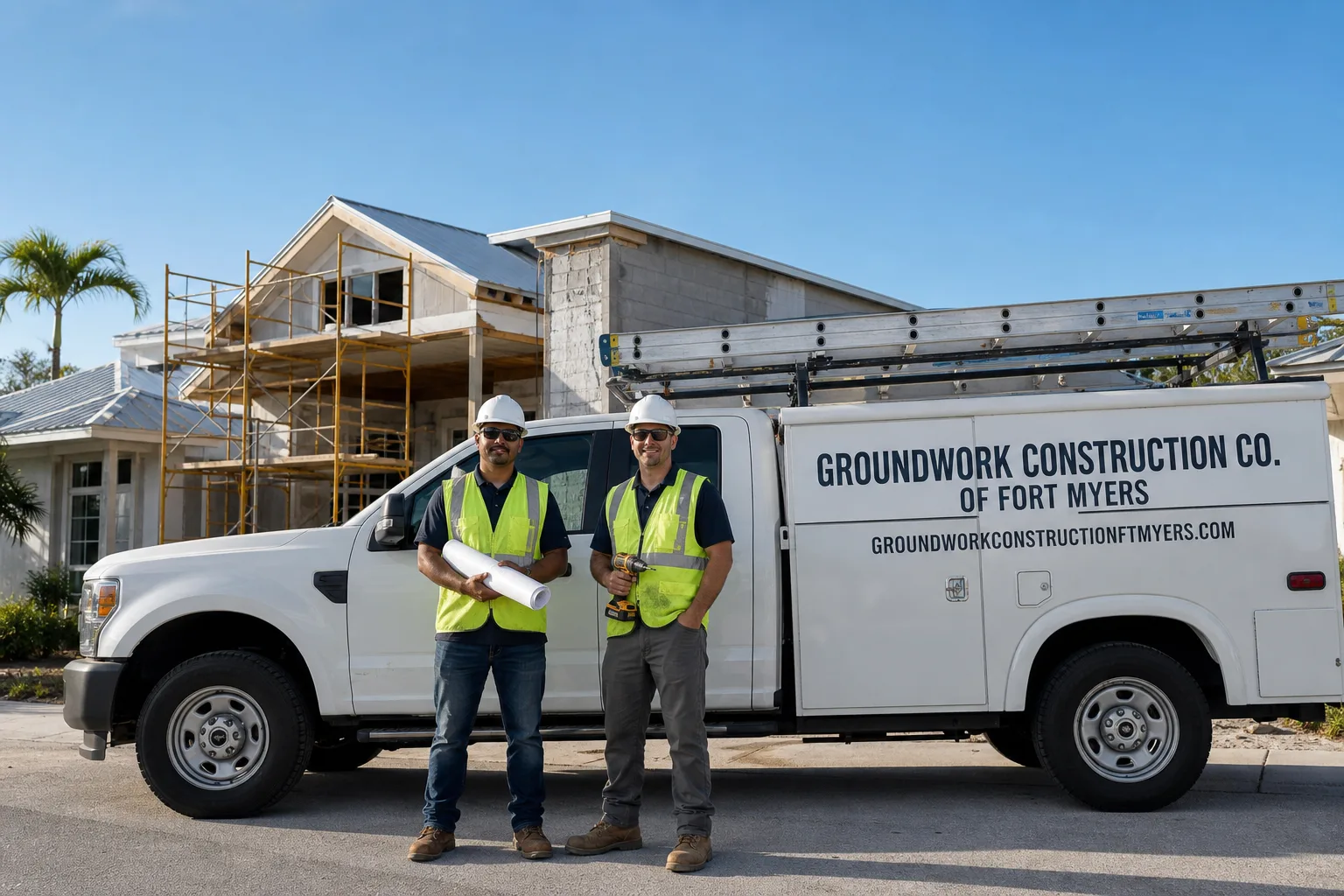
What It Actually Takes to Replace a Roof in Charlotte Harbor, FL
A full roof replacement in Charlotte Harbor is a teardown to the deck and a complete rebuild, not a patch job. Most homes here take five to seven working days from tear-off to final inspection, and a typical architectural shingle replacement runs $8,000 to $20,000 depending on size, pitch, and the condition of the decking underneath. If you’re staring at a roof that’s pushing 20 years old in this salt air, or you’re buying a pre-Charley home that still has its original strapping, call us at (844) 638-7249 for a free on-site estimate that spells out every line item before you sign anything.
How a Charlotte Harbor Roof Replacement Goes, Step by Step
We’ve done enough roofs in Charlotte Harbor to know that surprises live under the old shingles, especially on homes built before 2004. Here is exactly how the job unfolds so you know what to expect and when you’ll need to make a decision.
1. Permitting and material ordering (2-5 days before tear-off)
Charlotte County requires a full building permit for any roof replacement, and the building department reviews wind-load calculations and the specific fastener schedule before issuing it. We pull the permit, submit the product approvals for the shingles and underlayment we’re using, and order your materials so they arrive on site the morning of tear-off. You pick your shingle color and grade during this window; we’ll walk you through the options that meet code for your specific wind zone.
2. Tear-off and deck inspection (Day 1)
The crew arrives at 7:00 a.m. with a dump trailer and begins stripping the old roof down to bare plywood or spaced sheathing. In Charlotte Harbor, where pre-Charley homes often have 3/8-inch plywood that’s been baked and soaked for 40 years, we find rotted decking on roughly one in three jobs. We photograph every sheet of damaged decking, show you the rot ourselves, and replace only what’s failed - you approve the additional cost before a single sheet goes down. Tear-off and deck prep typically take one full day on the average 2,000-square-foot ranch.
3. Underlayment, flashing, and water barrier (Day 2)
Once the deck is sound, we roll out a synthetic peel-and-stick underlayment across the entire roof plane - Charlotte County now requires a secondary water barrier in most wind-borne debris regions, and we don’t consider felt paper adequate for a harborfront climate anyway. Valley metal, drip edge, and new lead or aluminum flashing at every penetration go in next. If the home has a chimney or skylight, we replace the step flashing and install ice-and-water shield at those transitions. You won’t need to make any decisions at this stage; it’s all standard best practice built into our upfront price.
4. Shingle installation and ridge ventilation (Days 3-4)
Shingles go on in overlapping courses, nailed to the manufacturer’s exact pattern with ring-shank fasteners long enough to bite fully into the deck. In Charlotte Harbor’s higher-wind zones, that often means six nails per shingle instead of the standard four, a small material cost increase we build into the estimate. We cut in a continuous ridge vent at the peak and confirm soffit venting is clear so the attic breathes - trapped heat and moisture are what kill a roof here, not just hurricanes. By the end of Day 4, your roof is watertight and the dump trailer is gone.
5. Final inspection and walkthrough (Day 5-7)
Charlotte County sends an inspector to verify nail pattern, strapping, flashing, and underlayment before signing off. As anyone who works in Charlotte Harbor knows, the inspector will look specifically at hurricane-strap continuity from rafter to top plate - something crews from Lee County sometimes get caught on. We meet the inspector on site, address any findings on the spot, and walk you through the finished roof once it passes. You get photos of every stage and a written close-out packet with your material warranties and our 730-Day Done Right Promise in writing.
The Material and Spec Choices You’ll Actually Make
You don’t need to become a roofer to choose the right roof. The decisions break down into three categories, and we’ll explain the trade-offs in plain language so you spend your money where it counts.
- Asphalt architectural shingles. This is what 85% of Charlotte Harbor homes get. A dimensional shingle rated to 130 mph, with a 30-year or limited-lifetime warranty, keeps you in the $8,000-$14,000 range on a typical ranch. The trade-off is cosmetic: architectural shingles look clean and perform well, but they don’t have the texture of a premium product.
- Designer or impact-rated shingles. If you want a heavier slate-look profile or a Class 4 impact rating that some insurers discount, expect $14,000-$20,000. In Charlotte Harbor, where wind-driven debris from palm fronds and tropical storms is a fact of life, impact-rated shingles can pay back part of their premium in reduced insurance costs over time.
- Metal standing seam. A 24-gauge standing-seam metal roof starts around $15,000 on smaller ranches and runs past the high end of our replacement range on larger homes. It lasts 50-plus years, shrugs off 140 mph winds when installed correctly, and sheds the heavy afternoon rain we get during summer. The trade-off is upfront cost, and you’ll want to verify any HOA restrictions in neighborhoods like Harbour Heights or Deep Creek before committing.
- Ventilation upgrades. Most Charlotte Harbor homes we re-roof were built with passive soffit-and-gable venting that doesn’t move enough air for our humidity. Adding a continuous ridge vent and baffled soffit vents - or a solar-powered attic fan if the roof geometry limits ridge length - costs $400-$900 and significantly extends shingle life by keeping the attic within 10 degrees of outdoor air temperature.
- Underlayment grade. Code demands a synthetic underlayment; we use a high-temperature peel-and-stick product as standard because it self-seals around nails. In Charlotte Harbor’s flood-prone lots, where wind-driven rain is more common than still drizzle, this is the single best dollar-for-dollar upgrade on the whole roof.
What Roof Replacement Costs in Charlotte Harbor, FL
We price most Charlotte Harbor roof replacements between $8,000 and $20,000, with that range accounting for the variables that actually move the needle. Here is what pushes a job toward the low or high end:
- Roof size and complexity. A 1,200-square-foot gable roof is on the low end; a 3,000-square-foot hip roof with multiple valleys, dormers, and a steep pitch is on the high end. Every additional plane adds labor hours and material waste.
- Decking condition. Charlotte Harbor homes built in the 1960s and 1970s frequently have delaminated or rotted plywood decking. We charge per sheet to replace damaged sections, and a roof with 12 sheets of rot will add $800-$1,200 to the final number. We don’t know how much decking is bad until the shingles come off, and we show you every sheet before replacing it.
- Shingle grade. Standard architectural shingles keep the price in that $8,000-$14,000 band. Stepping up to an impact-rated or designer shingle can add $3,000-$6,000. Metal standing seam pushes the job above $15,000 on even modest homes.
- Hurricane-strap retrofit. On pre-Charley homes, Charlotte County inspectors will flag missing or undersized straps. Adding the required connectors and strapping at every rafter-to-top-plate connection typically adds $800-$2,000 depending on access, and we include that estimate line-item from the start if we know the home’s build era.
- Permit and engineering scope. A straightforward re-roof permit runs $200-$400 in Charlotte County. If your home sits in a FEMA AE or VE flood zone - common for properties along the harbor shoreline - the county may require an elevation certificate or engineer’s letter before issuing the permit, which adds $400-$800.
Every estimate we write in Charlotte Harbor includes tear-off, disposal, deck inspection, underlayment, flashing, shingles, ridge vent, permit coordination, and a final walkthrough. The number you see on the proposal is the number you pay unless we find decking rot or the inspector requires something we could not have seen beforehand, and we stop work and get your approval before proceeding. Call (844) 638-7249 for a free, written estimate that breaks all of this down for your specific address.
What Charlotte Harbor Homes Specifically Do to a Roof Replacement
Charlotte Harbor sits at the mouth of one of Florida’s largest tidal estuaries, and the homes here tell two different stories. The first story is the surviving pre-Charley stock - mostly single-story CBS-block ranches built in the late 1960s through early 1980s - where we routinely find original 3/8-inch plywood decking fastened with smooth-shank nails that have lost their grip in the salt-humid air. These roofs were built to a code that no longer exists, and simply nailing new shingles onto old decking will fail the county’s rough-framing inspection, which checks for hurricane-strap continuity at every rafter-to-top-plate connection with a level of rigor that surprises crews who normally work across the river in Lee County.
The second story is the post-2004 rebuilds, engineered to the Florida Building Code’s most aggressive wind-load and flood-elevation chapters, which typically have thicker decking, secondary water barriers, and impact-rated openings already in place. On these homes, a roof replacement is faster and less likely to uncover hidden rot, but the material specification still has to answer to the harbor’s funnel-shaped geography, which amplifies storm surge and drives a salt-corrosion factor that eats cheap flashing in five years. Whether we’re working on Burnt Store Road or a waterfront lot off Melbourne Street, the permitting reality is the same: Charlotte County will issue the permit only after confirming the product approvals match the home’s specific wind zone, and the final inspection will not pass without properly sized hurricane straps at every connection point. We price for that reality from day one so there are no change orders on inspection day.
Our team covers all of Charlotte Harbor, from the older neighborhoods near the estuary up through the post-Charley rebuild corridors, and we know which inspectors tend to flag which details before they even pull up. If your project is part of a full Roofing in Charlotte Harbor overhaul, our Roofing crew coordinates with the rest of the job so you’re not managing separate trades. Homeowners often pair a new roof with Window Replacement in Charlotte Harbor or Door Installation in Charlotte Harbor to bring the entire exterior envelope up to current code in one permitting cycle.
Serving Charlotte Harbor, FL - Our Local Coverage Area
We’re based in the Charlotte Harbor area and know this community well. Use the map below to see our service coverage - if you’re nearby, we can almost certainly help.
Frequently Asked Questions - Roof Replacement in Charlotte Harbor, FL
Five to seven working days is the realistic window for a standard asphalt shingle replacement on an average Charlotte Harbor home. The tear-off and deck inspection eat up Day 1, underlayment and flashing go in on Day 2, shingle installation fills Days 3 and 4, and the county inspection and final walkthrough wrap up on Day 5 or 6. Metal roofs, steep roof pitches, or extensive decking replacement can stretch the timeline to eight or nine working days. Rain delays in July and August can push inspections by a day or two; we build that into the schedule and communicate every delay the morning it happens. Call (844) 638-7249 for a timeline specific to your roof’s size and shape.
Yes. Charlotte County requires a building permit for any roof replacement that involves stripping the roof to the deck, and the building department reviews the wind-load calculations for your specific wind zone before issuing the permit. We pull the permit as part of the job, coordinate the inspection, and stand with the inspector on site until the roof passes. If your home sits in a FEMA flood zone, the county may also ask for an elevation certificate before they release the permit.
In almost every case, yes. A standard tear-off and re-shingle stays on the exterior. The only time we’d need interior access is if we find decking rot that requires sistering rafters from inside the attic, or if you have a cathedral ceiling with no attic access and the decking fails. We’ll tell you in the estimate whether your roof structure makes interior access likely, and we protect floors and furniture with drop cloths if it comes to that.
A typical architectural-shingle roof replacement in Charlotte Harbor runs $8,000 to $20,000. Size, pitch, shingle grade, decking condition, and whether the home needs a hurricane-strap retrofit are the five variables that determine where your job falls in that range. We provide a written line-item estimate at no charge so you see exactly what’s included and why your number is your number. Call (844) 638-7249 to schedule the estimate.
Every roof replacement we install carries the shingle manufacturer’s material warranty - typically 30 years to limited lifetime on architectural shingles - and our 730-Day Done Right Promise on workmanship. If anything isn’t right within two full years, we fix it. Between the salt air, the tropical-storm cycle, and the sun, Charlotte Harbor puts a roof through more in five years than inland homes see in fifteen; we stand behind the work for two years because a short warranty in this climate is a bet against the homeowner, and we don’t take that bet.
Get a Free Roof Replacement Estimate in Charlotte Harbor
The fastest way to get a real number is a 20-minute on-site walkthrough. We’ll measure the roof, check the attic, photograph the decking where accessible, and hand you a written estimate that covers tear-off, materials, flashing, ventilation, permit coordination, and any Charlotte County inspection requirements specific to your home. The number on the estimate is the number you’ll pay - no add-ons, no change orders for work we should have seen upfront. Call (844) 638-7249 to schedule yours.
Written by Derek Hollenbeck, Owner at Groundwork Construction Co., serving Charlotte Harbor and the surrounding communities with straight answers and written pricing since 2014.