
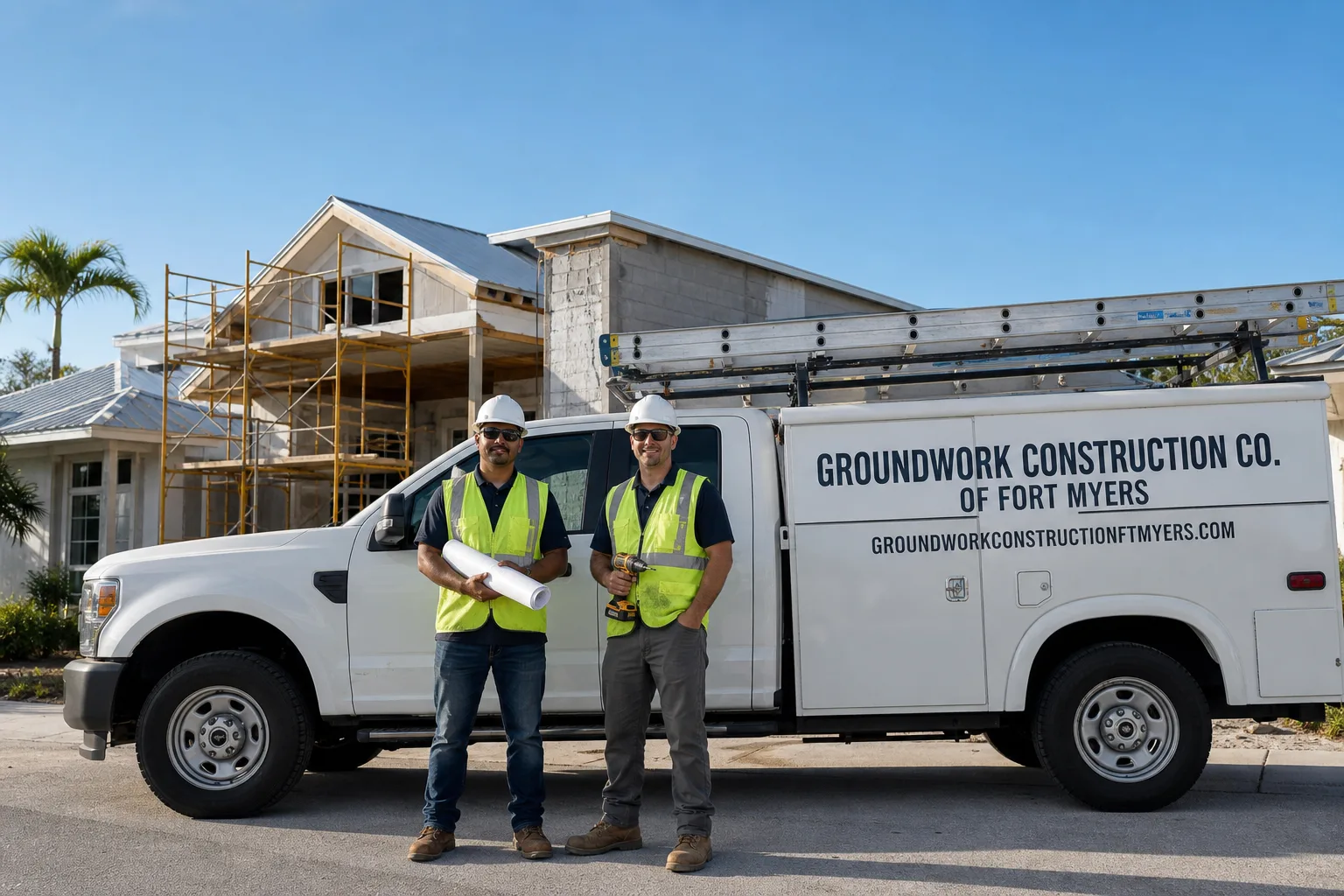
What a New Detached ADU Really Looks Like in Pine Ridge
A new detached ADU in Pine Ridge typically runs between $90,000 and $220,000 depending on size, foundation complexity across our karst terrain, and finish level. Most projects take five to eight months from site-prep to certificate of occupancy. Groundwork Construction Co. handles the whole thing - design, permitting through Citrus County, the foundation pour, all rough and finish trades, and the final walk-through. If you’re weighing whether your lot can support a standalone unit, call (844) 638-7249 and we’ll walk the property with you.
Pine Ridge isn’t like most Florida communities where you can drop a pre-fab structure and call it done. The Pine Ridge Civic Association covenants govern setbacks, exterior materials, rooflines, and even the color palette of any detached structure. And Citrus County’s karst limestone plain means a ground-penetrating radar or standard sinkhole evaluation is quietly standard practice before we break ground. Neither of those steps is optional if you want the build to pass inspection and hold its value.
The Actual Sequence - How a New Detached ADU Gets Built Here
We follow the same disciplined process on every new detached ADU, but Pine Ridge lots always throw a few curveballs. Here’s what the calendar genuinely looks like.
Stage 1: Site assessment and subsurface check (Days 1-14). Before a single stake goes in the ground, we bring in a GPR contractor to scan for the solution cavities and voids that are endemic to the karst limestone plain under Pine Ridge. You get a written report. If anomalies show up, we adjust the foundation spec - typically moving from a standard monolithic slab to a reinforced mat foundation or helical piers. This is also when we flag any roots from the mature live oaks and slash pines that canopy practically every 1-acre-plus lot. The homeowner decides: proceed with the standard footprint, or shift the building envelope to save a tree that defines the property.
Stage 2: PRCA covenant review and permit assembly (Days 15-45). The Pine Ridge Civic Association has binding deed restrictions on detached structures - setbacks, minimum roof pitches, exterior materials (no vinyl siding, for instance, on most lots), and paint colors. Derek Hollenbeck’s team pulls the existing deed file, drafts the architectural submittal exactly to PRCA spec, and walks it through their review board. Simultaneously we file with Citrus County Building Division for the actual construction permit. You make the final call on the exterior finish package here - HardiePlank lap siding versus stucco, the shingle profile, window trim style. This is the window where most unpermitted backyard structures get red-tagged if the contractor doesn’t know the PRCA exists.
Stage 3: Foundation and rough trades (Days 46-100). This stretch involves site clearing, formwork, the actual pour, and cure time. Once the slab passes inspection, our framing crew stands the structure. Electricians and plumbers rough in while the walls are open. If the ADU has a kitchenette or full bath - and nearly all our Pine Ridge ADUs do - this is when we stub out the drain lines and set the panel. Homeowner decisions: recessed lighting layout, window placement, and whether to pre-wire for a mini-split heat pump. The humid subtropical climate means we pay extra attention to moisture-barrier detailing on the crawlspace side of any elevated floor assembly; the wood rot we find in existing Pine Ridge ranch homes is almost always traceable to skipped vapor-barrier steps during original construction in the ’80s.
Stage 4: Dry-in, insulation, and finishes (Days 101-150). Roof sheathing, underlayment, and shingles go on. Windows get set and flashed. Insulation and drywall follow. Our trim carpenters hang doors, set baseboards, and install the kitchen or bath cabinetry. Flooring, tile, and paint happen in this phase. Homeowners choose countertop material, cabinet door profile, and fixture finishes. It’s common for clients to pair this phase with our Backsplash, Tile & Flooring in Pine Ridge work so the whole unit matches. This is not a rush job - proper dry-in matters enormously when the afternoon thunderstorms roll through every July afternoon and the humidity stays above 80%.
Stage 5: Final inspections, punch list, and CO (Days 151-170). Citrus County does a structural final, an electrical final, a plumbing final, and a zoning compliance check. If the ADU sits within 200 feet of an existing horse barn or stable - and in Pine Ridge, that’s more common than not - the fire marshal may require an additional separation-distance signoff. Our crew stays on site through every inspection. You walk through with Derek or your project lead, flag anything that doesn’t sit right, and we address it before the final sign-off. Certificate of occupancy in hand, the unit is legal, insurable, and rentable.
The Options You’ll Choose Between
Every new detached ADU in Pine Ridge starts as a set of decisions. Here are the ones that move the needle most, with honest trade-offs.
- Foundation type: Standard slab vs. reinforced mat or pier system. A standard slab is the lower-cost route and works on lots with clean GPR readings. If the subsurface scan finds karst voids - and they appear frequently in the eastern sections of Pine Ridge near the equestrian trail corridors - you’re looking at a reinforced mat or helical piers. That adds $8,000-$18,000 but eliminates the risk of a footing settling into a void three years later.
- Exterior siding: Fiber cement vs. stucco. HardiePlank lap siding runs about $4-$7 per square foot installed and holds up well against Citrus County humidity when painted every 7-10 years. Stucco costs $6-$10 per square foot, gives a clean Florida-modern look, and resists woodpeckers - a real nuisance in the wooded lots here. The PRCA covenants on your specific tract will limit which option is even allowed, so we check that before you spend any mental energy choosing.
- Kitchenette scope: Wet bar vs. full cooktop kitchen. A wet bar with a sink, undercounter fridge, and microwave runs $4,000-$8,000. A full kitchen with a range, vent hood, dishwasher, and a 6-foot run of cabinetry pushes into the $12,000-$22,000 zone and may require a gas-line extension if you’re on propane (common in Pine Ridge where municipal natural gas lines are sparse). This is a property-value decision: an ADU with a full kitchen rents differently than one without.
- Climate system: Ductless mini-split vs. small central unit. A 1.5-ton mini-split heat pump costs $3,500-$6,000 and handles both cooling and heat for the handful of cold mornings Pine Ridge gets. A small central system with ductwork adds $9,000-$14,000 but provides more even temperature distribution. For studio or one-bedroom layouts under 700 square feet, the mini-split usually wins on value.
- Flooring: Luxury vinyl plank vs. tile vs. engineered hardwood. LVP is the most common choice at $4-$8 per square foot installed - it laughs at humidity and handles the sand and hay debris that inevitably gets tracked in from the paddock. Tile runs $7-$14 per square foot and stays cool, a genuine benefit in a Pine Ridge summer. Engineered hardwood looks rich but struggles if the ADU isn’t continuously climate-controlled; we steer cautious clients away from it in detached units that may sit empty between guests.
These choices stack. A 500-square-foot studio ADU on a clean lot with LVP floors, a wet bar, and a mini-split can land near $92,000. An 800-square-foot one-bedroom with a full kitchen, stucco exterior, a central HVAC system, and a reinforced foundation can cross $190,000 quickly. The line-item estimate you get from us shows where every dollar goes - no lump-sum fog, no change orders you didn’t authorize.
What a New Detached ADU Costs in Pine Ridge, FL
Plan on $90,000 to $220,000, with real numbers typically clustering between $110,000 and $160,000 for a thoughtfully finished one-bedroom unit on a standard lot. That range covers design, permits, the foundation, all rough and finish construction, and the final Citrus County inspections. It’s not a guess; it’s grounded in actual invoices from recent Pine Ridge builds.
Five variables push the price toward the high end. First, the GPR scan result - if we need to engineer around subsurface anomalies, the foundation cost jumps. Second, the distance from the main house to the ADU - trenching electrical, water, and sewer lines across a 300-foot run costs substantially more than a 50-foot run, and our Home Additions & ADU in Pine Ridge team sees this regularly on deep one-acre lots. Third, the kitchen and bath scope - adding a full bath with a tiled shower enclosure versus a half-bath moves the plumbing budget. Fourth, the PRCA-required exterior finish package - certain lots mandate architectural-grade shingles and specific window profiles that are more expensive than builder-grade equivalents. Fifth, the timeline - material costs shift, and if you order custom cabinets or specialty windows, lead times can compress the schedule, which affects crew allocation.
A written estimate from Groundwork Construction Co. includes the site scan, all permit and covenant-review hours, foundation, framing, roofing, mechanical rough-in, drywall, flooring, trim, paint, and the final walk-through punch list. What it does not include: furniture, window treatments, landscaping beyond regrading and sodding the disturbed area, and any upgrades you make after the contract is signed. Our upfront pricing means the number you see is the number you pay - it’s the same discipline we bring to every Home Additions & ADU project, from a garage apartment to a full detached suite.
What Pine Ridge Homes Specifically Do to This Job
Pine Ridge is Florida’s largest deed-restricted equestrian community, and that fact reshapes every detached ADU we build here. The Pine Ridge Civic Association enforces covenants that dictate siding materials, minimum roof pitches (often 5:12 or steeper, which rules out the flat-roof modern boxes common in coastal markets), paint colors drawn from an approved palette, and setback distances measured not just from property lines but from existing horse barns and paddocks. A contractor who skips the PRCA architectural review will have the project red-tagged mid-build, and the homeowner will be on the hook for a tear-down. We don’t skip it.
The lots themselves change the construction math. Most Pine Ridge properties sit on one acre or more of wooded land, which means site prep involves clearing live oaks and understory - and Citrus County has tree-protection rules that require permitting for removal of certain hardwoods. The deep setbacks common on these properties mean the utility-trenching run from the main house to the ADU is often 150 feet or more, pushing the underground rough-in budget higher than a typical suburban infill lot. And the karst limestone geology is not a footnote. We’ve seen lots in the eastern section of Pine Ridge near the trail network where a GPR scan revealed a void 15 feet down, directly under the planned building pad. That scan, standard for us, turned a potential catastrophe into a routine foundation re-spec before a single yard of concrete was poured.
The existing housing stock matters too. Most Pine Ridge homes are ranch-style single-stories from the late 1970s through early 1990s. When we tie a new ADU into the existing electrical service, we frequently discover the original panel is a 150-amp unit that’s already maxed out - particularly true in homes that still have their original single-pane windows and pre-HVAC-era wiring. Derek Hollenbeck’s crew factors a service upgrade into the estimate from the jump when the main house is of that vintage. Homeowners often find that pairing the ADU with a Kitchen Design & Layout in Pine Ridge project in the main house lets them modernize the electrical and plumbing across both structures in a single pull.
If you’re building within view of a paddock or riding ring - and many Pine Ridge lots are - we also account for dust control during construction. Fine limestone sand from riding surfaces travels on the wind and will scour fresh paint and gum up HVAC coils if we don’t stage the build sequence to protect finished surfaces. That’s not in any county codebook. It’s just Pine Ridge.
Serving Pine Ridge, FL - Our Local Coverage Area
We’re based in the Pine Ridge area and know this community well. Use the map below to see our service coverage - if you’re nearby, we can almost certainly help.
Frequently Asked - New Detached ADU in Pine Ridge
Yes. Citrus County requires a full building permit, plus electrical, plumbing, and mechanical sub-permits, for any detached dwelling unit with a kitchen or bath. Additionally, the Pine Ridge Civic Association requires architectural-review approval before the county will issue the permit. Skipping either review process risks a stop-work order, fines, and a potential order to demolish unpermitted work. We handle both approvals from day one - you never have to walk into the county building or the PRCA office.
Five to eight months from site assessment to certificate of occupancy. The PRCA architectural review adds two to four weeks on the front end compared to an unrestricted-lot build. The GPR subsurface scan and any foundation re-engineering typically consume the first two weeks. The most frequent schedule variable is the window order - if you choose custom Andersen or Marvin units, expect eight to twelve weeks for manufacturing. We order those in Stage 2 so they don’t hold up framing. Call (844) 638-7249 and we’ll give you a detailed schedule based on your specific lot.
Sometimes. Many Pine Ridge properties are on septic systems, and the health department requires a minimum setback between the drainfield and any new dwelling - typically 75 feet, but it varies by lot size and soil-perc rate. If the only viable building site encroaches on that setback, you’ll need a new drainfield or an extension, which adds $5,000-$12,000. Wells have similar setback rules. We flag this during the initial site walk; it’s one of the first things we check.
Design, the PRCA architectural submittal, the GPR sinkhole scan, all Citrus County permit fees, site prep and tree clearing, the foundation, framing, roofing, siding, windows, electrical and plumbing rough-in and trim, drywall, flooring, paint, HVAC, kitchen and bath fixtures, and the final inspections and punch list. Items outside the range: freestanding furniture, window treatments, landscaping beyond disturbed-area regrading and sod, and any change you request after the contract is signed. Our Pine Ridge estimates are written as line items, so you see exactly what drives the number.
Not unless you change the scope. We write fixed-price contracts based on the site assessment, the GPR report, and the selections you approve before we break ground. If the subsurface scan surprises us - a void we couldn’t have predicted - we discuss the foundation adjustment with you before proceeding, with its own specific price line. But we never hand you a vague change order mid-job. The upfront pricing discipline runs through every project Groundwork Construction Co. does, from the smallest Backsplash, Tile & Flooring in Pine Ridge to a full detached ADU. The quote you sign is the number you pay.
Get a Free On-Site Estimate for Your Pine Ridge ADU
If you’re considering a new detached ADU in Pine Ridge, the next step is a no-charge site walk. Derek Hollenbeck or a senior project lead will meet you on the property, assess the build site, talk through the PRCA covenant restrictions on your specific lot, and outline a realistic budget and schedule. There’s no pitch, no pressure, and the estimate comes in writing. Call (844) 638-7249 - a live person answers, any hour, any day - and we’ll schedule the visit. You’ll know exactly what’s possible before you spend a dollar.
Written by Derek Hollenbeck, Owner at Groundwork Construction Co., serving Pine Ridge and the surrounding communities.