
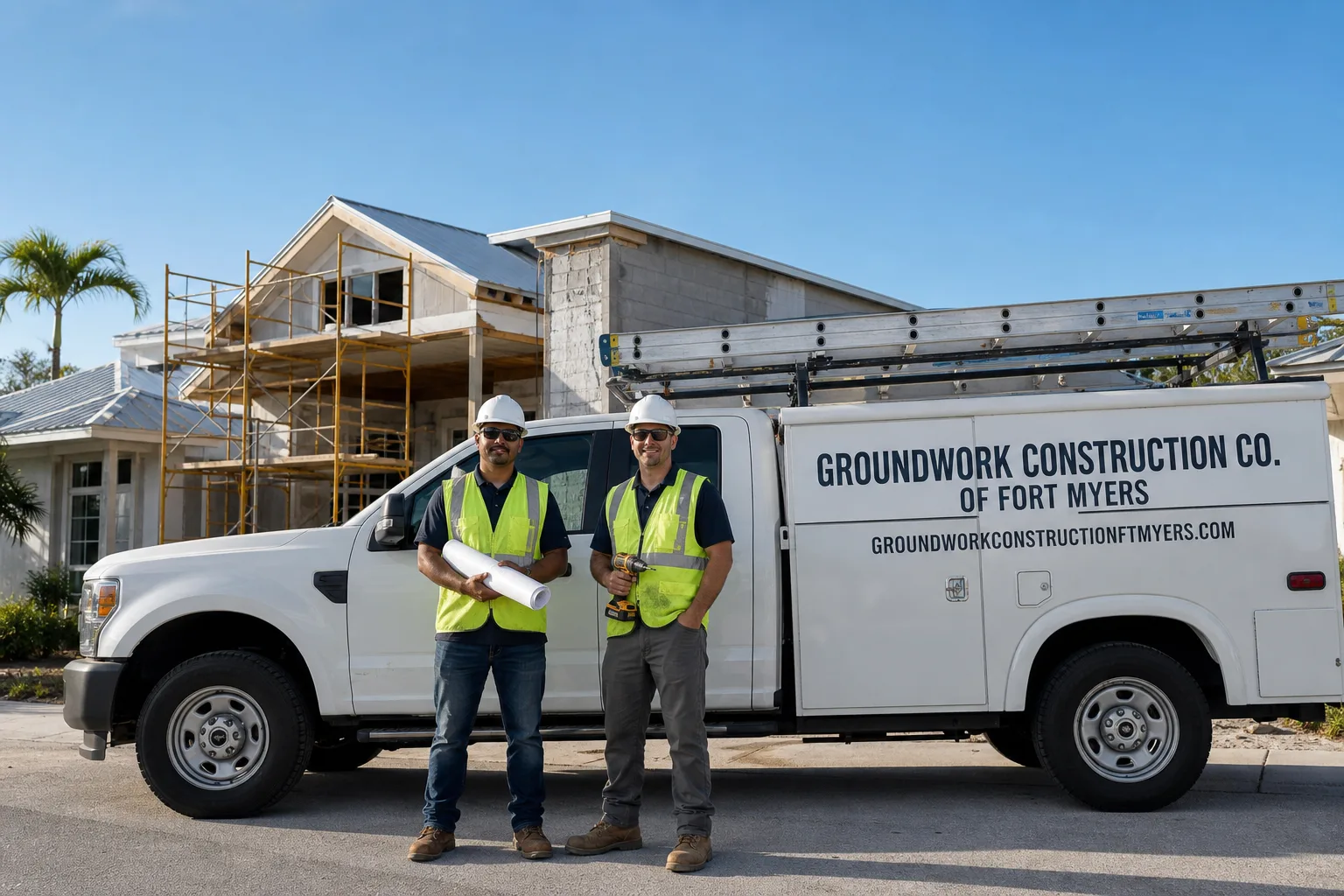
What a Garage Conversion ADU Actually Costs and Takes in Marco Island
A garage conversion ADU in Marco Island is the process of turning an existing attached or detached garage into a fully self-contained living unit with its own kitchen, bathroom, and entrance. On the island, these projects typically run between $75,000 and $130,000 and take four to seven months from design to final inspection. That timeline stretches if your property falls within a FEMA VE flood zone and requires an elevation certificate or structural reinforcement. Call (844) 638-7249 and we will walk through what your specific garage can realistically become, along with a fixed line-item estimate that does not change once work starts.
The sequence of a garage conversion on Marco Island
Every garage conversion in Marco Island follows the same logical progression. Here is what happens, stage by stage, and what you will decide at each point.
Stage 1: Site assessment and design (2-4 weeks). We pull the original building permit records for your home (critical for 1965-1985 Mackle-era CBS structures) and assess the slab condition, ceiling height, and existing electrical panel capacity. In Marco Island we specifically look for rebar corrosion in the garage slab, which is common when salt air has wicked through unsealed concrete for decades. This stage ends with stamped architectural drawings submitted to Collier County. You decide the ADU’s layout - studio, one-bedroom, or compact two-bedroom, and where the kitchen and bath will sit relative to existing water and drain lines.
Stage 2: Demolition and structural rough-in (2-4 weeks). The garage door comes out, that bay gets framed and sheathed to match the main house’s exterior, and we cut any new window and door openings. On Marco Island, every new opening requires impact-rated assemblies, so window and door selections happen before we cut the block. If we are relocating plumbing across the slab, this is the week the concrete saw runs. We trench, lay new drains, and tie into the existing system. The floor gets closed back up and the entire envelope is dried in with housewrap and flashings rated for coastal salt exposure.
Stage 3: Rough-in (3-5 weeks). New electrical subpanel installation, wiring the kitchen and bath circuits separate from the main house, running supply lines, installing the mini-split HVAC system. This is the point where earlier decisions about appliance locations matter - moving a stove six feet means a different breaker, a different rough-in path, and typically $800 to $1,400 extra in labor and materials. The rough framing inspection and the rough-in inspection happen back-to-back here, and Collier County inspectors are methodical about floodplain compliance documentation. We schedule these to keep your job moving without gaps.
Stage 4: Insulation, drywall, and finishes (3-6 weeks). Closed-cell spray foam insulation goes in. We recommend it over fiberglass batts in Marco Island garages because garages here tend to be poorly ventilated concrete boxes with one exterior wall, and closed cell also acts as a secondary air barrier against the Gulf humidity. Drywall, taping, texture, and paint follow. Flooring, millwork, cabinets and countertops go in, bathroom tile gets set, light fixtures and plumbing trim are installed. Toward the end of this stage the kitchen backsplash, tile, and flooring wraps up - homeowners often pair this work with new backsplash, tile, and flooring in Marco Island if the main house needs a refresh alongside the ADU.
Stage 5: Final inspection and punch list (1-2 weeks). The building inspector walks the unit, verifies smoke and CO detectors, checks GFCI placement, confirms the energy code compliance on the envelope, and signs off. Any small items we log on the punch list get knocked out in the days right after. You walk the finished ADU with our lead carpenter, note anything that needs attention, and we resolve it. Our 730-Day Done Right Promise means that two years from now, if something we built is not performing as it should, we make it right.
The finish choices that shape your ADU
A garage conversion ADU has fewer moving parts than a ground-up build, but the decisions you make on these items change both the final cost and the everyday feel of the unit.
- Flooring: Luxury vinyl plank vs. porcelain tile. LVP runs $4 to $7 per square foot installed and handles the humidity well. Porcelain tile costs $8 to $14 per square foot and stands up to sand and salt tracked in from the beach better than anything else. For a garage slab with minor moisture, LVP with a built-in underlayment works fine. For a slab that has wicked salt and moisture for decades, tile over a decoupling membrane is the safer long-term play.
- Kitchen configuration: Kitchenette vs. full galley kitchen. A kitchenette with a two-burner cooktop, undercounter fridge, and a small sink saves square footage and roughly $8,000 to $12,000 compared to a full galley layout with a range, dishwasher, and standard-depth refrigerator. For an ADU rented as a short-term vacation unit on Marco Island, a full kitchen delivers a measurably higher nightly rate and a faster booking calendar.
- Wall between house and ADU: Sound-rated assembly vs. standard partition. A standard 2×4 wall with R-13 batts meets code. Adding a second layer of 5/8-inch drywall on resilient channel, plus acoustic sealant at all penetrations, adds about $2,500 to $3,800 and makes a real difference when the ADU shares a wall with the main living room. If the garage is detached, this is a non-issue.
- Mini-split placement and sizing. A single 12,000-BTU ductless unit cools a 400-square-foot studio reliably. For a one-bedroom layout with a separate sleeping area, we spec a multi-zone unit or two heads, which adds $2,200 to $3,500. In Marco Island, undersizing the AC in a converted garage with one exterior wall leads to a unit that runs constantly from May through October and never pulls humidity low enough to feel comfortable.
What a garage conversion ADU costs on Marco Island
A garage conversion ADU in Marco Island costs $75,000 to $130,000, with the majority of projects landing between $90,000 and $115,000. The final number has almost nothing to do with the contractor’s mood and everything to do with five specific variables.
Garage size and layout. A 300-square-foot one-car garage converted to a studio costs less than a 500-square-foot two-car bay converted to a one-bedroom with a separate sleeping area. The difference is roughly $200 to $280 per additional square foot, because you are paying for more flooring, more drywall, more electrical circuits, and more mini-split capacity.
Plumbing location. If your garage shares a wall with a bathroom or kitchen, the water and drain connections are short and straightforward. If the garage sits on the opposite side of the house, running a new drain line across the slab means cutting concrete, trenching, and tying in downstream of the existing vent stack. That slab-cutting and drain-relocation work typically adds $6,000 to $12,000 on a Marco Island home where the garage sits at the front of a narrow lot and the existing plumbing stack is at the rear.
Electrical panel upgrade. Many Mackle-era homes still have a 100-amp or even 60-amp service panel. Adding a kitchen, mini-split, and bathroom circuit to an ADU pushes the calculated load past what that old panel can handle. A 200-amp service upgrade with a new meter base and weather head adds $3,500 to $5,500. We flag this during the site assessment so there are no surprises after demolition starts.
Impact-rated openings. Every window and exterior door installed in a garage conversion in Marco Island must be impact-rated or protected by an approved shutter system. Impact windows cost more than standard insulated glass, and that cost is non-negotiable. The difference between impact and non-impact for a typical garage conversion’s openings runs $2,000 to $4,500, depending on the number and size of units.
Finishes. A kitchen with stock cabinets, a laminate countertop, and an entry-level appliance package lands at the lower end of the range. Switching to plywood-box cabinets, quartz counters, and a mid-tier appliance brand moves the line. The choices you make in that one room alone can swing the total by $8,000 to $15,000. We provide a written estimate that separates structural and mechanical costs from finish-level costs so you can see exactly where your budget stands and make changes without re-bidding the whole project.
Every Groundwork Construction Co. estimate is a fixed line-item document showing what we will do, exactly what materials we will use, and the dollar figure that includes all labor, materials, and permits. No change orders appear later because we missed something in the estimate. Our 730-Day Done Right Promise backs every garage conversion with a written workmanship warranty that is one of the longest in residential construction.
Why a Marco Island garage conversion is different from one in Naples or Estero
A garage conversion on Marco Island is not the same job as a garage conversion ten miles inland. The island’s entire building stock sits on engineered fill over organic coastal substrate, and that fact alone changes how we approach the slab. On roughly one in four Mackle-era garage slabs, we find enough moisture wicking and rebar spalling that a standard flooring install without a moisture barrier will fail within two years. We test the slab early and, when the numbers call for it, spec a topical moisture barrier or a dimpled underlayment membrane before a single finish goes down.
The Collier County permitting process on Marco Island also moves differently than it does on the mainland. Because the island sits inside FEMA AE and VE flood zones, any garage conversion that adds more than 50% of the structure’s pre-improvement market value triggers a full elevation compliance review. That does not happen in Golden Gate or Immokalee. We navigate those reviews regularly, and our plans already account for the floodplain documentation the county will request at plan check. On an attached garage conversion we also have to prove the existing roofline, roof-to-wall connections, and wall bracing meet current wind codes before the building official signs the final.
Practically speaking, this means a garage conversion on Marco Island carries about two to three weeks of additional review time compared to the same project in a non-floodplain lot in Collier County, and the structural documentation requirements are heavier. We expect that, plan the schedule around it, and let you know at the estimate what to anticipate rather than discovering it mid-project.
Serving Marco Island, FL - Our Local Coverage Area
We’re based in the Marco Island area and know this community well. Use the map below to see our service coverage - if you’re nearby, we can almost certainly help.
Frequently asked - Garage Conversion ADU in Marco Island
A garage conversion ADU in Marco Island takes four to seven months from the day we submit plans to the day you get the keys to the finished unit. The design and permit stage accounts for six to ten weeks of that window. Actual construction runs ten to sixteen weeks, with the largest variable being how much slab work is needed, whether an electrical service upgrade is required, and how quickly Collier County schedules each inspection cycle. Call (844) 638-7249 for a timeline specific to your property.
Yes. Every garage conversion ADU on Marco Island requires a building permit from Collier County, and if your property is in a FEMA flood zone (which applies to the vast majority of the island’s residential lots), the permit package must include floodplain documentation, an elevation certificate, and, in many cases, structural calculations demonstrating compliance with current wind-load codes. We pull all required permits and manage the inspections as part of the project. No part of the work proceeds without an approved permit set.
It can, but only if your garage already sits adjacent to an existing bathroom or kitchen wall where we can share a wet wall. If the garage is on the opposite side of the house and you want a full bathroom and kitchen, trenching through the slab for new drain lines is unavoidable. We show you exactly where the tie-ins will happen on the site plan before you commit, so you know before we cut concrete whether relocating plumbing is part of the scope.
A basic garage conversion ADU includes closing in the garage door bay with a framed, sheathed, and finished exterior wall that matches the house, adding impact-rated windows and an exterior access door, building out a full bathroom with shower, toilet, and vanity, installing a kitchen with sink, range, and refrigerator, running new dedicated electrical circuits with a subpanel, installing a ductless mini-split for heating and cooling, insulating the entire envelope to code, and finishing with drywall, paint, flooring, and trim. Every trade is permitted and inspected.
Every garage conversion ADU we build on Marco Island is covered by our 730-Day Done Right Promise. If something we built is not right two years after completion, we fix it. That applies to workmanship across every trade - framing, electrical, plumbing, drywall, flooring, and finishes. We are not a crew that disappears after final payment. Call (844) 638-7249 to schedule a free on-site estimate and we will answer every question in person, with real numbers and no vague language.
Start with a free estimate for your garage conversion ADU
If you are looking at your garage on Marco Island and wondering what it could become, the next step is simple. Call (844) 638-7249 and we will come to your property, walk the space, discuss what the Collier County permit path looks like for your specific lot, and give you a written, fixed-price estimate that breaks out every cost. There is no charge for the estimate and no obligation. The call is answered by a live person, day or night, and the person who shows up is a background-checked, uniformed professional who knows garage conversions and knows Marco Island’s permitting reality firsthand.
Written by Derek Hollenbeck, Owner at Groundwork Construction Co., serving Marco Island homeowners with transparent pricing and a 730-Day Done Right Promise.