
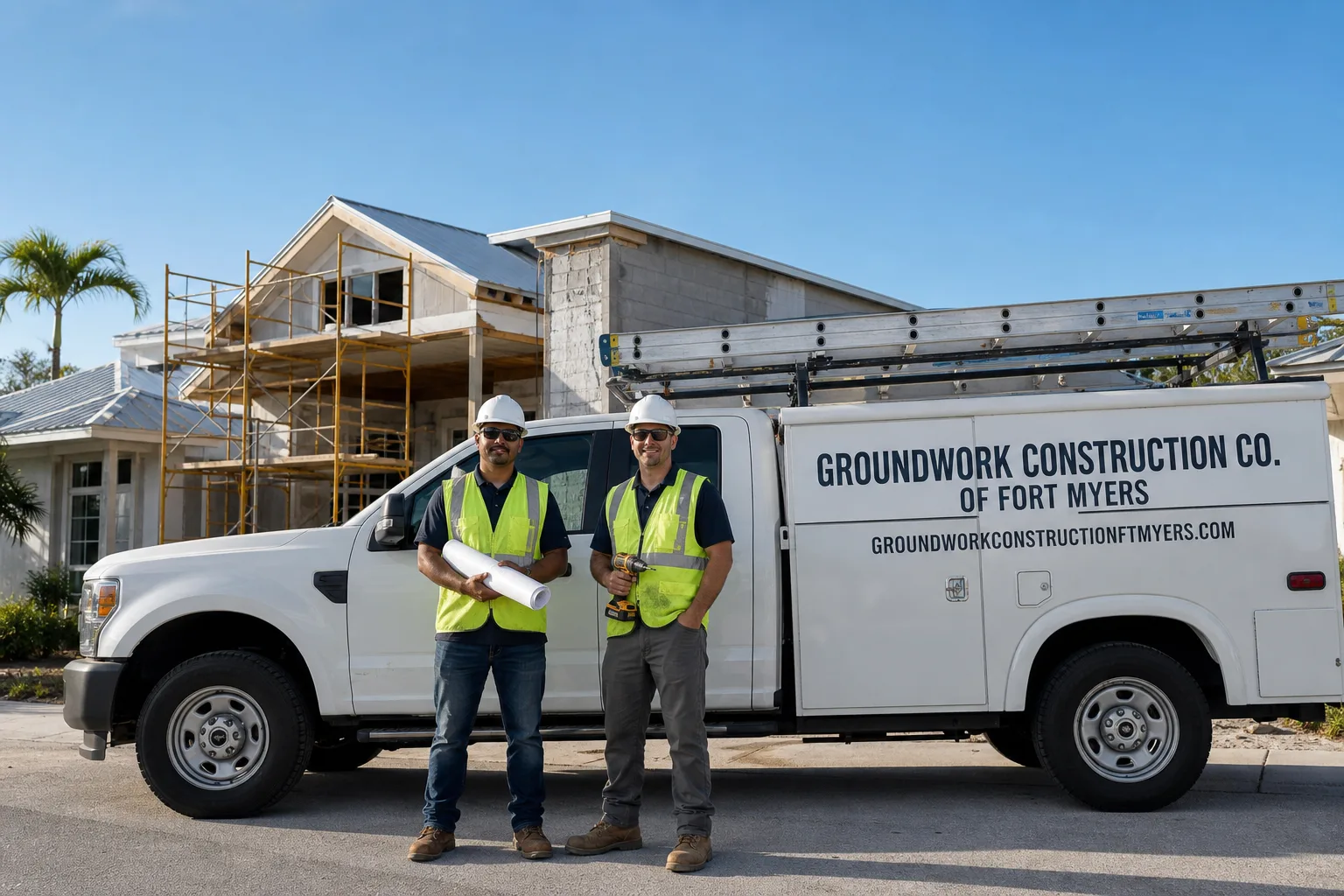
What ADU site prep and utilities actually cost and take in Fort Myers
Prepping a Fort Myers lot and running utilities for an accessory dwelling unit typically runs $45,000-$130,000, with most jobs taking 4 to 10 weeks from the first shovel to the final utility hookup sign-off. The spread is wide because what lurks underground and what Lee County now requires after Hurricane Ian changed the math for everyone. Call (844) 638-7249 for a free on-site estimate that accounts for your specific parcel, not a generic square-footage guess.
A lot of homeowners researching ADU site prep in Fort Myers have an older home on a mid-century lot along the McGregor corridor or in a neighborhood like Whiskey Creek, and they are trying to figure out whether the existing sewer lateral, water service, and electrical panel can even handle a second dwelling without ripping up half the backyard. That is the exact conversation we have on the walkthrough, and it is where the real number comes from.
How we handle ADU site prep and underground utility work, start to finish
Stage 1: Site survey, locate, and utility mark-out (days 1-3)
Before any dirt moves, we flag and map every existing underground line. We pull the survey, verify setback lines and easements against the plat, and confirm the ADU footprint sits cleanly inside the buildable area. In Fort Myers post-Ian, we also check FEMA’s advisory flood maps because finished floor elevation requirements have shifted on parcels that were remapped. If your parcel got a higher BFE in the 2023 advisory, that single number can change the foundation type and the site-prep cost by $8,000-$15,000. The homeowner decides here: stem-wall crawlspace or slab-on-grade, knowing the elevation requirement.
Stage 2: Clearing, rough grading, and foundation pad prep (days 4-12)
We strip the topsoil and any old sod, bring the pad area to subgrade, and compact it in lifts. Fort Myers sits on a mix of sandy loam and shell-rich fill that drains fast but shifts with heavy saturation, so we test compaction and cut in a stabilized base where the soil report calls for it. This is also the week we trench for the primary utility corridor, which is usually the longest single trench on the job because it has to carry water, sewer, and electric from the main house or the street tie-in point to the ADU footprint. We do not trench and backtrack; the corridor gets cut once and inspected rough before anything goes in the ground.
Stage 3: Underground rough-in and backfill (days 10-18)
Sewer lateral, water service line, and electrical conduit go in the trench with proper separation and fall. If the ADU is part of a full Home Additions & ADU in Fort Myers project, we size the water meter and the sewer tap for the combined load now so you are not digging again later. In Lee County, the sewer tie-in must pass a visual and a pressure or vacuum test before backfill, so we call the inspection, get the green tag, and only then close the trench. For homes on septic, this stage also includes the drain-field survey and tank-sizing decision, which is a big cost driver for rural parcels east of I-75.
Stage 4: Above-grade rough-in and panel tie-in (days 18-30)
With the pad poured or the stem wall cured, we stub up water, sewer, and electric through the slab, set the meter base and main disconnect, and pull the feeder to the subpanel location inside the ADU footprint. If the main house panel is a 150-amp or smaller unit from the 1970s, we almost always need a service upgrade here. Our Home Additions & ADU crew coordinates the utility-disconnect window with FPL and Lee County so the rough-in inspection and the service change happen in one trip. Homeowners often pair this with a Full Bathroom Remodeling in Fort Myers project on the main house while the plumbing and electric crew is already on site, since the wall is open anyway.
Stage 5: Final grade, drainage, and utility sign-off (days 25-40)
We slope finish grade away from both structures, install any required swales or catch basins, and tie downspout drains into a positive-outflow system. Fort Myers is flat and gets tropical downpours, so grading is not a cosmetic detail but a structural necessity. The Lee County final on utilities is a two-part sign-off: one for the building inspector verifying the service is hot and the fixtures are set, and one for the plumbing or mechanical inspector verifying the water and sewer connections hold pressure and flow. We do not ask for the final check until we have done our own pressure test the day before. When both tags are signed, the ADU is utility-ready.
If you are also considering updating the kitchen in the main house while we have the trench open for plumbing, we have done a number of Small & Partial Kitchen Remodels in Fort Myers in parallel because sharing the underground rough-in saves a second mobilization.
The options you will choose between during site prep
- Water service: tap the main house line vs. separate meter. Tapping the existing line is cheaper up front and works fine for a modest one-bedroom ADU. A separate meter costs $3,000-$6,000 more once you factor the tap fee, the meter can, and the backflow preventer, but it lets you bill the ADU separately if it is a rental.
- Sewer: gravity tie-in vs. grinder pump. A gravity lateral is quieter, cheaper, and simpler. If your main sewer line exits the house too high relative to the ADU slab elevation, you need a grinder pump and a pressurized discharge line, which adds $4,000-$8,000 to the underground budget and introduces a mechanical component that will eventually need service.
- Electrical: subpanel feed vs. separate service drop. A 100-amp subpanel fed from a 200-amp main house panel is the most common Fort Myers configuration. If the main panel is full or undersized, we size the service upgrade for both structures. A completely separate FPL drop and meter eliminates load-sharing headaches but adds the second monthly meter charge.
- Foundation type: slab-on-grade vs. stem-wall crawlspace. Slab is faster and costs less. Stem-wall gets you the elevation you need when the FEMA BFE requires it and gives you an accessible under-floor chase for future plumbing work. On a Fort Myers lot in an AE flood zone, the BFE will dictate this choice, and there is no shortcut around it.
- Drainage: swale and gravity outflow vs. dry-well or pumped discharge. If the lot has positive fall to the street or a storm drain, gravity drainage is straightforward. If the ADU sits lower than the discharge point, we cut in a pumped system with a sump basin, which adds mechanical complexity but keeps water moving during a summer gullywasher.
- Trench backfill material. We use compacted clean fill and a Quikrete or Sakrete stabilized sand mix where the subgrade is soft, which is common in Fort Myers neighborhoods built on fill over older wetland zones. The cheaper option is native backfill, but native sandy soil here can settle unevenly, and we will not warranty the trench patch if it sags.
What ADU site prep and utilities cost in Fort Myers, FL
A full utility trench, foundation pad prep, and service tie-in for a detached ADU in Fort Myers runs $45,000 on the low end and $130,000 on the high end. The spread is real, and here is what pushes it.
A compact one-bedroom ADU on a flat lot with good soil, a short utility run to the main house, no flood-zone complications, and an existing 200-amp panel that can take a subfeed will land near the $45,000-$60,000 mark. A larger two-bedroom unit on a lot in a post-Ian AE flood zone that requires a stem-wall foundation, a separate sewer grinder pump, a full electrical service upgrade, and a 100-foot utility corridor through root-heavy soil will push past $100,000. The single largest variable in Fort Myers right now is the finished floor elevation, because FEMA’s advisory maps raised the BFE on hundreds of parcels by two to four feet, and that forces a foundation change that cascades into grading, steps, and utility riser costs.
Our written estimate breaks out the site-prep and utility scope line by line: clearing and rough grading, foundation excavation and compaction, trenching and backfill, water and sewer lateral materials and labor, electrical feeder and subpanel, drainage and finish grade, plus the Lee County permit fees as a pass-through. What is not part of the site-prep number: the ADU structure itself, interior finishes, HVAC equipment, appliances, and any landscaping or hardscaping beyond the disturbed area. You get the exact scope in writing before you sign, and the number you see is the number you pay, backed by the 730-Day Done Right Promise.
What Fort Myers homes specifically do to this job
Fort Myers was ground zero for Hurricane Ian’s Category 4 landfall in September 2022, and every construction project here now operates inside a post-disaster permitting environment that simply does not exist in other Florida markets. Lee County processed tens of thousands of permits in the two years after Ian, and the building department is stricter now about elevation certificates, flood-zone compliance, and foundation engineering than at any point in the last two decades. For an ADU site-prep job, that means we spend more time in plan review and more time waiting for the FEMA flood-zone determination than we would in a market that did not get remapped.
The housing stock along the McGregor corridor and in older neighborhoods like Dean Park and Edison Park is heavily concrete block construction from the 1950s through the early 1980s, and those homes were not built with a spare 200-amp service or a sewer lateral sized for a second dwelling. We regularly open up a main panel on these houses and find it full, with no main breaker space for a subfeed. That triggers a service upgrade, which adds real cost but also brings the main house up to current code. The positive is that those older block homes sit on generous lots, so the actual ADU footprint and utility corridor generally have room to work.
After Ian, Lee County ran joint enforcement sweeps with the DBPR targeting unlicensed out-of-state contractors who took deposits and disappeared or did non-compliant underground work that failed the first inspection. Homeowners in Fort Myers have been burned by this in a way that homeowners in undamaged markets have not. We carry a verified Lee County license, our technicians are background-checked and uniformed, and every utility rough-in gets inspected by the county before one scoop of backfill goes in the trench. That is not marketing language but the bare minimum a Fort Myers homeowner should demand after what this market has seen.
Serving Fort Myers, FL - Our Local Coverage Area
We’re based in the Fort Myers area and know this community well. Use the map below to see our service coverage - if you’re nearby, we can almost certainly help.
Frequently asked - ADU site prep and utilities in Fort Myers
Plan on 4 to 10 weeks from the day we start clearing to the day Lee County signs the final utility tag. A straightforward job on a clear lot with short utility runs and no flood-zone surprises can finish in four weeks. A job that requires a foundation elevation change, a service upgrade, and a sewer grinder pump will take the full ten. The variable that eats the most calendar time is the permitting pipeline, because Lee County plan review is still working through elevated post-Ian volumes.
Yes. Every part of the underground utility work (water, sewer, electric), the foundation prep, and the drainage grading requires a Lee County permit and a passed inspection before backfill or cover. Trenching without a permit and a utility locate risks hitting a gas line or a fiber trunk, and unpermitted underground work will get flagged on the title search if you ever sell. Call (844) 638-7249 and we will pull the permits as part of the job.
In most cases, yes. We cut a new sewer lateral and water line from the ADU to the street tap or the septic tank without touching the main house’s plumbing. The tie-in happens at the main line, not by rerouting through the house. The exception is when the ADU sits behind the main house and the only viable sewer path is to tie into the existing lateral downstream of the house, which sometimes requires cutting a cleanout into the main line. Even then, the disruption to the main house is one day, not a full replumb.
Five things. One, the finished floor elevation required by FEMA’s post-Ian flood maps: a stem-wall crawlspace costs more than a slab. Two, the distance from the ADU footprint to the sewer tap or septic tank: every extra foot of trench adds material and labor. Three, whether the main electrical panel needs a service upgrade. Four, soil conditions: soft, organic fill needs more excavation and a stabilized base. Five, whether the sewer tie-in can work by gravity or needs a grinder pump. Those five variables explain the entire spread. Call (844) 638-7249 for a free estimate that accounts for your specific parcel.
The entire site-prep and utility scope is covered by our 730-Day Done Right Promise: if something is not right, we make it right, full stop. That covers the trench backfill settlement, the sewer lateral, the water service, the electrical feeder, and the drainage grading. We also carry the manufacturer warranties on any pump or mechanical component we install. Underground work that passes a pressure test on day one should not fail in year two, but if it does, the warranty is not prorated or conditional, and someone answers the phone when you call.
Get a free ADU site-prep estimate in Fort Myers
If you are planning an ADU on your Fort Myers property, the utility scope is the part that makes or breaks the budget. We will walk the lot with you, check the panel, locate the sewer lateral, pull the flood-zone determination, and give you a written, line-item estimate that accounts for what is actually under your dirt, not a square-footage guess. Call (844) 638-7249 to schedule the walkthrough. A live person picks up, 24/7, and the estimate is free.
Written by Derek Hollenbeck, Owner at Groundwork Construction Co., serving Fort Myers homeowners with ADU site prep and full-scope construction since 2014.