
What a chain link fence in Charlotte Harbor costs and how long it takes
A chain link fence installation in Charlotte Harbor, FL typically runs $3,500-$9,000 for a standard residential lot, with most jobs completed in 2-4 working days. The work involves setting galvanized steel posts in concrete, stretching the mesh fabric between them, and installing the gate hardware and tension wire that keep the fence standing straight through years of coastal humidity and storm-season winds. Call (844) 638-7249 for a free on-site estimate with a written, line-item price you’ll have in hand before any work begins.
The chain link fence process, step by step
We start every chain link fence job in Charlotte Harbor with a site visit. Derek or one of our senior crew leads walks the property line with you, marks where the corners and gate posts will land, and flags any underground utility conflicts. If you haven’t had the lot surveyed recently, we’ll recommend pulling your plat map from the Charlotte County Property Appraiser’s site so we’re putting the fence exactly on the property line, not six inches inside it. That conversation takes about an hour and ends with a written estimate.
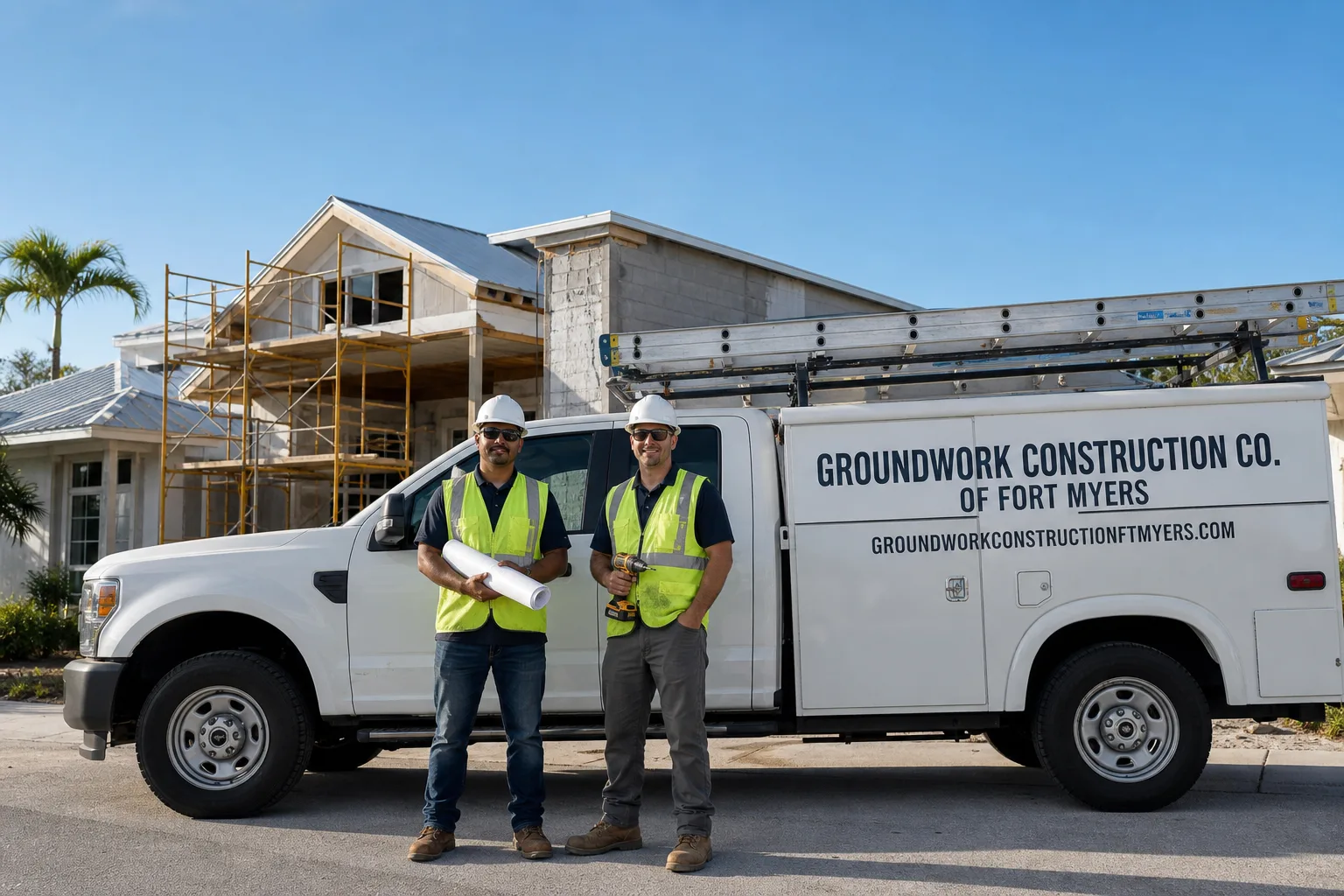
Day one is layout and post-setting. The crew arrives in a marked Groundwork Construction truck, calls in a locate ticket to Sunshine 811 if we haven’t already done it, and then strings the line. Post holes get augered to 24-30 inches deep, below the top of the water table that sits high across much of Charlotte Harbor. We set terminal posts first - corners and gateposts - in a wet concrete mix that cures by the next morning. Line posts follow. If the soil is sandy or saturated, which it often is in parcels near the Peace River side of the harbor, we’ll oversized the footing by a few inches. We don’t charge extra for that; it’s just what the ground demands.
Day two is fabric and framework. We bolt on the top rail and line-post caps, then unroll the galvanized mesh fabric and pull it tight with a come-along. Tension wire gets woven through the bottom and anchored at each terminal post to stop the fence from bowing when kids or dogs lean against it. Gate frames get hung and adjusted so the latch catches clean. If you’ve chosen vinyl-coated fabric, the color goes on now - black or green, almost always, though we can order darker architectural finishes if the HOA requires it.
Days three and four, when they’re needed, are for gates, privacy slats, and the final walk-through. A double drive gate on a corner lot adds a half day of layout and concrete curing. If you’re adding privacy slats - the vertical inserts that slide into the chain link mesh - we’ll install those last so they don’t slow down the fabric pull. Before we clean up, we tension-check every post, confirm every gate swings without dragging, and walk you around the fence line to make sure the finished product matches the drawing we agreed on.
Every chain link fence we build in Charlotte Harbor is covered by our 730-Day Done Right Promise. If the fence sags, a gate binds, or a post shifts in the first two years, we come back and make it right. You won’t chase a voicemail. You won’t wait until Monday. Calls to (844) 638-7249 are answered by a live person, any hour, any day.
The specs you’ll actually decide on
Chain link isn’t one product. It’s a set of choices that determine how the fence looks, how long it lasts, and where your estimate lands. Here are the four decisions that matter most in Charlotte Harbor:
- Galvanized vs. vinyl-coated fabric. Standard galvanized is the lower-cost option and holds up well, but in Charlotte Harbor’s salt-tinged air - especially on parcels within a half-mile of open water - the zinc coating starts to dull faster than it would inland. Vinyl-coated fabric (typically black or green) adds a bonded PVC layer over the galvanized core that resists the salt haze and keeps the fence looking cleaner for longer. Budget roughly 20-25% more for vinyl-coated on the material line.
- Gauge of the wire. Residential chain link typically uses 11- or 11.5-gauge wire. Lighter 12.5-gauge is cheaper but dents more easily and is more likely to belly between posts over time. We default to 11-gauge for most Charlotte Harbor yards because the humidity cycle here - dry-season sun, wet-season saturation - accelerates the sag on thinner wire. If you’re fencing a dog run for a strong breed, we’ll recommend 9-gauge, which is what you’d spec for a kennel.
- Post size and schedule. Terminal posts are 2.5-inch or 3-inch outside diameter, schedule 40 galvanized steel. Gateposts take the largest diameter because they carry the hanging weight. We space line posts at 7-8 feet on center. Tighter spacing is stronger; wider spacing saves a few posts up front but gives you a wavier top line over time.
- Privacy slats and windscreen. Chain link is see-through by design. If you want more privacy, you’ve got two paths: slide-in aluminum or PVC slats that weave vertically through the mesh, or a fabric windscreen that laces onto the outside face and can be taken down for hurricane prep. Slats are permanent and add roughly $8-12 per linear foot installed. Windscreen is removable and costs less, but it will need replacement every few years under Florida sun.
We don’t push one option over another. We’ll show you samples, walk you through the math, and let you decide what’s worth your budget. The estimate you get is the price you pay - no change orders, no end-of-job surprises.
What a chain link fence costs in Charlotte Harbor, FL
The working range for a residential chain link fence in Charlotte Harbor is about $3,500 on the low end and $9,000 on the high end. A 150-linear-foot perimeter with standard galvanized fabric, one walk gate, and one drive gate on level ground typically lands in the $4,200-$5,800 range. That includes post concrete, tension wire, hardware, and the labor to install it straight and square.
Five variables move the number:
- Linear feet. The most obvious one. Chain link is priced per foot, and every extra foot adds material and labor. A small 80-foot side-yard dog run costs far less than fencing a full half-acre lot.
- Fabric choice. Galvanized is the entry point. Vinyl-coated fabric adds material cost. 9-gauge wire adds more. Each step up pushes the per-foot price.
- Gate count and type. A single walk gate is straightforward. A double drive gate with drop-rod hardware and a concrete threshold pad adds significantly. If the gatepost needs a deeper footing because a vehicle will swing near it, that’s more concrete and more labor.
- Soil conditions. In parts of Charlotte Harbor near the harbor’s tidal fingers, the soil is sandy loam that drains fast and requires broader post footings to resist wind load. If we hit shell rock or coral remnants shallow, we switch to a rock auger bit, which adds time. We’ll know this the day we set posts and we’ll have flagged the possibility in the estimate.
- Permit and HOA requirements. Charlotte County requires a permit for any fence over four feet. The fee is modest, but the time to pull it and schedule the inspection has to be built into the timeline. Some Charlotte Harbor HOAs specify a particular mesh size, color, or top-rail finish. We’ll pull your HOA’s fence guidelines during estimating so the permit application matches what the community requires.
Every estimate we write is a fixed price. It includes the permit fee, the materials, the labor, the cleanup, and the project management. If you’re also considering Concrete Driveways & Concrete Work in Charlotte Harbor or Asphalt Driveways & Resurfacing in Charlotte Harbor, ask about bundling during the estimate visit. The 0% financing for 18 months applies to qualified projects, and we take $1,000 off the total when the job is over $10,000.
What Charlotte Harbor homes specifically demand from a chain link fence
Charlotte Harbor sits on one of Florida’s largest tidal estuaries, and that geography writes the rules for every fence we build here. Parcels on canal-front streets like those off Melbourne Street or around the Harbor Heights neighborhood regularly fall in FEMA AE flood zones, which means the county’s building department will ask for a site plan showing the fence won’t obstruct natural drainage. In practice, that usually translates to a bottom-of-fabric clearance of 2 inches and open-mesh construction that lets water pass through - which chain link does by default, making it one of the few fence types that rarely gets pushback on floodplain compliance.
The corrosive mix of salt air and high humidity also makes galvanized steel the only practical metal choice. Untreated or powder-coated steel posts rust at the base within a few seasons if they’re within a mile of the harbor. We use hot-dipped galvanized posts and fittings exclusively, and on waterfront lots we’ll often spec the denser zinc coating on terminal posts to buy extra years before the first sign of oxidation. This isn’t cost-adding fluff. It’s what Charlotte County’s own post-hurricane building standards effectively require, born from the institutional memory of Hurricane Charley’s 2004 landfall that leveled whole blocks of this community.
Speaking of Charley: much of Charlotte Harbor’s housing stock is either pre-Charley CBS block from the 1960s-70s or post-2004 rebuilds engineered to the county’s aggressively updated wind code. The older surviving homes sometimes lack a survey that’s current enough to place a fence confidently. If your property hasn’t been surveyed since before Charley, we’ll recommend pulling a boundary survey before we dig - it’s an extra step, but it’s cheaper than moving a fence line six months later because a neighbor challenged the property line. The newer rebuilds tend to have HOA-governed subdivisions with specific fence-height and color restrictions that we’ll cross-reference before the estimate is final.
We work across Charlotte Harbor every week, and we’ve learned to read the soil, the setback rules, and the inspection priorities that surprise out-of-town crews. A Charlotte County inspector will check post depth and gate-swing clearance. They won’t care what the fence looks like. They will care whether the gatepost footing is deep enough to hold in saturated ground. Our crews are background-checked and uniformed on every site, and they’ve passed more Charlotte County fence inspections than we can count. When you’re ready to start, we’re the fence installation crew you’ll see on permit day.
Homeowners with larger property plans often pair a chain link perimeter with a full Fence Installation in Charlotte Harbor project that mixes materials - chain link for the back boundary where you want to keep the view of the water open, and something more private for the street-facing sides. If that’s the direction you’re heading, we’ll coordinate both scopes in one estimate so you’re not paying two mobilization fees.
Serving Charlotte Harbor, FL - Our Local Coverage Area
We’re based in the Charlotte Harbor area and know this community well. Use the map below to see our service coverage - if you’re nearby, we can almost certainly help.
Frequently asked - chain link fence in Charlotte Harbor
Most residential chain link fences in Charlotte Harbor are finished in 2-4 working days. Day one is layout, utility marking, and post-setting. Day two is fabric, top rail, tension wire, and gate hanging. Days three and four apply when there are multiple gates, privacy slats, or weather delays. We don’t start digging until Sunshine 811 has cleared the locates, which usually takes two business days after the ticket is called in.
Yes, Charlotte County requires a building permit for any fence over four feet in height. The permit application includes a site plan showing the fence location relative to the property lines and any easements. We pull the permit on your behalf as part of the contract. The inspection happens after posts are set and before the final walk-through. If you’re replacing an existing fence in the same footprint with the same height, the permit path is simpler but still required.
Yes. Chain link handles slope two ways: racked panels, where the fabric is cut to follow the grade while the top rail stays level, or stepped panels, where the fence drops in level sections. On the gentle slopes common around the Harbor Heights and Peace River Shores areas, racked fabric usually looks cleaner and costs less in labor than stepping. For steeper grades, we’ll step the sections so the fence doesn’t pull itself out of tension.
Galvanized chain link in Charlotte Harbor needs a rinse-down with a garden hose a few times a year to clear off salt haze and pollen. Vinyl-coated fabric barely needs that. The gate hinges and latch should get a shot of silicone lubricant annually. If you’re within a quarter-mile of open water, plan to inspect the terminal-post base coating every three years for any rust blooming; touching it up early with cold-galv spray keeps a small spot from becoming a structural problem. This is one of the lowest-maintenance fence types you can put in a coastal climate. For more on how this fits with broader property projects, ask about Fence Installation options when you call.
It won’t, as long as the scope doesn’t change. The estimate we hand you is a fixed price built on a measured site visit. The only thing that shifts the number mid-job is a change you request - like adding a gate, extending a fence line, or upgrading to vinyl-coated fabric after posts are already in the ground. We put that policy in writing because the alternative - vague bids and surprise charges - is exactly what homeowners in Charlotte Harbor have told us they’re tired of.
Get a written estimate for chain link fence in Charlotte Harbor
If you’re ready to price a chain link fence for your Charlotte Harbor property, the next step is a free on-site estimate. Derek or one of our senior crew leads will walk the lot with you, talk through the gauge, coating, gate placement, and any HOA constraints, and leave you with a fixed-price proposal you can make a decision on. There’s no deposit due at the estimate, no high-pressure follow-up, and no obligation. Call (844) 638-7249 to schedule - a live person answers, every time.
Written by Derek Hollenbeck, Owner at Groundwork Construction Co., providing upfront pricing and the 730-Day Done Right Promise to homeowners across Charlotte Harbor, FL.