
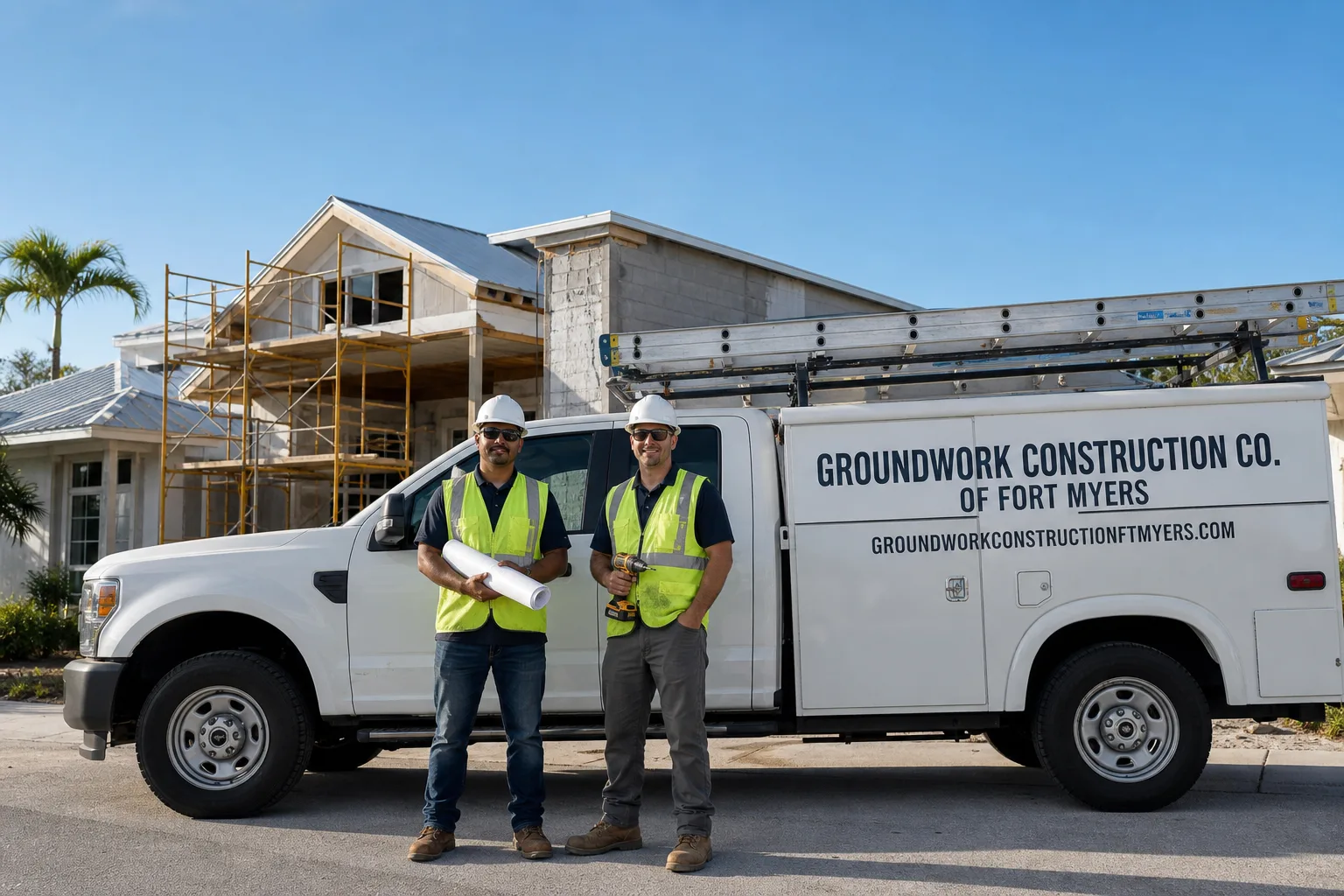
What Concrete Driveways & Concrete Work in Marco Actually Costs and How Long It Takes
Concrete driveway installation in Marco, FL runs $4,500-$12,000 for a typical two-car residential pour, with most jobs finished in five to seven working days from form-set to cure-ready. The work includes demolition of the old slab (if there is one), base prep, formwork, rebar or mesh reinforcement, the pour itself, and a power-trowel finish with control-joint cutting. Call us at (844) 638-7249 for a free on-site estimate. We walk the site, measure, check the existing grade, and hand you a written line-item price before we leave the driveway.
How We Pour a Concrete Driveway in Marco - Start to Finish
Every job follows the same sequence. No shortcuts, no skipped stages. Here is what you should expect when we show up for your concrete driveway installation in Marco.
1. Demolition and site clearing - Day 1
If there is an existing driveway slab, we saw-cut and remove it. The old concrete gets loaded out and hauled from the site. We also remove any landscape edging, pavers, or asphalt that sits inside the new footprint. On Marco teardown-replacement lots where the original Deltona slab-on-grade ranch had a narrow ribbon drive, we usually find the sub-base was never compacted beyond what the original crew did with a small roller in 1972 - which means the dirt underneath needs real attention before any new concrete goes down. This stage takes one day. We need clear access to the full pour zone.
2. Sub-grade prep and base compaction - Day 2
We excavate to an 8-inch depth below finished grade and lay in a 4- to 6-inch compacted gravel or crushed concrete base. On Marco, salt-saturated canal-proximate lots demand extra attention to base drainage - standing moisture under the slab accelerates rebar corrosion and leads to slab cracking within three to five years. Our crew compacts in lifts, checking grade with a laser level. If the existing lot sits low relative to the crown of the road or the canal seawall, this is the day we address positive drainage away from the garage slab. A driveway that slopes toward the garage door is a standing-water problem waiting to happen, and we will not pour until the grade is right. This stage is one day. At this point, the homeowner needs to confirm the final slab dimensions and decide whether the driveway ties into a new walkway or pool deck, which shifts the formwork layout the next morning. If this is part of a full Driveway & Pavers in Marco project, we coordinate the tie-in elevations now.
3. Formwork, reinforcement, and any embedded utilities - Day 3
Our crew builds the wood forms to the exact slab dimensions, sets the grade stakes, and ties the rebar grid or wire mesh. For most Marco driveways we spec #4 rebar on 18-inch centers with plastic high-strength chairs to keep the steel suspended in the middle of the pour. If the driveway needs embedded conduit for future landscape lighting or an electric gate, this is the day we rough it in. Any project inside a FEMA flood zone - which is every square foot of Marco - must maintain the existing site drainage pattern, so we verify the form heights against the lot survey. Collier County inspectors will check this before we pour. Homeowners sometimes ask about adding a small apron extension or a side path at this stage, and we can pivot as long as the forms are still open. This stage is one day.
4. Concrete pour, screed, and finish - Day 4 (sometimes Day 5)
We batch and pour a 4-inch-thick slab using a 3,000-psi mix with a 4-inch slump - standard for Florida residential driveways - and adjust to a 4,500-psi mix when the homeowner plans to park heavier vehicles or store a boat trailer on the slab. Our team screeds, bull-floats, and power-trowels the surface to a clean, non-slip finish. On Marco, we avoid a high-gloss burnished finish; the slick surface gets hazardous during the daily summer afternoon rain. We cut control joints the same day, typically in a 10-foot grid pattern, to direct inevitable slab cracking into invisible lines. This is the most weather-sensitive stage. If afternoon thunderstorms are forecast - a near-daily reality on the island from June through September - we may push the pour to the next clear morning. Concrete exposed to a sudden downpour before the initial set is ruined. Our Driveway & Pavers crew has poured hundreds of slabs on this barrier island and we read the sky as carefully as we read the grade.
5. Curing, cleanup, and the first walkthrough - Day 7
We strip the forms on Day 5, backfill the slab edges with clean fill, and do a full site cleanup. The concrete cures over 28 days, but it reaches about 70% of design strength within the first week - enough for standard passenger vehicles. We tell every Marco homeowner the same thing: stay off the slab with any heavy truck or boat trailer for a full 14 days. Saltwater dripping from a trailered boat can stain unsealed concrete in under 48 hours, so we recommend a penetrating silane-siloxane sealer applied after the 28-day cure is complete. We schedule the final walkthrough on Day 7 to review the control joints, check drainage, and hand you a maintenance card. If the job was tied to a Garage Conversion ADU in Marco, we coordinate the driveway walkthrough with the conversion crew so the slab is signed off before interior work begins.
The Options You’ll Choose When You Pour Concrete in Marco
Not all concrete driveways in Marco are the same slab. Here are the actual decisions you will make, and what each one means for cost and longevity.
- Standard gray 3,000-psi mix - This is the workhorse spec. It handles passenger vehicles and light trucks without issue, and it is what we pour on 80% of Marco residential driveways. It keeps your price at the lower end of the range. The trade-off: it does not resist salt pitting as well as a higher-psi mix, so canal-front homes should budget for sealer reapplication every two years.
- 4,500-psi high-strength mix - A denser, harder slab that stands up to heavier loads and resists the spalling that brackish-water exposure causes over time. We recommend this on any Marco lot within a quarter-mile of the Gulf or on a direct canal. It adds roughly $1.50-$2.00 per square foot. For homeowners who store a large boat on a trailer at the property, the extra density pays for itself in avoided crack repair within five years.
- Fiber-reinforced vs. wire mesh vs. rebar - Rebar is our default on Marco because the island’s sandy, often saturated sub-base shifts more than inland clay soils. Fiber mesh alone saves a few hundred dollars on a two-car pour, but it does not resist the tensile stress that wet-season soil expansion puts on a slab edge. In our experience, the savings are not worth the call you will make three years later when a corner crack opens up.
- Broom finish vs. exposed aggregate - A broom finish is the standard non-slip texture: functional, cost-effective, and what we recommend for anyone who just wants the car parked without drama. Exposed aggregate - where the top layer of cement paste is washed away to reveal the stone - looks sharper and hides stains better, but it costs 30-40% more and requires a skilled finisher to get the reveal even. Both hold up in Marco’s sun. Neither is wrong.
- Color admixture or integral pigment - Adding color to the mix (rather than staining after the pour) gives the slab a uniform tone that does not peel. It adds $600-$1,200 on a two-car driveway. The salt air bleaches unstained gray concrete to a chalky white within a decade, so pigment also serves as a UV buffer. We use Sakrete and Quikrete integral color products when a homeowner wants something beyond natural gray.
- Sealer: penetrating vs. acrylic film - A penetrating silane-siloxane sealer soaks into the concrete and blocks water and salt intrusion without changing the surface texture. An acrylic film sealer sits on top, adds a slight sheen, and needs reapplication more often in Marco’s UV. For driveways that see daily use, we point people toward the penetrating sealer every time.
What Concrete Driveways & Concrete Work Costs in Marco, FL
A two-car concrete driveway in Marco runs $4,500-$12,000. The number depends on four variables, and none of them are a mystery once we walk the site.
Square footage and shape. A standard 20-by-40-foot two-car slab is 800 square feet. A curved, flared, or extra-long driveway - common on Marco’s larger canal-front lots - can push past 1,200 square feet. More concrete, more formwork, more rebar. That moves you toward the upper end of the range.
Existing slab removal and sub-grade condition. If your current driveway is an original 1960s Deltona-era ribbon slab with no compacted base underneath, demolition is fast but the base prep is not. We often haul out a full load of loose sand and organic fill before we can begin compacting. That adds labor and material cost compared to a new-build lot where the pad is already rough-graded.
Mix spec and reinforcement. A standard 3,000-psi gray slab with wire mesh costs less than a 4,500-psi fiber-plus-rebar slab with integral color. The delta between the low and high spec on the same 800-square-foot footprint can be $3,000 or more. We walk you through exactly what each upgrade buys so you decide with your eyes open.
Permit and inspection scope. Every concrete driveway replacement in Marco requires a Collier County permit, and the inspection covers formwork, reinforcement, and final drainage. If the new slab ties into a home addition or a New Detached ADU in Marco, the permit scope expands and the engineering review adds cost. Our written estimate includes the permit fee as a separate line item so you see exactly where the money goes.
Every estimate we hand you is a fixed-price, line-item quote. No allowances, no “we’ll figure it out later.” We price the concrete, the steel, the base, the labor, the permit, and the sealer. If something changes during the job - say, you decide to widen the apron on Day 2 - we price the change order in writing before we touch a form. Upfront pricing, no surprises.
What Marco Homes Specifically Do to a Concrete Driveway Job
Pouring a concrete driveway on Marco is not the same as pouring one twenty miles inland in Fort Myers. The island was built out by the Deltona Corporation starting in 1962, leaving a dense grid of concrete-block ranch homes on slab-on-grade foundations, many of which now sit at or below current FEMA Base Flood Elevations. When we pull up an original driveway on a 1968 canal-front lot on Collier Boulevard or a side street off Bald Eagle Drive, we almost always find the same thing: a thin, unreinforced slab poured directly on loose sand with no compacted base, no rebar, and no positive drainage away from the garage. Those driveways have been spalling and cracking since the 1980s, and the only real fix is full replacement.
The permitting reality on Marco adds a layer that mainland homeowners rarely deal with. Because the entire island falls within FEMA Special Flood Hazard Areas - with canal-adjacent parcels in VE velocity zones - Collier County building officials check every new driveway pour against the existing site drainage plan and the structure’s flood elevation certificate. If your home is an original Deltona slab that sits below current BFE, a driveway replacement by itself does not trigger the substantial improvement rule, but it must not worsen the site drainage in a way that directs water toward the home or the neighbor’s seawall. We pull the permit, we coordinate the inspection, and we make sure the slab passes on the first visit.
Salt corrosion is the other Marco-specific factor. Rebar and wire mesh embedded in concrete are pH-protected by the cement paste - until chloride ions from salt spray and brackish canal water penetrate the slab over years and reach the steel. Once corrosion starts, the rebar expands, the concrete cracks from the inside, and the driveway surface starts spalling in chunks. This is why we spec plastic high-strength rebar chairs instead of metal ones and why we recommend a penetrating sealer on every Marco pour. The up-front cost is modest. The alternative is a slab that starts failing from the inside out before the payment book is closed.
Homeowners in neighborhoods like Olde Marco, Key Marco, and the estates along South Collier Boulevard are increasingly pairing a new driveway with a broader property lift or teardown-rebuild, which puts the slab on an entirely new structural footing. For those who are keeping the original home but need a functional driveway now, we design the pour to accommodate future elevation - meaning we set the slab elevation and drainage pattern so it can be tied into a raised foundation and stem wall later without saw-cutting the whole thing out. That kind of planning costs nothing extra on the day of the pour and saves thousands down the road.
Serving Marco, FL - Our Local Coverage Area
We’re based in the Marco area and know this community well. Use the map below to see our service coverage - if you’re nearby, we can almost certainly help.
Frequently Asked - Concrete Driveways & Concrete Work in Marco
Five to seven working days from demolition to the day you can park a passenger vehicle on it. We pour on Day 4 or 5, strip forms the next day, and recommend waiting a full 14 days for heavy trucks or boat trailers. Summer afternoon thunderstorms in Marco can shift the pour by a day, but we build that buffer into the schedule.
Yes. Collier County requires a permit for any new concrete flatwork that replaces or expands an existing driveway in Marco. We pull the permit, schedule the form and drainage inspection, and handle the close-out. It is included as a line item in your estimate.
Almost always yes. We saw-cut the old driveway flush at the garage slab edge and at the property line so the new pour is independent. We take extreme care around seawall caps and canal-edge structures - any vibration from demolition is kept well away from the seawall, and our excavation stays clear of the setback. If the garage slab is also failing, we will have that conversation with you separately so you are not paying for a fresh driveway that butts up against a sinking garage floor.
Adding a 4-foot-wide strip along one side of an existing two-car driveway typically runs $1,800-$3,500, depending on base prep, reinforcement tie-in, and whether the existing slab is sound enough to dowel into. If the original slab is cracked and moving, a full replacement often costs only slightly more than a partial widening and gives you a monolithic slab with uniform drainage. We price both options so you can compare.
It does, and it is one of the longest workmanship guarantees you will find on a residential concrete job in Southwest Florida. If the slab settles, cracks outside the control joints, or drains incorrectly within the first two years due to our workmanship, we make it right. Surface wear, staining from saltwater or vehicle fluids, and cracking caused by soil subsidence beyond what a properly compacted base can resist are not workmanship issues, and we explain that clearly during the walkthrough so there are no surprises. Call (844) 638-7249 for an exact quote - estimates are free.
Get a Free On-Site Estimate for Concrete Driveways & Concrete Work in Marco
We walk your property, measure the footprint, check the grade and the existing slab (if one is there), and hand you a written fixed-price quote for your concrete driveway installation in Marco before we leave. No vague ranges, no follow-up pressure. Call (844) 638-7249 to schedule the walk. A live person answers, day or night, and we will have a background-checked, uniformed estimator at your home within days. From the first shovel of demo to the final control-joint cut, we do it once and we do it right - backed by the 730-Day Done Right Promise and built to handle what Marco’s salt, sun, and storms throw at it.
Written by Derek Hollenbeck, Owner at Groundwork Construction Co., serving Marco with concrete and full-scope home construction since 2014.