
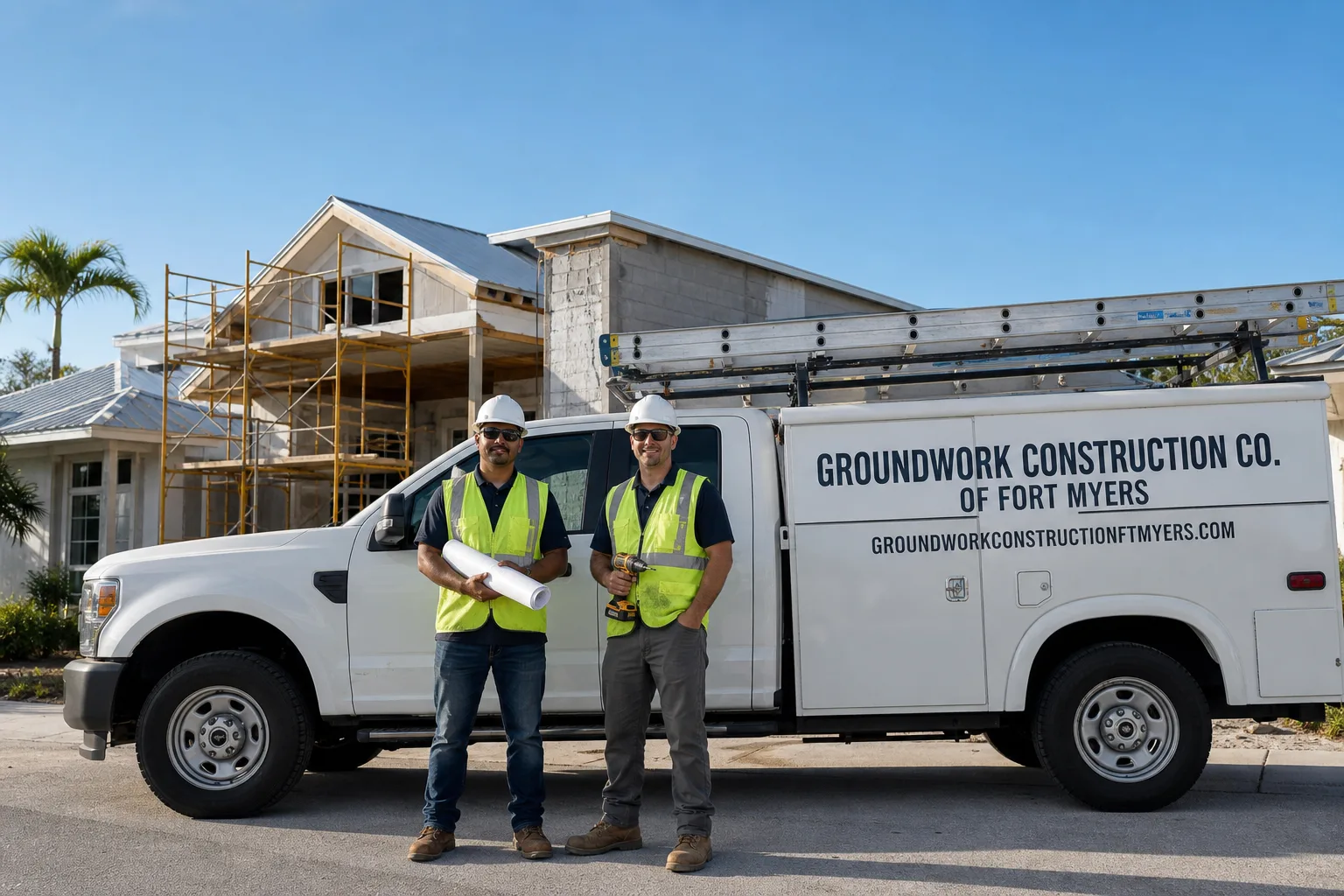
What a New Concrete Driveway in Port LaBelle Actually Costs and How Long It Takes
A concrete driveway installation in Port LaBelle, FL typically runs $4,500 to $12,000, with most standard two-car driveways landing around $6,800 to $9,500. The job takes five to seven working days from demolition to final cure, though the full timeline from permit application to driving on it stretches three to four weeks. Call (844) 638-7249 and we’ll give you a line-item quote for your specific lot - free, no strings. Because half the lots in Port LaBelle have never been built on, the real variables aren’t just square footage. They’re what’s under the grass.
How We Build a Concrete Driveway on a Port LaBelle Lot
Every Port LaBelle job starts with the ground itself. We don’t guess what’s down there and we don’t price a slab until we know. Here’s how it goes, stage by stage.
Stage 1: Site check and geotechnical call (Day 1, before the estimate is final). We walk the lot with a laser level and probe the soil. On the older paper-platted Port LaBelle parcels, we’re checking for silted-in swales, buried organic debris from decades of overgrowth, and the water table depth. If the lot sits in a FEMA flood zone, the slab elevation and any required flood venting get locked in here. This stage determines whether we can use a standard 4-inch slab on compacted base or whether we need to over-excavate and bring in engineered fill. You decide what you’re willing to invest in the base prep once we show you the numbers.
Stage 2: Demolition, clearing, and grade work (Days 2-3). If there’s an existing cracked slab or old asphalt, we saw-cut and remove it. On raw Port LaBelle lots, we grub out roots, strip topsoil, and cut the driveway subgrade to the design elevation. This is where the swale restoration piece often surfaces - if the county’s drainage swale along the road frontage has disappeared under ten years of weeds and silt, we coordinate regrading it before the slab inspection can be scheduled. You don’t always see that cost coming, but we flag it in the estimate so there’s no surprise.
Stage 3: Formwork, reinforcement, and base compaction (Day 4). We set wood or steel forms to the driveway perimeter, lay a compacted limestone base (typically 4 to 6 inches in Port LaBelle’s sandy-loam soils), and tie the rebar grid. For a standard residential driveway, we use #3 or #4 rebar on 18-inch centers. If the driveway will carry heavier loads - a boat trailer, an RV, a work truck - we tighten the grid and step up to a 5-inch or 6-inch slab thickness. You tell us how you’ll use the driveway and we size the steel accordingly.
Stage 4: Pour, finish, and control joints (Day 5 or 6). We order a 3,000 to 4,000 PSI mix from a local batch plant - in Port LaBelle’s heat, we typically spec a mid-range water reducer and a set-retarding admixture to keep the mud workable without adding water on-site. The finish you choose - broom, exposed aggregate, or smooth trowel - gets locked in before the pour. We cut control joints within 24 hours at intervals that follow the slab dimensions, not a guess. A driveway that cracks at the joint looks like good engineering; one that cracks across the panel looks like a mistake.
Stage 5: Cure, backfill, and final inspection (Days 7-14). Concrete needs seven days of moist curing to hit design strength in Port LaBelle’s climate. We keep the slab damp, schedule the county inspection, and then backfill the edges with clean fill and sod where needed. Hendry County will check slab elevation relative to the flood plain, swale function, and reinforcement before signing off. Once we pass, the driveway is yours to use - no waiting period beyond the standard cure.
This sequence isn’t a sales pitch. It’s the actual week-by-week reality of building concrete on undeveloped and semi-developed Port LaBelle parcels that haven’t seen a foundation in 50 years. If your lot is one of the built-out CBS-home parcels from the 1980s, the process often moves faster because the access, drainage, and soil compaction history are already established.
The Concrete and Finish Decisions You’ll Need to Make
You’ll make about four real choices on a Port LaBelle driveway pour. The rest is engineering and code compliance on our end. Here are the ones that affect the final look, performance, and price.
- Slab thickness: 4 inches is the residential standard and handles passenger vehicles without issue. If you park a loaded work truck or a 30-foot RV, we recommend 5 to 6 inches with a tighter rebar schedule. The material cost difference is real - expect the jump to add $1.50 to $2.50 per square foot - but so is the consequence of a cracked slab two years in.
- Finish type: A broom finish gives you a slip-resistant surface that handles Port LaBelle’s afternoon downpours well and costs the least. Exposed aggregate - where we wash the top layer of cement paste to reveal the stone - runs $2 to $4 more per square foot and gives a decorative look that hides minor surface imperfections. Smooth trowel looks clean but gets slick when wet; we generally steer pool decks and driveways away from it unless there’s a specific aesthetic reason.
- PSI and mix design: A standard 3,000 PSI mix works for most driveways. We often bump to 3,500 or 4,000 PSI when the soil report shows soft spots or when the driveway doubles as a turn-around for heavier vehicles. The upgrade adds roughly $10 to $15 per yard - a modest line item on a full driveway pour - and buys a meaningful margin against cracking in Port LaBelle’s shrink-swell soils.
- Cure method: We can wet-cure with periodic hosing (included) or apply a spray-on curing compound that seals moisture in (small adder). On Port LaBelle lots with no shade and full July sun, the compound is worth considering because it reduces the risk of surface crazing from rapid drying. We use products from Quikrete and Sakrete for cure-and-seal applications, selected based on the finish and exposure.
If your project is part of a wider property build-out - say a Driveway & Pavers in Port LaBelle scope that includes a paver patio or walkways - we coordinate the concrete pour so the elevations tie together on day one. Some homeowners pair the driveway with a Garage Conversion ADU in Port LaBelle or a New Detached ADU in Port LaBelle, which means sequencing the slab alongside foundation work. That’s standard for us; it changes the schedule but not the quality.
What Concrete Driveways & Concrete Work Costs in Port LaBelle, FL
A concrete driveway installation in Port LaBelle runs $4,500 to $12,000. Most standard two-car driveways (roughly 400 to 600 square feet) land between $6,800 and $9,500, which includes demolition of any existing slab, base prep, 4-inch reinforced concrete, broom finish, and control joints. Here are the variables that push a job toward the low or high end of that range.
Lot condition and accessibility. A cleared, level lot with easy street access and an intact drainage swale sits at the bottom of the price curve. A raw paper-platted Port LaBelle lot with overgrown vegetation, a missing swale, and a water table two feet down requires more excavation, possible engineered fill, and swale restoration coordination - all of which add cost before the first yard of concrete arrives.
Slab dimensions and reinforcement. A 400-square-foot driveway at 4 inches thick with standard #3 rebar is the baseline. Every additional 100 square feet adds material and labor proportionally. Bumping to a 6-inch slab with #4 rebar on 12-inch centers for RV parking can add $2 to $3 per square foot. The square footage drives the concrete yardage; the reinforcement drives the labor and inspection scope.
Existing demolition. If there’s an old concrete slab or asphalt driveway to remove, figure $1.50 to $3 per square foot for saw-cutting, breaking, and haul-off. Trees or large roots in the driveway footprint add clearing time and sometimes require stump grinding, which is a separate line item on our estimate.
Finish and detail upgrades. A basic broom finish is included. Exposed aggregate, integral color, stamped patterns, or a decorative border all add $2 to $8 per square foot depending on complexity. These are aesthetic choices that don’t affect structural performance but do change the curb appeal significantly on Port LaBelle’s residential streets.
Permit, inspection, and swale costs. Hendry County permit fees are project-specific, but the hidden variable in Port LaBelle is the swale restoration review. If the county requires the drainage swale to be regraded and re-sodded before the slab inspection, that’s typically a $500 to $2,000 pre-construction expense depending on the frontage length and how far the swale has degraded. We include a swale-check line in every Port LaBelle estimate because we’ve learned the hard way not to assume it’ll pass.
Every estimate we write is line-item and fixed. You’ll see the concrete yardage, the rebar schedule, the base depth, the demo cost, and any swale or permit line items broken out separately. What’s not in the number: change orders that show up mid-job because we didn’t check something upfront. The 730-Day Done Right Promise covers the workmanship; the upfront pricing covers your budget.
Why Port LaBelle’s Paper-Platted History Changes How We Pour Concrete
Port LaBelle is not a typical Southwest Florida suburb. General Development Corporation platted thousands of lots here in the 1970s, built roads and drainage infrastructure on paper, and then never built the houses. Half a century later, contractors in Port LaBelle are breaking ground on parcels where the drainage swale along the street has silted into a shallow depression, the buried utility stub - if it exists - is corroded or abandoned, and the soil compaction history is zero. Every driveway we pour here starts with a site investigation that would be overkill in Fort Myers or Cape Coral. It’s not overkill here.
Hendry County permitting triggers a swale restoration review on many of these long-dormant lots. Before the slab inspection passes, the frontage swale has to be graded to the county’s original design elevation and stabilized. That’s a cost and a scheduling step that’s almost unique to Port LaBelle among the markets we serve. The water table sits within two to three feet of grade across much of the Caloosahatchee floodplain here, which means our base compaction and slab elevation decisions are driven as much by hydrology as by the driveway layout. We build the slab high enough to keep it dry through a summer of afternoon storms and low enough to meet the county’s flood-plain elevation requirements. That balance is local knowledge, not a textbook formula.
The housing stock tells the same story in a different way. On streets where one lot has a 1980s CBS ranch and the next lot is untouched scrub, the soil conditions change literally from one property line to the next. We’ve poured driveways on Port LaBelle streets where the adjacent parcel had five feet of compacted structural fill from a 1985 build, while the customer’s lot was uncompacted native sandy loam with 18 inches of organic muck. We caught the difference with a probe rod in ten minutes. If the estimate had been written without that step, the slab would have failed within three years. Our Driveway & Pavers crew treats every Port LaBelle lot as its own engineering problem because, in this subdivision, that’s exactly what it is.
Serving Port LaBelle, FL - Our Local Coverage Area
We’re based in the Port LaBelle area and know this community well. Use the map below to see our service coverage - if you’re nearby, we can almost certainly help.
Frequently Asked Questions About Concrete Driveways in Port LaBelle
The physical pour and finishing work runs five to seven working days. From permit submittal to driving on the slab, expect three to four weeks total. Hendry County permit review, swale inspection coordination, and the seven-day concrete cure cycle are the longest-duration items. We handle the permit package and schedule the inspections so you’re not chasing the county yourself.
Yes. Any new concrete driveway or full replacement in Port LaBelle requires a Hendry County building permit, and the inspection will check slab elevation relative to the flood plain, reinforcement, and drainage swale function. We pull the permit, schedule the inspections, and make sure the work passes on the first visit. Skipping the permit risks a stop-work order and a tear-out - it’s not worth the shortcut.
We almost never recommend pouring over an existing slab in Port LaBelle. The old slab’s cracks telegraph through the new pour within a year or two, and the added thickness changes the driveway elevation relative to the garage floor and the street swale. The right approach is demolition, base prep, and a single monolithic pour. We include demolition in the standard price when there’s existing concrete to remove.
Every concrete driveway we pour is covered by our 730-Day Done Right Promise. If something isn’t right - cracking beyond the control joints, settling, or finish defects - we make it right. That’s two full years of workmanship coverage, which is one of the longest guarantees you’ll find in residential concrete in Port LaBelle. The concrete itself is spec’d to last decades with normal use.
For a standard 4-inch reinforced driveway with broom finish, expect $8 to $14 per square foot, including demo, base prep, concrete, rebar, finishing, and control joints. The range tightens or widens based on access, swale work, and finish upgrades. Call (844) 638-7249 for an exact number on your specific lot - we’ll walk it, probe it, and price it in writing.
Get a Line-Item Concrete Driveway Estimate in Port LaBelle
If you’re on a Port LaBelle lot - built or raw - and you’re ready to price a concrete driveway, call (844) 638-7249. We’ll schedule a site visit, probe the soil, check the swale, and hand you a fixed-price estimate that breaks out every line item. No deposit required for the estimate, and a live person answers the phone. We serve all of Port LaBelle - from the older built-out streets to the paper-platted parcels that haven’t seen a foundation in 50 years.
Written by Derek Hollenbeck, Owner at Groundwork Construction Co., bringing straight answers and fixed pricing to Port LaBelle homeowners.