
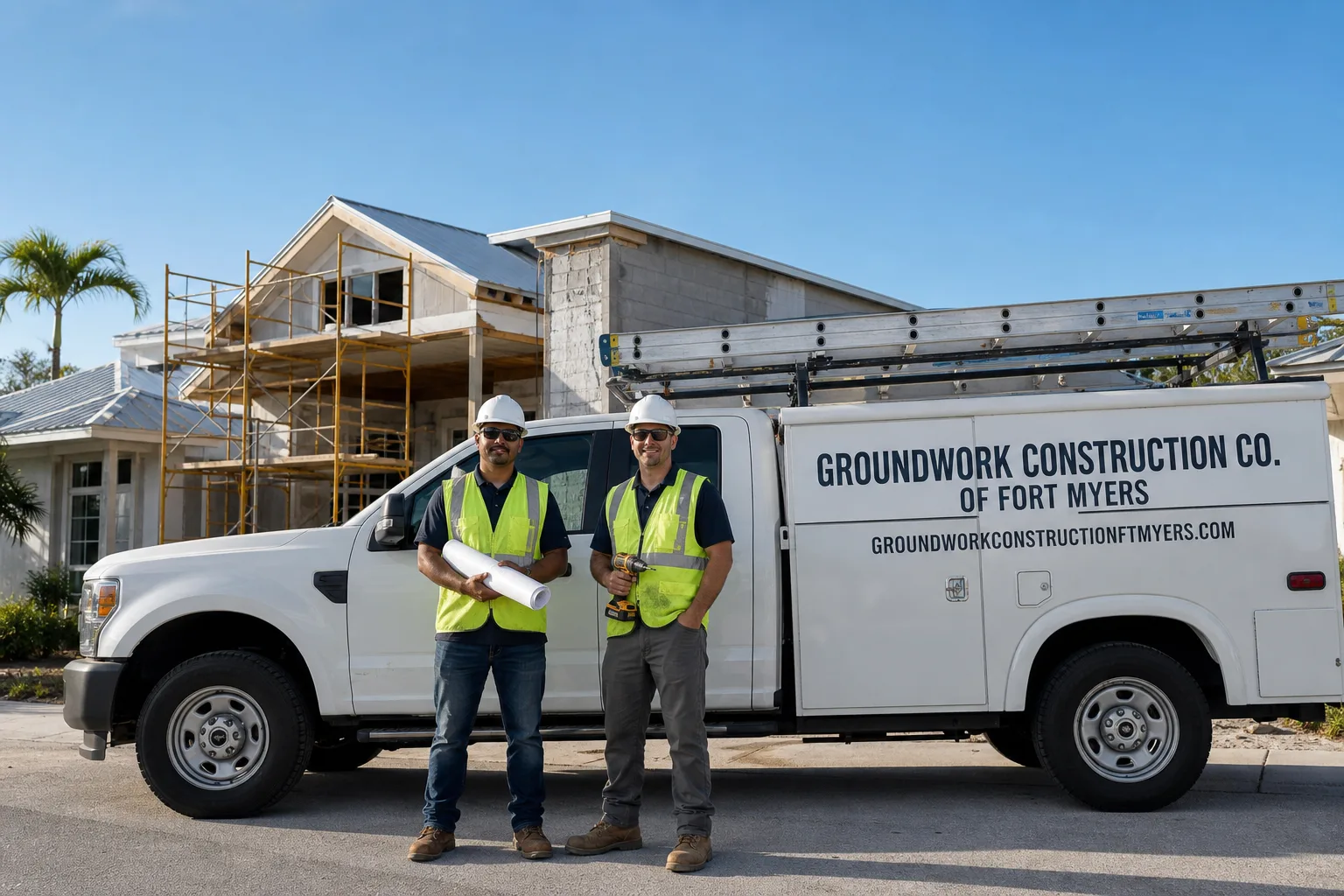
What Concrete Driveways & Concrete Work in Punta Gorda Isles Really Takes
A new concrete driveway in Punta Gorda Isles runs $4,500-$12,000 for a standard residential pour, with most jobs finishing in 5-10 working days from demolition to cure. That’s not a guess, it’s where the numbers land across the hundreds of driveways we’ve poured in this community. Call (844) 638-7249 for a written, line-item estimate that holds firm once we walk your property. Concrete work here isn’t the same as concrete work twenty miles inland. The salt air, the high water table, the soil conditions on these canal lots, and the post-Charley code requirements all shape how we approach every pour. A driveway that lasts thirty years in Port Charlotte can spall and crack in fifteen out here if the mix, the sub-base, and the reinforcement aren’t specified for this exact environment.
How We Pour a Concrete Driveway in Punta Gorda Isles, Start to Finish
There’s a real sequence to this, and knowing it helps you plan. Here’s what happens on a typical residential concrete driveway replacement or new pour in Punta Gorda Isles.
Stage 1: Demolition and site inspection (day 1). If there’s an existing slab, we saw-cut it into manageable sections and haul it away. This is also when we check what’s underneath. In Punta Gorda Isles, that matters more than most places. The older canal-adjacent lots often have decades of organic fill that settled unevenly, or sandy subsoil that’s been moving with the tidal groundwater for forty years. We’ll probe and sometimes dig a small test hole to see what we’re building on before we commit to a base design. If the existing driveway failed because the sub-base washed out, we need to know that now, not after we pour.
Stage 2: Sub-base preparation (days 2-3). We excavate to a minimum depth, usually 6-8 inches below the finished slab elevation, then compact a layer of crushed limestone or gravel. On Punta Gorda Isles lots where the water table sits just a few feet down, we often go thicker on the base and specify a coarser aggregate that drains better than standard road base. This is the part of the job nobody sees, and it’s the part that determines whether your driveway still looks new in year ten. We compact in lifts, not all at once, and we check grade repeatedly. The slope has to move water away from the house and toward the street or canal-side storm drains, and on flat canal-front lots that takes some finesse.
Stage 3: Forming and reinforcement (days 3-4). We build wood forms to the exact dimensions and layout you approved. Then we install steel reinforcement, typically a grid of #4 rebar on 18-inch centers, tied and chaired so it sits in the middle of the slab, not on the bottom. For driveways that will carry heavy vehicles or where the sub-base is less stable, we may move to a tighter grid or specify a higher-strength mix. The forms also set the control joints. We cut or tool those joints at specific intervals to manage where the concrete cracks, because it will crack. What you want is for it to crack where you planned it to, in a straight line you can’t see from the street.
Stage 4: The pour and finish (day 4 or 5). Concrete arrives in a ready-mix truck, and we place it, screed it level, and float it. Then we apply the finish texture you chose: broom finish for grip on a flat canal-front drive, a light salt finish for some texture without looking aggressive, or exposed aggregate if you want the stone to show. Timing on the finish is everything in Florida. The heat and humidity in Punta Gorda Isles accelerate the set, so our finishers work fast and watch the bleed water closely. A rushed finish blisters. A late finish won’t close the surface properly. We’ve done enough pours on these streets to know the window.
Stage 5: Curing, sealing, and final walk (days 5-10). Concrete cures chemically, not by drying out, so we keep it moist for the first several days with a curing compound or occasional misting. We’ll apply a penetrating sealer once it’s cured, usually around day 7. That sealer is non-negotiable in Punta Gorda Isles. The salt spray off the canals, the rain, and the UV all work on unsealed concrete fast. Once the sealer is down, we walk the job with you to confirm the slope drains correctly, the joints are clean, and the finish matches what we agreed on. You make one decision at this stage: whether you want us to apply a second coat of sealer in a year, or whether you’ll handle that maintenance yourself.
The Choices You’ll Make Before We Pour
You’re not just picking “concrete.” You’re making four or five real decisions that change how the driveway looks, performs, and holds up over time. Here are the main ones, with the honest trade-offs of each.
- Broom finish vs. exposed aggregate. Broom finish is the standard: a light texture dragged across the surface for grip. It’s clean, simple, and costs the least. Exposed aggregate reveals the stone in the mix by washing away the top layer of cement paste. It hides stains better and gives a higher-end look, but it costs more per square foot and can feel rougher under bare feet. Both hold up fine in Punta Gorda Isles when properly sealed.
- Standard 4-inch slab vs. thickened or reinforced. A standard 4-inch slab with rebar handles passenger vehicles without issue. If you park a heavy pickup, an RV, or a boat trailer on the driveway regularly, we recommend stepping up to a 5- or 6-inch slab or adding a fiber reinforcement to the mix. Most Punta Gorda Isles homeowners own a boat or a trailer, so this comes up often.
- Straight control joints vs. decorative saw-cut patterns. Every concrete slab needs joints to manage cracking. Standard straight joints are tooled into the wet concrete and run in a grid. Saw-cut joints let us create squares or rectangles that look intentional, almost like a tile floor. The difference is aesthetic, not structural, and saw-cutting adds a modest cost.
- Integral color vs. natural gray. We can mix pigment into the concrete at the plant for a consistent earth tone that won’t fade or peel. Natural gray is timeless and costs less. Colored concrete costs more upfront but hides tire marks and canal-side grime better. We use Quikrete and Sakrete color systems when tint is specified.
- Sealer type. We apply a high-solids acrylic sealer as standard because it penetrates and protects without creating a surface film that gets slippery when wet. A film-forming sealer gives a glossier look but can peel in the Florida sun if not maintained every couple of years. We’ll walk you through both before you decide.
What Concrete Driveways & Concrete Work Costs in Punta Gorda Isles, FL
A concrete driveway installation in Punta Gorda Isles runs $4,500-$12,000 for a typical two-car residential pour. A short single-car driveway on a smaller canal lot can land around $4,500. A long, wide driveway with decorative finishes, a thickened edge, and exposed aggregate can reach the upper $11,000s. Most jobs in this community settle between $6,000 and $9,000.
What pushes the number one direction or the other comes down to five variables. Square footage is the biggest driver: more concrete, more money. Access matters a lot on Punta Gorda Isles lots, where many driveways sit tight between a seawall and a house with narrow side yards. If the concrete truck can’t pull right up to the pour site, we have to wheelbarrow or pump the mix, and that adds labor and sometimes equipment cost. The condition of the existing base is the wild card. If the old driveway was poured directly on uncompacted fill that’s been settling for decades, we may need to over-excavate and bring in more stone than the typical 6-inch base. Decorative finishes, added thickness, and integral color each add per-square-foot cost. And finally, demolition of the old slab. Thick slabs or slabs with wire mesh take longer to cut and haul, and disposal fees in Charlotte County factor in.
Every estimate we write is line-itemed. You’ll see exactly what the concrete costs, what the base prep costs, what the finish costs, and what the sealer costs. No lump-sum number with a handshake. The estimate includes all labor, materials, demolition, hauling, base prep, reinforcement, pour, finish, sealer, and cleanup. It does not include any landscape repair beyond the immediate pour area, and it doesn’t include the cost of permit fees, which we pull on your behalf and pass through at cost.
What Punta Gorda Isles Specifically Does to a Concrete Driveway
The salt air moving off those 55-plus miles of navigable canals isn’t just a postcard backdrop, it’s an active corrosive force on everything built near it. Concrete here absorbs airborne salt, which accelerates the rusting of embedded rebar and leads to spalling, where chunks of the slab face pop off. That’s why we specify a higher cement content in our mix designs for Punta Gorda Isles pours and why we use only epoxy-coated or stainless-tied rebar on canal-front properties. Standard black rebar tie wire rusts through within a few years in this environment, and once the ties go, the rebar grid loses its structural connection.
The housing stock plays in too. Most homes in Punta Gorda Isles are concrete-block construction built between the 1960s and 1990s, with a significant number rebuilt after Hurricane Charley’s 2004 direct hit. When we pour a new driveway on a home that was rebuilt post-Charley, we’re typically working against the current Florida Building Code elevation requirements and wind-load standards. When we pour on an original 1970s home that’s never been substantially renovated, we sometimes find the existing slab was poured at grade with no slope away from the structure, which means we’re correcting drainage as part of the new pour. The two scenarios demand very different prep work, and we’ve done both often enough to know the difference the moment we walk the site.
Permitting here goes through Charlotte County, and a concrete driveway replacement in Punta Gorda Isles that doesn’t change the footprint usually moves through as a straightforward permit. New pours, expansions, or any work within the canal setback easement can trigger additional review. We handle the permit from application to final inspection, and we know what the county plans examiners look for on a driveway submittal in this specific zip code.
If you’re planning a wider property overhaul, our Driveway & Pavers in Punta Gorda Isles work often ties directly into the concrete phase. We’ll coordinate the pour so it aligns cleanly with any paver walkways, patios, or pool decks. We work across the full scope, which is how we avoid the “two contractors, two schedules, one mess” problem homeowners hate. And for homeowners who need more space than a driveway reconfiguration can provide, we’ve seen Punta Gorda Isles clients pair this with a Garage Conversion ADU in Punta Gorda Isles or a New Detached ADU in Punta Gorda Isles when the long-term plan is multi-generational living or rental income on a canal-front property. Our Driveway & Pavers team can walk you through how all the pieces fit.
Serving Punta Gorda Isles, FL - Our Local Coverage Area
We’re based in the Punta Gorda Isles area and know this community well. Use the map below to see our service coverage - if you’re nearby, we can almost certainly help.
Frequently Asked Questions About Concrete Driveways in Punta Gorda Isles
Most concrete driveway installations in Punta Gorda Isles take 5-10 working days. Demolition and base prep eat up the first two to three days, forming and reinforcement take a day, the pour and finish happen on day four or five, and the concrete needs three to five days of curing before we seal it and you can park on it. Weather can shift the schedule. A week of afternoon thunderstorms, which we get often here in summer, means we may push the pour a day to avoid finishing in the rain.
Yes. Charlotte County requires a permit for new concrete driveway installations and for replacements that alter the footprint or elevation. We pull the permit as part of the job, and the cost passes through to you at the county’s fee schedule rate. The inspection happens after the forms and reinforcement are in place but before the pour, then again after completion. We schedule both. Call (844) 638-7249 and we’ll outline the exact permit path for your property.
Yes, all concrete cracks. What we control is where it cracks. We install control joints, which are planned weak points in the slab, at specific intervals so the inevitable cracks happen inside those joints, not randomly across the surface. We also use steel reinforcement to hold the slab together and prevent vertical displacement if a crack does form. A properly jointed and reinforced driveway in Punta Gorda Isles will crack in ways you can’t see from ten feet away. We warranty our workmanship for 730 days under our Done Right Promise, and we stand behind the joint layout we design.
We can get close on color and finish, but a perfect match between new and old concrete is not realistic. Existing concrete has years of UV exposure, salt air weathering, and wear that change its color and surface. We’ll match the finish texture, broom stroke direction, and joint pattern. If you want the driveway and patio to read as one unified surface, replacing both at the same time or considering a Driveway & Pavers in Punta Gorda Isles approach with pavers that tie the spaces together is worth discussing.
All our work is covered by the Groundwork Construction Co. 730-Day Done Right Promise. If something isn’t done right, we make it right. For concrete specifically, that covers the structural integrity of the slab, the finish, and the joint performance. It does not cover normal surface wear, staining from vehicle fluids, or hairline shrinkage cracks that are cosmetic and expected in any concrete pour. We’ll explain exactly what’s covered before we start, in writing, so there’s no ambiguity later.
Get a Concrete Driveway Estimate in Punta Gorda Isles
Call (844) 638-7249 to schedule a free on-site estimate for your concrete driveway or concrete work in Punta Gorda Isles. One of our background-checked estimators will walk the property, take measurements, check the sub-base conditions, and hand you a written quote that breaks down every dollar. No pressure, no same-day close pitch, just the real numbers and a plan. Estimates are free, and someone answers the phone when you call.
Written by Derek Hollenbeck, Owner at Groundwork Construction Co., serving Punta Gorda Isles through our Fort Myers office.