
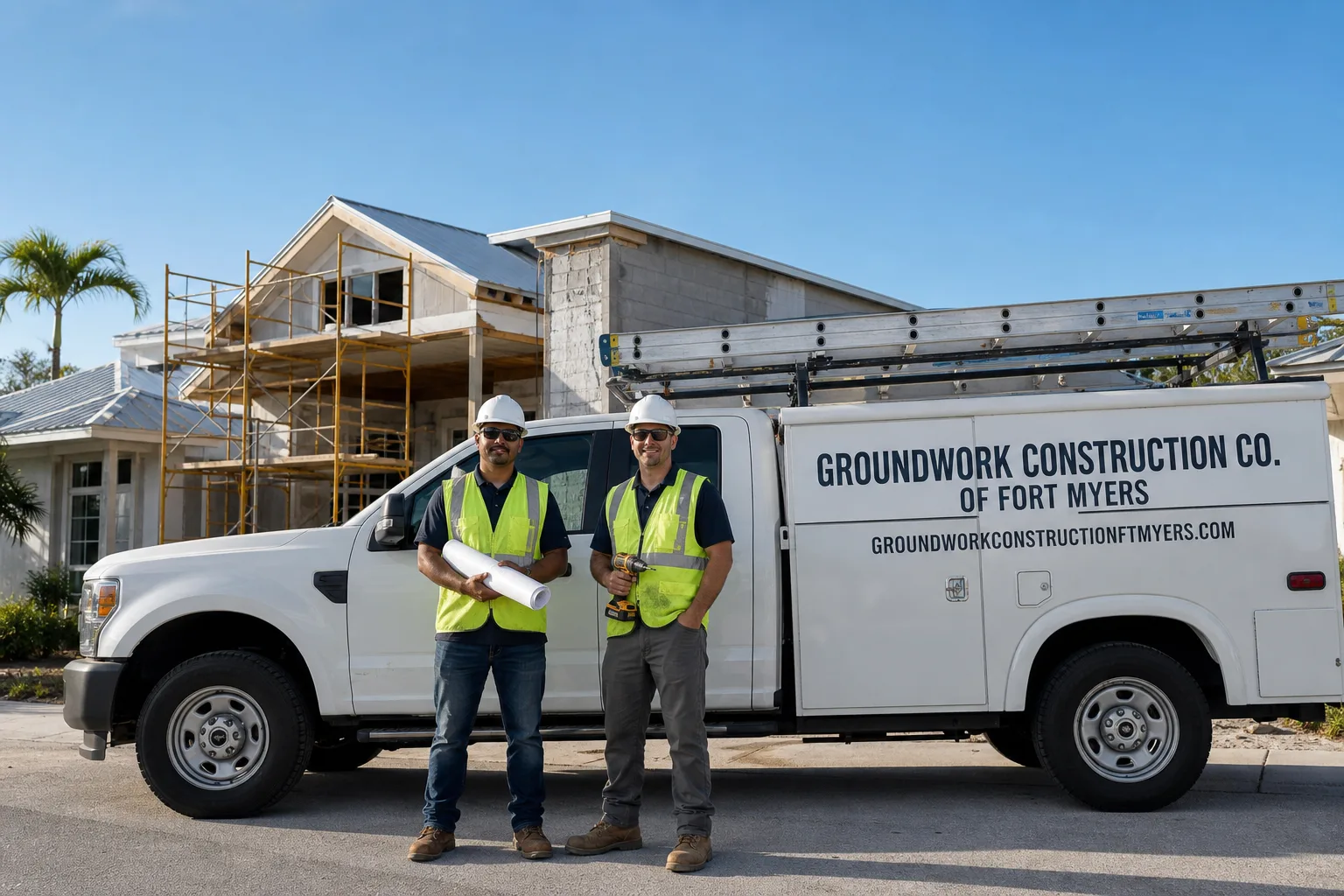
What Concrete Driveways & Concrete Work Actually Looks Like in Vineyards, FL
A new concrete driveway in Vineyards typically costs $4,500-$12,000 and takes 5 to 10 days from demolition to drive-on ready, depending on square footage, site access, and what the Architectural Review Board requires. Most jobs here involve tearing out a cracked, 30-year-old slab on a CBS home built between 1988 and 1998, then pouring a reinforced replacement that meets current Florida Building Code wind-mitigation and drainage standards. We answer the phone at (844) 638-7249 and can walk you through what your specific street and setback will need before you spend a dime.
How We Pour a Concrete Driveway That Lasts in This Part of Collier County
Every concrete driveway in Vineyards follows the same basic sequence, but the wet-season water table and the Community Association’s inspection checkpoints mean we don’t skip steps that crews from Lee County sometimes overlook. Here’s the actual rhythm of the job.
Stage 1: ARB submission and Collier County permit routing (1-3 weeks, we handle it)
Before a shovel hits the ground, your project needs written approval from the Vineyards Community Association’s Architectural Review Board. We submit the finish sample, the site plan showing setbacks and drainage flow, and a color swatch from the approved palette the Association maintains. Collier County won’t issue the permit until the ARB sign-off letter is in hand, so we batch both submissions together. You’ll make exactly two decisions here: the slab finish (broom, exposed aggregate, or a light salt finish) and whether to extend the pour to a side walkway that connects to your lanai or pool deck.
Stage 2: Demo and base prep (1-2 days)
The old slab comes out with a skid steer and a breaker attachment. On Vineyards lots where the water table sits less than three feet down, we check the sub-base moisture immediately after demolition. If the muck layer is wetter than optimal, we over-excavate by four to six inches and build back up with compacted limerock to give the new slab a dry, stable bearing surface. This is the step that determines whether your driveway stays flat for ten years or starts heaving after two rainy seasons.
Stage 3: Forming, reinforcing, and the pre-pour walkthrough (1 day)
We set wood forms at the final grade, tie #4 rebar on a 16-inch grid, and call you out for a five-minute walkthrough before the concrete truck arrives. You’ll confirm the shape, the thickness (4 inches minimum, often 5 on RV pads or circular drives), and exactly where the control joints will be cut. If your HOA requires a specific ribbon-curb profile or a particular gutter tie-in, we verify that against the approved drawings right then.
Stage 4: The pour and finish (1 day)
The truck shows up early, usually by 7:00 a.m., and the crew places, levels, and finishes the slab in a single long day. We pour at a 3,500 PSI mix with a water-reducing admixture, which gives you a denser surface than the standard 3,000 PSI mix many production builders used in the 1990s. The finish you chose at the ARB stage gets applied while the concrete is still plastic: a broom finish for grip, exposed aggregate if you want a decorative look, or a light salt finish for something in between. Edges get a half-inch radius tool joint so they resist spalling.
Stage 5: Cure, cut, seal, and final sign-off (3-5 days)
We cut the control joints within 24 hours using a soft-cut saw to prevent random cracking, then apply a penetrating silane sealer after a three-day minimum cure. You can walk on the slab the next morning; we ask you to keep vehicles off it for five full days. The last step is a final drive-by with the ARB contact if they want one, plus a copy of the Collier County inspection sign-off for your records. From first call to cars on the slab, you’re looking at three to five weeks total, with most of that in the ARB and permit pipeline.
The Concrete Choices That Actually Matter for a Vineyards Driveway
Concrete isn’t just concrete, and the decisions you make now determine whether the slab still looks good when your roof hits its 15-year replacement mark. Here are the real options, with the trade-offs we talk through on every estimate.
- Finish type: broom, exposed aggregate, or salt finish. Broom finish is the most common and the most affordable, providing good slip resistance with almost no upkeep. Exposed aggregate, using a pea-gravel or crushed-shell mix from a local batch plant, adds color and texture and runs $2-$4 more per square foot, but it’s harder to patch cleanly if a section ever needs repair. A light salt finish splits the difference: some texture, no exposed stone, and it hides tire marks better than a slick trowel.
- PSI and mix design. We pour driveways at 3,500 PSI minimum, which is a step above the standard 3,000 PSI residential spec. In Vineyards, where summer storms dump two inches of rain in an afternoon and standing water is common on flat lots, the denser mix reduces surface absorption and slows the tiny crack propagation that turns a hairline into a spall. A fiber-mesh additive costs about $0.50 per square foot extra and serves as secondary reinforcement, which helps if the sub-base shifts slightly during the wet-dry cycles Collier County sees every year.
- Thickness and reinforcement. Four inches is the residential standard and what most HOA-approved drawings will specify. If you park a heavy pickup, a large SUV, or an RV, we recommend going to five inches in those load zones and tightening the rebar spacing to 12 inches on center. It adds maybe $1.50 per square foot to that section, but it eliminates the flex that eventually cracks a thinner slab under repeated weight.
- Curbing and drainage tie-ins. Many Vineyards homes have a ribbon curb along the driveway edge or a shallow swale that carries runoff toward the street. If we’re replacing a slab that currently drains toward the house (a common problem on lots that have settled over 30 years), we’ll regrade the base so water sheets toward the curb line or into a channel drain cut across the driveway apron. That channel drain, if required, adds $600-$900 to the job and avoids ponding against the garage slab.
What Concrete Driveways & Concrete Work Costs in Vineyards, FL
A standard two-car concrete driveway replacement in Vineyards runs $4,500-$7,500. A larger circular driveway, an RV pad extension, or a full wraparound that ties into a side-entry garage pushes the job into the $9,000-$12,000 range. The price per square foot, all-in with demo, base prep, rebar, pour, finish, and sealer, falls between $9 and $14 depending on the variables below.
The four things that move the number the most: first, the size of the pour (square footage is the largest cost driver, full stop). Second, the condition of the sub-base after demo: if the existing slab was thin and poorly reinforced and the soil underneath is saturated or rutted, the over-excavation and limerock fill add a day of labor and several hundred dollars in material. Third, the finish: broom is baseline, exposed aggregate adds $2-$4 per square foot, and any integral color from a supplier like Davis Colors pushes the material cost higher. Fourth, whether the job requires a channel drain, a new culvert, or a tie-in to an existing paver walkway or lanai deck. Those edge details are common in Vineyards and each one is a line item on the estimate.
Every written estimate we give you breaks out the line items: demo and haul-off, base prep, forming and steel, concrete and placement, finish, jointing, sealer, and any drainage work. There’s no lump-sum mystery number. We include the Collier County permit fee and the ARB submission package. The only thing typically not included is landscaping repair beyond the immediate pour zone-if we need to remove a section of sod to stage equipment, we’ll level and prep the area, but replanting is on you unless we agree to it upfront. Call (844) 638-7249 and we’ll put a fixed-price estimate together, usually within two business days of walking the site.
What Vineyards Homes Specifically Do to a Concrete Driveway Job
Vineyards is a master-planned, HOA-governed golf community where most homes were built between the late 1980s and late 1990s. Those CBS homes are now 25 to 35 years old, and their original concrete driveways are showing it: alligator cracking from thin pours over poorly compacted fill, spalling edges from decades of pressure-washing, and slabs that have settled enough to direct rainwater toward the garage instead of the street. Every exterior project here, including a driveway replacement, has to clear the Vineyards Community Association’s Architectural Review Board before Collier County issues a permit. That’s a dual-approval sequence that out-of-area crews routinely underestimate, and it’s why we plan for a three-week front-end window before demolition even starts.
The water table in this part of Collier County sits close to the surface, which means any excavation deeper than about 18 inches can hit saturated soil quickly. We’re used to it. We check the base moisture, over-excavate when necessary, and build the sub-base back up with compacted limerock so the slab has a dry platform. We’ve also replaced enough driveways on streets like Vineyards Boulevard and Arbor Lake Drive to know which lots have natural drainage toward the rear of the property and which ones need a channel drain cut across the apron to move stormwater away from the house. The ARB has a specific, narrow set of approved colors and finishes, and we bring the physical sample to the estimate so you’re not guessing what passes.
A concrete driveway replacement here often pairs with other exterior upgrades homeowners are tackling to satisfy Florida’s hardening insurance requirements. We see a lot of driveways getting replaced alongside a roof overlay or new impact windows - and sometimes homeowners use the driveway teardown as the moment to run conduit for a future detached structure. If you’re thinking bigger, our team handles Garage Conversion ADU in Vineyards projects and New Detached ADU in Vineyards builds, and we can coordinate the site work so the slab pour accounts for what might come later. For the full exterior scope, see our Driveway & Pavers in Vineyards page. And our Driveway & Pavers crew works with the same upfront pricing and 730-Day Done Right Promise as every other trade under our roof. We cover all of Vineyards, including the coach home communities and the single-family sections around the country club.
Serving Vineyards, FL - Our Local Coverage Area
We’re based in the Vineyards area and know this community well. Use the map below to see our service coverage - if you’re nearby, we can almost certainly help.
Frequently Asked Questions About Concrete Driveways & Concrete Work in Vineyards
On-site work takes five to ten days: one to two days for demolition and base prep, one day for forming and reinforcing, one day for the pour and finish, and three to five days of cure time before vehicles can drive on it. The longer lead time is the permit and ARB approval window, which typically takes one to three weeks depending on the Association’s meeting schedule and Collier County’s permit turnaround.
Yes. Collier County requires a permit for any driveway replacement that involves demolition and a new pour. Before the county will issue that permit, the Vineyards Community Association’s Architectural Review Board must approve the project, including the finish, color, and site plan showing drainage. We manage both submissions for you and the permit fee is included in our estimate. Call (844) 638-7249 and we’ll start the paperwork.
It won’t change unless you ask us to change the scope. We write fixed-price estimates with line items for every stage, and the number you sign off on is the number you pay. The only scenario where a change order comes up is if we demo the old slab and find a buried issue nobody could have seen, like a collapsed drainage pipe or a void under the garage apron that needs structural fill. If that happens, we stop, show you what we found, and give you a separate price to address it before we proceed. No surprise invoices at the end.
A broom finish gives you the best combination of slip resistance, durability, and easy maintenance in Vineyards’ wet-dry-wet climate. It hides minor surface imperfections and doesn’t require resealing more than once every two to three years. Exposed aggregate looks sharper and adds texture but costs more and can be harder to patch cleanly if a section ever settles. A salt finish is the middle ground: some texture, no exposed stone, and it holds up well under the intense summer sun without showing tire marks the way a slick trowel finish will.
We can, and we typically use integral color from a supplier like Davis Colors to get the slab tone close to existing pavers, walkways, or a pool deck. We’ll bring sample chips to the estimate and you’ll approve the batch ticket before the pour. Keep in mind that integrally colored concrete will lighten as it cures and will weather over time, so it won’t stay an exact match forever. For a precise long-term match, some homeowners choose to do the driveway and a side walkway or patio in the same pour so everything weathers together. If that broader scope interests you, our Driveway & Pavers in Vineyards page covers the full range.
Get a Fixed-Price Estimate for Your Vineyards Concrete Driveway
We’ll walk your property, talk through finishes and drainage, and hand you a line-by-line written estimate that spells out exactly what the job costs and how long it takes. No pressure, no vague numbers, and no voicemail. Call (844) 638-7249 to schedule a free on-site estimate for concrete driveway work in Vineyards. Derek and the team handle everything from the ARB submission to the final Collier County sign-off, and every pour is backed by our 730-Day Done Right Promise.
Written by Derek Hollenbeck, Owner at Groundwork Construction Co., serving Vineyards and Collier County with upfront pricing and a workmanship guarantee you can actually hold us to.