
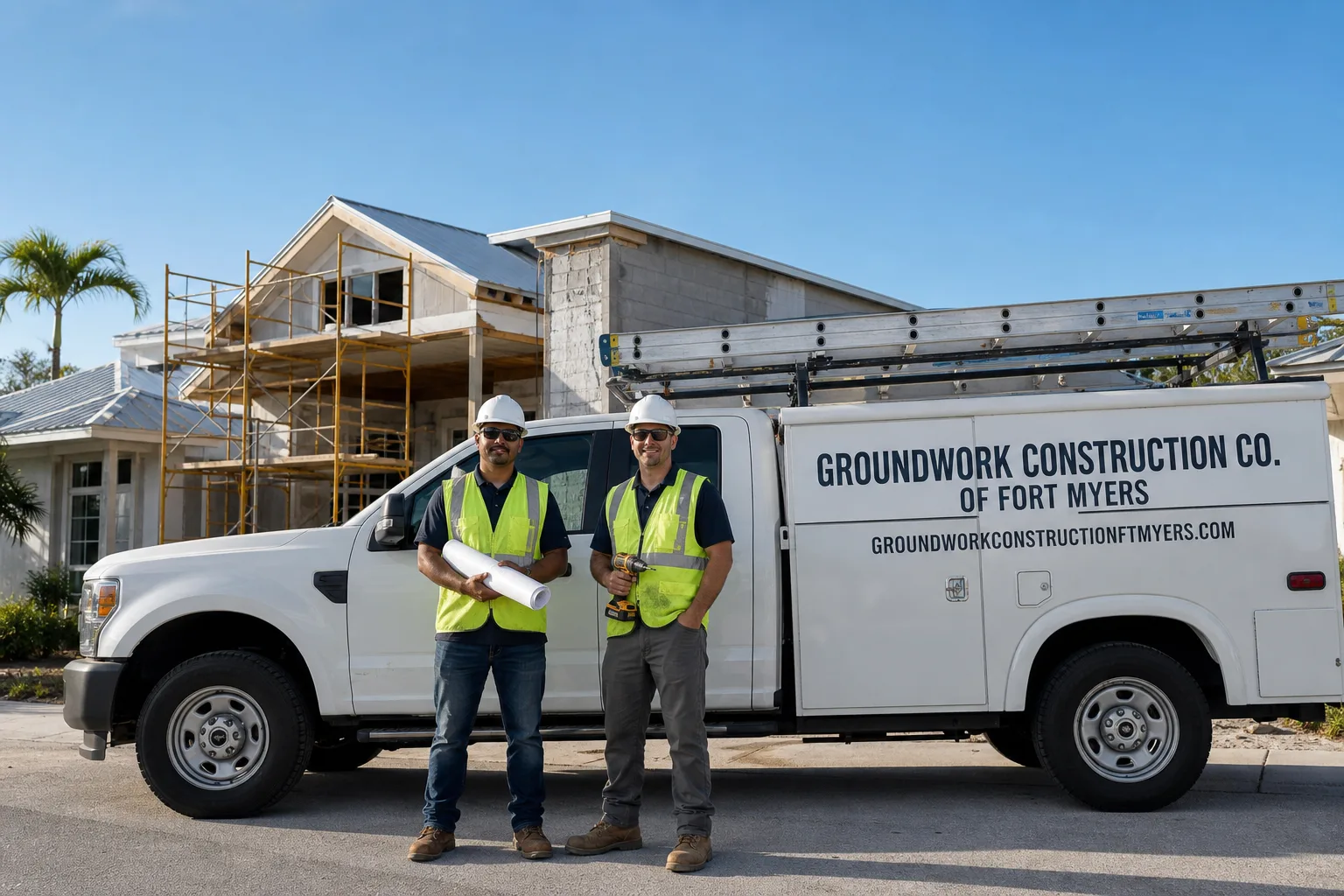
What Emergency Storm Damage Repairs Actually Take in Island Walk
Emergency storm damage work in Island Walk typically runs $1,500-$12,000 depending on what the storm hit, and the first priority is always a temporary tarp or board-up, done within hours of your call to (844) 638-7249. For most wind-driven roof damage, we can have a crew on-site the same day to stop water coming in, and the permanent repair follows once materials arrive and permits clear. The real variable is whether the damage is surface-level, like missing shingles or displaced ridge vents, or structural, where trusses or the roof deck took a hit.
How we move from emergency to permanent repair
There’s a real sequence here, and knowing it helps you see why some steps can’t be skipped. We’ve worked through enough Island Walk storms to know when a fast patch holds and when the whole section needs to be stripped back.
Stage 1 - The immediate call and assessment. You call (844) 638-7249, a live person answers, and we dispatch a crew lead to your home. They arrive in a marked vehicle, uniformed, and do a ground-level and drone inspection of every surface the storm touched. This takes 30-45 minutes. You get photos, a written scope, and a tarp or board-up plan right there. No waiting until Monday.
Stage 2 - Temporary stabilization. Same visit, we install heavy-duty tarps with furring-strip anchors or screw-in board-ups over broken windows and door openings. The goal is simple: stop water, stop pests, stop further loss. This holds for weeks if needed and satisfies your insurer’s mitigation requirement. You sign a service authorization after seeing the stabilization plan and the upfront price.
Stage 3 - The permanent repair scope and estimate. Within a day or two, we deliver a line-item estimate for the permanent fix. This is where the real decisions happen. You’ll see separate line items for decking replacement, underlayment, shingles or tile, flashing, and any fascia or soffit work. We walk you through what insurance is likely to cover and what falls under your deductible. The estimate is free, and you’re under no pressure to proceed with us, though most homeowners do once they see it broken down plainly.
Stage 4 - Permitting and material ordering. For any work beyond a simple shingle patch in Island Walk, Collier County requires a permit. The poured-concrete DiVosta construction in this community means even re-nailing fascia often involves masonry anchors, and the permit office wants to see how we’re fastening to the wall. We pull permits, schedule inspections, and order materials. GAF and CertainTeed shingles are typically in local supply within 3-5 days. Specialty tile matching can take a week or two, and we’ll let you know the lead time upfront.
Stage 5 - Permanent repair and final inspection. The crew removes damaged materials, inspects the deck and framing underneath, replaces what’s compromised, and installs the new roofing or siding exactly to the manufacturer’s wind-rating spec. We take photos at every layer. The county inspector signs off, and you have the completed job with a workmanship warranty backed by our 730-Day Done Right Promise. Most emergency repairs that started with a tarp are fully closed out in 7-14 days.
The options you’ll choose between for storm repairs
Not every storm-damaged surface gets repaired the same way. Here’s what you’re actually picking between once we’ve stabilized the house.
- Shingle replacement vs. section overlay. If only a few shingles tore off and the rest of the slope is sound, we can replace those individually, matched to the existing color and profile. If the decking underneath is water-damaged or the underlayment is compromised, the better long-term call is stripping the entire slope back to the deck, replacing felt or synthetic underlayment, and re-shingling that section. The per-square-foot cost difference is real, but cutting corners on underlayment in Island Walk’s humidity invites rot within a season.
- Synthetic underlayment vs. traditional felt. Synthetic is lighter, stronger, and holds up better under the secondary water barrier requirements Collier County enforces post-Ian. Traditional #30 felt costs less upfront. For a repair on a DiVosta home with its concrete roof deck, the synthetic is the smarter call because any moisture trapped against that solid surface needs to escape efficiently.
- Impact-rated ridge vents and accessories. Standard ridge vents crack under flying debris. Impact-rated versions, often from GAF or Owens Corning, are built to take a hit and keep water out. They cost more per linear foot but reduce the chance of the same ridge failing in the next named storm. We recommend them for any Island Walk home where the previous vent was the point of failure.
- Flashing materials. Galvanized steel flashing is the default and works fine. For coastal-adjacent homes in Island Walk, where salt spray accelerates corrosion even this far inland, we often upgrade to stainless or copper flashing at penetrations. The price gap is maybe $150-$300 on a typical repair, and it eliminates a rust-through failure point five years down the road.
- Fascia and soffit repair. If wind peeled fascia boards loose or drove water into the soffit, you’re choosing between PVC trim board (won’t rot, won’t absorb water) and primed wood (paintable to match, less expensive). On DiVosta homes, the attachment detail matters: the fascia must be anchored into the solid concrete wall edge with specific fasteners, not just face-nailed into the rafter tail. Using the wrong fastener is a common mistake we see from crews that don’t know Island Walk construction.
What emergency storm damage repairs cost in Island Walk, FL
For an Island Walk home, emergency storm repairs land between $1,500 on the low end, for a minor tarp-and-patch with a few shingles, and $12,000 on the upper end, where a tree limb or wind-driven debris tore through decking, underlayment, and the interior ceiling below. Most jobs we quote fall in the $3,800-$7,200 range.
Here’s what moves the number:
- How much decking needs replacement. Water-soaked OSB or plywood has to come out. If a leak sat for even a day, one sheet turns into three or four. Decking replacement adds $75-$110 per sheet, installed.
- Whether the underlayment is reusable. If the tear only took shingles and the underlayment is intact and dry, the repair is fast. If water got underneath and the felt is peeling or bubbling, that whole slope gets stripped and re-laid.
- Tile matching vs. reroofing a slope. Barrel tile roofs are common on Island Walk’s DiVosta homes. If we can match the tile profile and color from current stock, the repair stays contained. If the tile is discontinued, a single-slope reroof in a complementary profile may be the only clean-looking option, and that pushes the price toward the high end.
- Access and safety. Two-story sections and steep pitches add setup time, ladder work, and fall-protection requirements. Island Walk has a mix of single-story and two-story configurations, and the two-story tile slopes take longer, plain and simple.
- Permit and inspection fees. Collier County permit costs for roof repairs scale with the job valuation. A simple repair permit runs lower; a full-slope replacement permit costs more. We include the permit line item in every estimate so you see exactly what the county charges, not a marked-up number.
Every estimate we write is line-item and upfront. No change orders unless you ask to expand the scope. You’ll see the material cost, the labor, the permit fee, and the warranty listed separately. That’s the only way anyone should price storm work. Our Roofing in Island Walk work follows the same standard, regardless of whether it’s emergency or planned.
What Island Walk homes specifically do to storm damage repairs
Island Walk isn’t built like most of Collier County’s CMU-block subdivisions, and that changes how storm repairs get done. DiVosta Homes built nearly every house here between roughly 1996 and 2006 using solid poured concrete walls. There’s no hollow cavity to run fasteners into. When wind rips a fascia board off or tears a section of roof edge, the attachment point is dense, solid concrete that requires a hammer drill, specific anchors, and a clean install or the repair fails at the next wind event. We’ve seen crews from outside the community show up expecting to sink a wood screw into a truss tail and leave half the job undone because they didn’t pack a rotary hammer. Our roofing crews know the DiVosta build inside out.
Permitting runs through Collier County, and since Hurricane Ian in 2022, the plan review desk has been strict about wind-mitigation details. If your repair involves any part of the roof-to-wall connection, even re-securing a lifted edge, the inspector wants to see the fastener schedule, the anchor type, and the secondary water barrier. This isn’t bureaucracy for its own sake. It’s a direct response to the structural failures Ian exposed across Southwest Florida. For Island Walk homeowners, the upside is that every permitted repair we complete also strengthens the home’s wind-mitigation credits, which can lower your insurance premium. We document everything for the mitigation report. Homeowners occasionally pair a storm-repair project with an upgrade to impact-rated Custom Windows & Doors in Island Walk when the same storm took out a window or sliding door.
Another local factor is the lake and canal network. A surprising number of Island Walk lots sit in or near a FEMA flood zone. If storm damage included interior water intrusion at the ground level, any rebuild below the base flood elevation triggers floodplain management requirements and possibly an elevation certificate. We coordinate that with the county so your repair doesn’t create a future insurance headache.
And because these homes were built in a tight window 20 to 30 years ago, we’re now seeing clustered roof-original failures. The first-generation tile roofs installed in the late 1990s are reaching end-of-life together, and a storm that might cause minor damage on a newer roof can expose brittle underlayment and cracked tiles across an entire slope. The community is hitting these aging thresholds all at once, which is why we keep materials and crew availability prioritized for Island Walk. Some homeowners after a storm repair decide to also replace a Wood Fence in Island Walk that the same winds knocked down, and we can scope both in one visit.
Serving Island Walk, FL - Our Local Coverage Area
We’re based in the Island Walk area and know this community well. Use the map below to see our service coverage - if you’re nearby, we can almost certainly help.
Frequently asked questions about emergency storm damage in Island Walk
We answer the phone live at (844) 638-7249, 24 hours a day, and can usually have a crew lead at your Island Walk home within 2-4 hours of your call. The first visit is assessment and stabilization: tarp, board-up, whatever stops more water from getting in. The permanent repair timeline depends on material availability and permitting, but stabilization happens the same day you call.
Yes, for anything beyond a minor shingle replacement or a tarp. If we’re removing and replacing decking, underlayment, or any structural component, Collier County wants a permit and an inspection. We pull it, schedule it, and stand with the inspector. Repairs done without a permit can create problems when you sell the home or renew your insurance. Call (844) 638-7249 and we’ll tell you whether your specific damage triggers the permit requirement before we touch anything.
If the repair we made fails due to our workmanship within two years, we fix it at no cost to you. That covers how we installed the materials, how we fastened the components, and how we sealed every penetration. It doesn’t cover new damage from a separate storm event, but that would be a new insurance claim anyway. It’s one of the longest workmanship warranties in residential construction, and it’s in writing.
Most policies in Florida cover windstorm damage, subject to your hurricane deductible, which is typically a percentage of your dwelling coverage, not a flat dollar amount. We document everything with photos and a written scope that your adjuster can use directly. We’ve worked through enough post-Ian claims in this community to format our reports the way insurers expect. We don’t negotiate with your carrier for you, but we give you the documentation that makes your claim straightforward.
In most cases, yes. If the damage is isolated to one roof slope or a section of exterior wall, the rest of the house remains livable. If water intrusion reached the interior and drywall needs to come out, or if electrical circuits got wet, we’ll tell you honestly whether you should stay elsewhere for a few days. Safety is the first call. The crew works around your occupied space and keeps the site clean at the end of every day.
Get a free emergency storm damage estimate in Island Walk
If your home took wind or water damage, call (844) 638-7249 now. A live person answers, day or night, and we’ll have a uniformed, background-checked crew lead at your Island Walk home to assess the damage, stabilize what’s open, and give you a written, line-item estimate for the permanent repair. No voicemail, no callbacks, no guessing what the repair actually costs. We cover the full scope: tarp, permit, materials, labor, and the 730-Day Done Right Promise on workmanship. From the first call to the final inspection, the price you see is the price you pay.
Written by Derek Hollenbeck, Owner at Groundwork Construction Co. Our crews serve homeowners across Island Walk with storm damage repairs, roofing, and full-scope construction.