
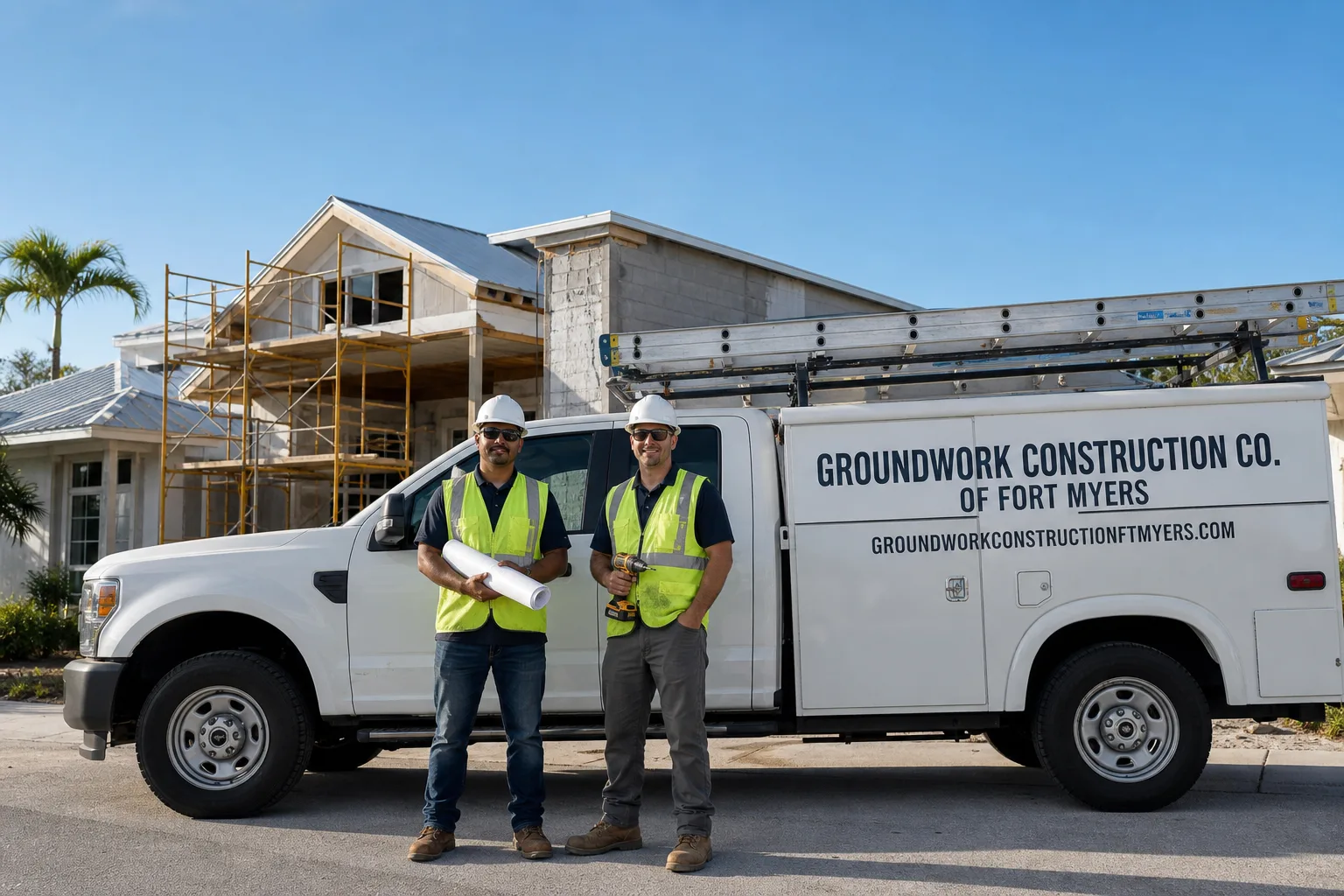
What Emergency & Storm Damage Restoration Actually Costs and Takes in Olga
Emergency and storm damage repair in Olga typically runs from $8,000 to $20,000 for a full roof replacement after a major wind event, with urgent tarping and temporary stabilization landing between $400 and $1,800 depending on the extent. Most post-storm jobs here include water intrusion mitigation, structural drying, and code-required upgrades triggered by Lee County’s post-Ian rebuild standards, and we can usually have a crew on your property within 24 hours of your call to (844) 638-7249. The number you get in our written estimate is the number you pay, no change orders snuck in later.
What fails first on a coastal garage door after a Florida storm
We see a pattern in Olga that inland crews don’t encounter. The salt air blowing off the Caloosahatchee River and the Gulf has been quietly eating at the hardware for years before a hurricane or a severe summer squall finally exploits it. The torsion springs corrode at the coil contact points where moisture gets trapped and never fully dries, and under a sudden 90-mph wind load those weakened springs snap. Hinges and rollers seize from rust pitting, then a gust slams the door panel and the seized roller tears right through the vertical track. The bottom seal extrusion, which is almost always aluminum on older doors, pits and delaminates until it can’t hold against standing water that follows a river-surge event. In Olga specifically, where the water table sits high and storm surge from the Caloosahatchee pushes onto low-lying parcels, a bottom seal failure isn’t a drip issue, it’s a flood entry point that soaks everything stored in the garage and feeds mold into the wall cavity behind the door framing.
On the opener side, the drive chain or belt rust-stretches and skips teeth under the extra weight of a wind-loaded door, and the circuit board in an older opener doesn’t have the logic to detect overcurrent from a binding mechanism, so it burns out the transformer mid-cycle. We document this exact sequence on half the post-storm calls we run in Olga. The fix isn’t just replacing the broken part. If we don’t address the coastal corrosion that set it up, the next part fails the same way within eighteen months and you’re calling again.
How we handle emergency and storm damage, start to finish
1. Triage call and on-site assessment, same day
When you call (844) 638-7249, a live person answers, not a voicemail. We ask what happened, what you’re seeing, and whether there’s active water entry. Dispatchers send a uniformed, background-checked technician to your property, typically within 24 hours or sooner if conditions allow. The tech walks the entire damage area, documents everything with photos, and checks for hidden failures, like a spring that hasn’t snapped yet but has fatigue cracks visible under the corrosion. By the time they leave, you have a clear scope of what needs to happen immediately to stabilize the opening and what the full repair or replacement will entail.
2. Emergency stabilization, hours 2 through 6
This stage is about stopping further damage. We tarp any roof penetrations above the garage, secure the door in place if it’s off its tracks but still structurally intact, or remove it entirely if it’s buckled and dangerous. We address active water by setting up commercial dehumidifiers and air movers inside the garage. If the opener is seized, we disconnect it so the door can be operated manually if needed. The goal at this point is a dry, secure, usable opening, not the final finished product. Most stabilization work is done within a single visit, typically four to six hours on a standard two-car garage.
3. Detailed estimate and material selection, day 2 or 3
With the immediate threat contained, we put together the full written estimate. This is where the hard numbers come in and where you make the big decisions: repair the existing system with upgraded corrosion-resistant parts, or replace the entire door and opener assembly. We walk you through the trade-offs on spring coatings, hinge grades, roller materials, track gauge, and opener drive types (more on that in the next section). The estimate is line-by-line and fixed. If the job scope doesn’t change, the price doesn’t change. We also check at this stage whether the repair crosses Lee County’s substantial improvement threshold, something that matters enormously in Olga flood zones, which we cover further down.
4. Full repair or replacement, typically 1 to 2 days on site
Once you approve the estimate and materials are ordered (most are in stock locally; specialty corrosion-resistant hardware may take two to three days), our crew arrives and executes the full job. This covers removing damaged components, inspecting and treating any corrosion on the remaining structure, installing the new springs, hinges, rollers, tracks, cables, bottom seal, and opener as specified, and calibrating everything for balanced operation. A full door replacement plus opener runs one long day; a spring-and-hardware overhaul on an otherwise sound door runs a half day. We do not leave a job where the door doesn’t operate smoothly by hand and by opener in both directions with the auto-reverse sensors correctly aligned and tested.
5. Final walkthrough, corrosion-prevention recommendations, and warranty registration
We walk the finished job with you, demonstrate operation, and explain what you’re seeing so you can spot early signs of wear before they become emergencies next storm season. We register every manufacturer warranty on the spot and document the job under our 730-Day Done Right Promise. If anything isn’t right, we make it right. For Olga homes, we also leave you with a straightforward maintenance card: when to clean and lubricate which parts given the local salt exposure, and what a six-month visual check should catch.
The hardware choices that change how long this repair lasts near salt water
Not all garage door parts are equal, and in a coastal community like Olga the wrong material choice shaves years off the service life. Here are the decisions we walk you through.
- Spring coating: oil-tempered vs. powder-coated vs. galvanized. Oil-tempered springs are the industry standard and the cheapest option, but they start showing surface rust within a year in Olga’s salt air. Powder-coated springs run about 20 percent more and hold up better, though coating scratches become corrosion initiation points. Galvanized springs cost roughly 35 to 40 percent more than oil-tempered and buy you the most time in this environment. For any home within two miles of the Caloosahatchee, we recommend galvanized as the baseline.
- Hinge and roller material: galvanized steel vs. stainless steel, steel rollers vs. nylon. Standard galvanized hinges last five to seven years in inland Florida but can seize in three near the river. Stainless steel hinges add cost but eliminate that failure mode. Standard steel rollers with ball bearings run quietly for a while, then rust-pit and grind. Nylon rollers with sealed bearings won’t rust, run quieter, and cost maybe $4 to $6 more per roller, a small premium for a part that takes a beating during every storm cycle.
- Track gauge and fastener material. The standard track on a residential door is 2-inch galvanized angle. For doors over 10 feet wide or in high-wind exposure zones, which includes much of Olga’s post-Ian rebuild footprint, we step up to a heavier 3-inch track for added stiffness under wind load. The fasteners matter just as much: standard zinc-plated lags corrode, so we use stainless steel lag screws into the framing, especially on the jamb brackets that take the spring tension.
- Bottom seal: rubber vs. vinyl vs. bulb-style, with an aluminum or stainless retainer. A standard vinyl bottom seal hardens and cracks after a few years of UV and salt exposure. EPDM rubber holds its flexibility longer and conforms better to uneven slab surfaces that are common in older Olga homes. The retainer channel matters because an aluminum retainer on a grade-level slab with occasional standing water will pit and eventually fail; a stainless retainer costs more but lasts. For homes in the FEMA flood zones along the river, where bottom seal integrity is the difference between a dry garage and water intrusion during a surge event, we strongly recommend the EPDM bulb seal with a stainless retainer.
- Opener drive type: chain vs. belt vs. screw, and DC motor logic. Chain drives are the workhorse and the least expensive, but they corrode faster in salt air and run louder. Belt drives with a reinforced rubber belt last longer in coastal conditions, run quieter, and add about $60 to $90 to the opener cost. Screw drives work fine but require more frequent lubrication, and in Olga that means more frequent cleaning to keep salt grit from turning the lubricant into grinding paste. A DC motor opener with soft-start and soft-stop logic reduces the mechanical shock on corroded hardware during operation, which is a genuine longevity benefit on older doors.
What emergency and storm damage repair costs in Olga, FL
A straightforward emergency spring replacement and track realignment on a single door in Olga runs $400 to $800. A complete garage door replacement with a mid-grade insulated door, galvanized springs, nylon rollers, and a belt-drive opener lands between $2,200 and $4,500 for a standard two-car opening. The job climbs to $5,500 and above when you move into a full-custom wood or high-R-value insulated door with stainless hardware, upgraded track, and a modern DC-motor opener with battery backup. Post-storm scenarios that include framing repair from wind-driven debris impact, replacing damaged sections of the opening’s structural header, or re-flashing the door opening to tie into new weather-resistant barrier behind the siding add $800 to $3,000 depending on scope.
The four big variables that push a number to the low or high end:
- Corrosion severity. If the springs, hinges, and tracks are the only casualties, the job stays in the lower range. If the opener rail, motor housing, and bottom bracket mounts have all rust-compromised and need full replacement, the total climbs fast.
- Door size and wind-load requirements. A standard 16×7 door on a 1990s home costs less to replace than a 10-foot-wide custom door that must meet current Lee County 160+ mph wind design pressure requirements, which often means a heavier-gauge door and reinforced track bracing.
- Opener features and backup power. A basic AC chain-drive unit is the lowest-cost option. A DC belt-drive with a built-in battery backup and MyQ smart connectivity, which we recommend in Olga where power outages follow major storms, adds several hundred dollars but lets you operate the door during an outage.
- Flood zone compliance triggers. As touched on above, if the door replacement is part of a broader repair that crosses the 50 percent substantial improvement threshold, the cost discussion expands to include elevation requirements that a garage door alone doesn’t cause but can be swept into. We flag this risk early so there are no surprises.
Every written estimate we provide in Olga is line-by-line. It tells you exactly what materials we’re using, what labor each stage takes, what the permit fees are if a permit is required, and what warranty covers which parts. What it won’t include are hidden add-ons or vague allowances that let the price drift upward mid-job. That’s our upfront pricing commitment. We also offer 0% financing for 18 months, and projects over $10,000 qualify for $1,000 off, which can turn a full post-storm door-and-opener replacement into something you can act on now rather than delaying.
What Olga’s location and housing stock specifically do to this job
Olga sits right along the Caloosahatchee River in unincorporated Lee County, and much of the community falls within FEMA Special Flood Hazard Areas. That’s not just a map designation, it’s a work-site reality. On the garage door calls we run here, we’re regularly dealing with slab-on-grade homes where the finished floor sits maybe 12 to 18 inches above the surrounding grade, and the bottom seal is the only thing between the garage interior and water moving across the yard during a heavy tropical system. We’ve pulled bottom seal retainers off doors in Olga where the aluminum channel was so pitted from years of wet-dry cycling and salt exposure that the seal itself had nothing left to grip, and the homeowner didn’t know until the river came up six inches and soaked the garage.
The housing stock shapes this too. We work on a lot of homes built in the 1970s through the 1990s, and a notable share are manufactured or mobile homes on larger lots with detached garages or carports that took heavy wind damage during Ian. Those structures were almost never built to current wind code, so when a door needs replacement now, Lee County requires the new door and its anchoring to meet the current 160+ mph design speed rating. That changes the hardware spec, the track bracing, and the permitting path compared to an identical repair in a newer development. Post-Ian rebuilds are still underway throughout Olga, and many homeowners are pairing the required structural upgrades with projects like Custom Windows & Doors in Olga or a new Wood Fence in Olga, especially when storm damage tore out fencing along with garage openings. When the damage extends past the garage to the roofline or soffits, we often coordinate with our roofing crew who handle Roofing in Olga, because water that came through a damaged garage door header usually found its way under the shingles or through the drip edge above it.
Permitting here runs through Lee County. A direct replacement of a garage door with the same size and structural configuration typically doesn’t require a permit, but if the opening size changes or the header needs repair, a permit gets pulled and the work gets inspected. Our team handles that from start to sign-off. We know the county’s inspectors, we know what they look for on wind-load anchoring, and we don’t schedule the final walkthrough with you until the inspection card is signed.
Serving Olga, FL - Our Local Coverage Area
We’re based in the Olga area and know this community well. Use the map below to see our service coverage - if you’re nearby, we can almost certainly help.
Frequently asked questions about emergency and storm damage in Olga
We answer the phone live, 24/7, and we dispatch a uniformed technician to your property, usually the same day you call (844) 638-7249. Stabilization work, tarping, securing the door, drying out the interior, gets done that first visit. Full replacement timing depends on materials; most common parts are available locally within one to three days.
Most Florida homeowner policies cover garage door damage from windstorms and named hurricanes, subject to your hurricane deductible. We provide the detailed documentation and photos insurers expect, and we can work directly with your adjuster. The important thing in Olga is that if the door was already compromised by corrosion, the insurer may attribute part of the failure to lack of maintenance. That’s why we document pre-existing corrosion versus acute storm damage separately in every post-storm estimate.
Rarely, by itself. Replacing a garage door is not a substantial improvement under FEMA guidelines. The risk comes when the door is part of a larger storm repair package that, in total, exceeds 50 percent of the structure’s pre-damage market value. If we’re on site and see that the total scope of work across the whole property might cross that threshold, we tell you before any work begins so you can make an informed decision with your insurance and the county.
Galvanized springs in this environment typically last 8 to 12 years with basic six-month lubrication. Stainless hinges and nylon rollers often outlast the door panels themselves. A belt-drive opener with a DC motor in a salt-air environment, properly maintained, runs 10 to 15 years. The variable is whether the door gets regular freshwater rinses and lubrication or sits untouched for years accumulating salt crust.
Our 730-Day Done Right Promise covers workmanship. If what we fixed fails because of how we fixed it, we make it right. Manufacturer warranties on springs, openers, and door sections run separately and vary by brand. We register every warranty at completion. Normal wear and tear from coastal exposure, including surface rust on non-stainless components, is not a warrantied failure, which is why we steer Olga homeowners toward the material upgrades that prevent it in the first place.
Free emergency and storm damage estimate in Olga
If your garage door took damage from a storm, or you’re seeing the rust and wear that makes the next storm a risk, call (844) 638-7249 for a free on-site assessment. We’ll walk the job with you, explain exactly what needs doing and what it costs, and put it in writing with no surprises. Phones are answered by a live person any time, any day. Our Roofing division can be looped in if the damage runs past the door into the roofline or soffit, so you’re not coordinating multiple contractors.
Written by Derek Hollenbeck, Owner at Groundwork Construction Co., providing emergency and storm damage restoration across Olga, FL.