
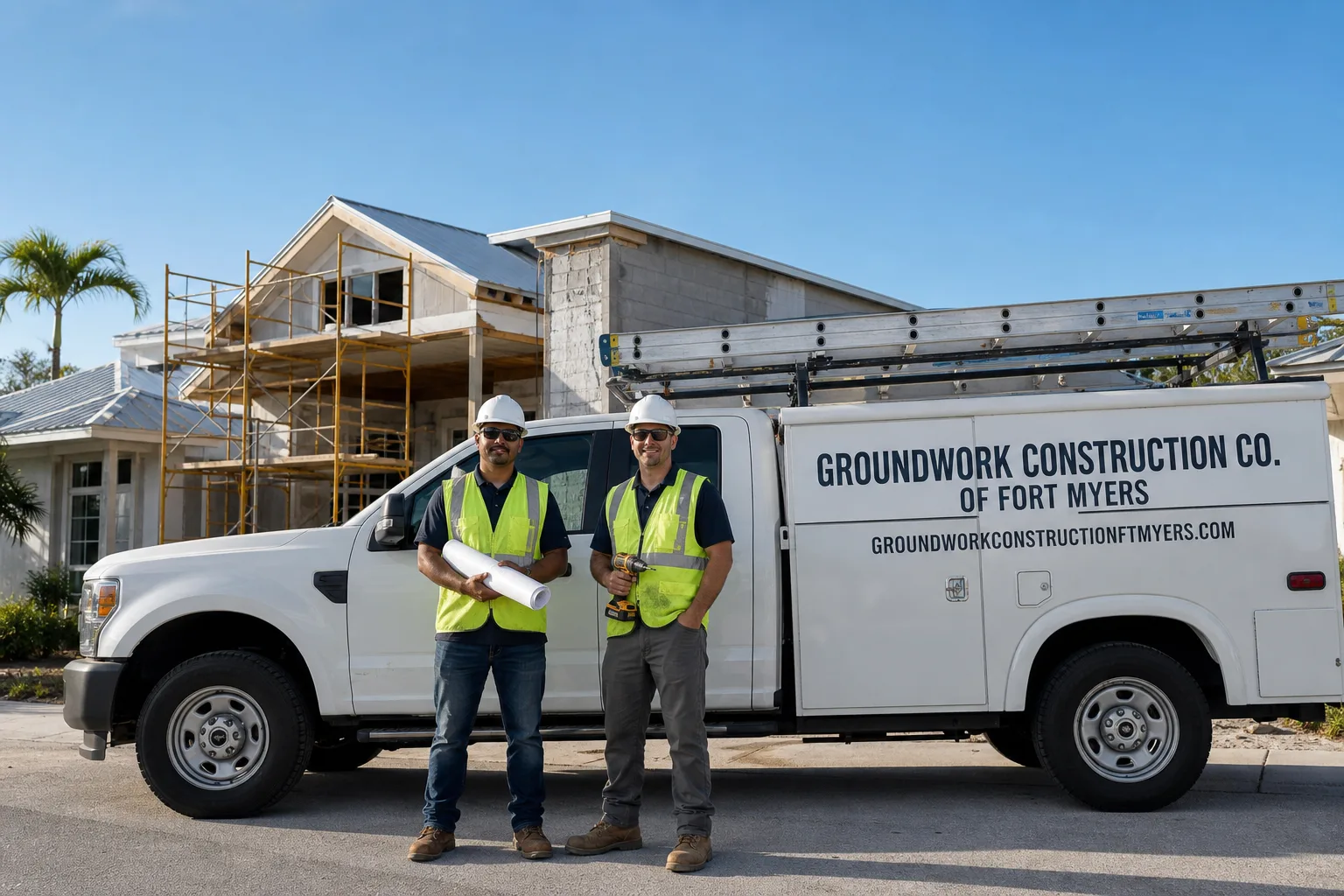
What a Wood Fence in Port Charlotte Really Costs and How Long It Takes
A new wood fence in Port Charlotte typically runs $3,500 to $9,000 for a standard residential lot, with most jobs finishing inside of five to seven working days once materials land. The range widens fast based on linear footage, access, and whether the old fence and concrete footings need full removal first. Call (844) 638-7249 for a line-by-line quote on your specific yard - we give written numbers before any work begins because you can’t budget off a ballpark.
How We Build a Wood Fence - Stage by Stage
Every crew handles the sequence a little differently. Ours runs a five-stage process that keeps your fence plumb, your gate swinging true six months later, and your yard usable while we go. Here’s what a standard Port Charlotte wood fence install looks like with us.
Stage 1: Property Marking and Utility Locate (Day 1 morning)
Before any post hole goes in the ground we mark the fence line with paint and stakes and walk it with you. You confirm placement at this stage, not after the concrete is poured. We also call in the locate ticket - Charlotte County has a dense web of shallow irrigation lines and older neighborhoods in Port Charlotte still carry original GDC-era utility laterals that maps don’t always catch. Sunbelt utility locators typically clear the site in 48 hours, and this window is baked into every schedule. You make one call here: final say on the line.
Stage 2: Post Hole Digging and Concrete Set (Day 2-3)
We dig to 24 to 30 inches, which is below the typical Port Charlotte soil-loosening depth from seasonal saturation. In the canal-front neighborhoods - think around Edgewater Drive or down toward the Manchester Waterway - the water table sits high enough that we often hit wet soil at 20 inches. Those posts get extra Sakrete high-strength concrete mix and a longer cure before we load the panels. Wood fence posts set in Port Charlotte’s sandy-loam base need that deeper socket because tropical-storm wind loads will lever a shallow post right out of the ground. Concrete cures for a full day before we hang anything on it.
Stage 3: Panel and Stringer Assembly (Day 3-4)
This is the most visible day. Pressure-treated pine stringers go up first, leveled and gapped for drainage. Then the pickets. We face-nail with ring-shank stainless fasteners - more expensive than galvanized, but in Port Charlotte’s salt-humid air, galvanized hardware pits inside two years and leaves rust streaks down every board. Spacing between pickets accounts for the summer wet-season swell; board-tight fencing in April buckles by August. You decide board orientation (good side facing out or alternating) at this stage.
Stage 4: Gate Build and Hardware (Day 4-5)
A wood fence gate that drags three months after install is usually a post problem, not a hinge problem. We frame gates with a Z-brace and set them on adjustable heavy-duty strap hinges mounted into the post, not the picket. For double-drive gates on corner lots - common in the older GDC-platted sections of Port Charlotte - we cross-brace both leaves and sink the latch post 6 inches deeper than the line posts. Latch hardware is stainless or powder-coated marine-grade. You walk the swing and confirm the clearance before we call it done.
Stage 5: Final Walk and Site Cleanup (Day 5-6)
We haul all demo debris, concrete spoil, and fasteners. Metal sweep with a magnetic roller. You do the final walk with the crew lead and flag anything that needs adjustment. If you find a picket cupping or a gate sagging in the next 730 days, the Done Right Promise means we come back and fix it - no invoice, no argument. That’s in writing.
The Options You’ll Choose Between
Wood fence sounds simple until you’re staring at a quote sheet with six different board grades. Here are the real choices and what they mean for a fence in Port Charlotte’s climate.
- Pressure-treated pine pickets: The workhorse of Florida wood fencing. Budget-friendly, takes stain well, and the treatment resists the subterranean termites that thrive in Port Charlotte’s sandy soil. Downside: without a quality sealant reapplied every two years, the sun and rain will gray and check the boards faster than you’d expect. Most homeowners choose a cedar-tone stain to bridge the look while keeping the price manageable.
- Cedar pickets: A step up in natural rot resistance and appearance. Western red cedar arrives with a tight grain that cups less than pine through wet/dry cycles. The trade-off is cost - typically a 20 to 30 percent premium on a full Port Charlotte lot, and the material still needs sealing to hold its color against UV. We recommend it for homeowners who want the fence to look finished on day one and stay that way with less maintenance.
- Board-on-board vs. shadowbox vs. standard dog-ear: Standard dog-ear is the most common picket profile and the lowest installed cost per foot. Shadowbox (alternating boards on both sides of the stringer) looks the same from both sides - popular on property-line fences where neighbor opinions matter. Board-on-board has no gaps; it’s a full-privacy barrier that also handles wind different from an open picket - the tighter surface catches more load, so post spacing and depth matter more, especially west of US-41 where nothing blocks the storm-season gusts off the harbor.
- Post caps and trim: A $3 copper post cap does more than dress the fence - it slows water absorption into the end grain of the post, which is the fastest path to rot in Florida’s daily afternoon showers. We include standard wood caps; upgraded copper or powder-coated aluminum are a small add that meaningfully extends post life.
What a Wood Fence Costs in Port Charlotte, FL
Most wood fence projects in Port Charlotte land between $3,500 and $9,000. A smaller yard - say a 50-foot run with one gate - sits toward the lower end. A full perimeter on a canal-front lot with 180-plus linear feet, demo of an existing chain-link fence, and a double gate pushes toward the upper end.
Five factors drive the number the most. Linear footage is the obvious one. The second is access: if we can’t get a skid steer into the backyard to pull old concrete footings, that time lands on the labor line. Third is material grade - pine vs. cedar, standard vs. premium pickets. Fourth is the gate count and size; a welded steel-frame double gate costs more to build and hang than a single walk gate. Fifth is demo scope - pulling an old wood fence with 80 concrete footings takes a day before the new fence even starts. Wet-season scheduling can also shift things slightly; Port Charlotte’s June-through-September afternoon storms can pause outdoor work, and we build that buffer into mid-summer timelines but not into the price.
Every quote you get from us is a written, line-item estimate. The number includes all materials, fasteners, concrete, demo and haul-off of old fencing, gate hardware, and site cleanup. It does not include stain or sealant application (that’s a separate scope, done after the wood has acclimated for a few weeks). It also does not include stump grinding or major grade correction if the fence line runs across an area that hasn’t been leveled. We walk all of this before the estimate is final so there is no change order surprise halfway through the job.
What Port Charlotte Homes Specifically Do to This Job
Port Charlotte is a GDC city. The General Development Corporation platted thousands of lots from the late 1950s onward, and that legacy means many of the homes we fence today sit on lots that were never built out until decades later. The practical effect for a wood fence is the condition of the property line. On newer infill lots in older neighborhoods like Section 15 or around Peachland Boulevard, we often encounter buried construction spoil from the original house pad - chunks of concrete block, old rebar stubs, tile fragments - that turn a simple post hole into a fight. It’s not unusual to lose an extra half-day swapping auger teeth and hand-digging obstructions that don’t show up on any survey.
The canal network adds another layer. Fence lines that run parallel to Charlotte County canals often fall within a FEMA-regulated flood-zone setback. Charlotte County building officials review fence permits for flood-zone compliance, and in VE or AE zones they require that fence construction does not obstruct the flow of floodwater. For a wood fence that means the bottom rail may need to sit higher, or the picket spacing may need to be wider than standard-privacy spec. It’s a fast back-and-forth with the permit desk - we handle it, but it’s a variable nobody tells you about unless they work these neighborhoods regularly.
And then there’s Hurricane Ian. Four feet of storm surge saturated thousands of wood fence posts at the soil line across Port Charlotte. A post that didn’t shear off during the storm spent 36 hours sitting in brackish water, and the rot that started in that soak has been showing up in fence failures ever since. When we pull an old fence in the city now, we almost always see post-base decay that wasn’t visible above grade. That’s why we set every new post deeper and with a full concrete sonotube collar - not just backfill. It’s a Port Charlotte-specific spec that comes from repairing enough post-storm fences to know what gives way first.
Homeowners who are already planning Fence Installation in Port Charlotte often pair the new wood fence with driveway work - we see a lot of demand for Paver Driveways in Port Charlotte and Concrete Driveways & Concrete Work in Port Charlotte on the same properties, especially where hurricane repairs triggered a broader exterior refresh. Our fence crew coordinates with the Fence Installation team across Port Charlotte so the sequence works.
Serving Port Charlotte, FL - Our Local Coverage Area
We’re based in the Port Charlotte area and know this community well. Use the map below to see our service coverage - if you’re nearby, we can almost certainly help.
Frequently Asked - Wood Fence in Port Charlotte
Do I need a permit for a wood fence in Port Charlotte?
Yes. Charlotte County requires a fence permit for any new fence over 3 feet high, and most residential wood privacy fences run 6 feet. The permit review checks for setback compliance, flood-zone restrictions, and that the fence design meets the wind-load requirements in the current Florida Building Code. We pull the permit as part of the job and include the fee in the estimate.
How long will the wood fence actually last in Florida weather?
A properly installed pressure-treated pine fence in Port Charlotte lasts 15 to 20 years with maintenance - meaning a quality sealant reapplied roughly every two years. Cedar usually buys you an extra 5 to 8 years. The things that shorten the lifespan fastest here are post rot from ground contact, fastener rust from salt air, and UV degradation of unsealed wood. All three are preventable at install.
Can you build the fence on the exact property line?
We can, but we won’t set a post until the line is marked and confirmed. If a survey pin isn’t visible at both corners, we recommend a boundary survey before we dig. Building even 4 inches onto a neighbor’s lot in Port Charlotte can turn into a expensive removal order. It’s worth the survey fee.
Does a wood fence block hurricane winds?
No fence blocks hurricane winds and we wouldn’t want it to. A solid privacy fence catches wind, which is why post depth, concrete collars, and stainless hardware matter so much here. The fence is designed to stay anchored, not to act as a windbreak. In the strongest storms, removing a gate panel ahead of landfall can reduce the load on the entire run.
What happens if the price changes once you start digging?
It doesn’t. Our upfront pricing is line-item and fixed. The only time a number shifts on a wood fence job is if you decide mid-project to add a gate, extend the run, or upgrade the material - and you approve that change in writing before we do the extra work. Otherwise, the quote you sign is the amount you pay.
Get a Free On-Site Estimate for Your Port Charlotte Wood Fence
We’ll walk the property, measure the run, talk through material options that make sense for your yard’s exposure, and hand you a written number before we leave. No pressure, no vague ranges. Call (844) 638-7249 to schedule a time - a live person picks up, day or night, and we’ll have a uniformed crew member at your Port Charlotte home to start the estimate. The call and the quote are free, and the work is covered by our 730-Day Done Right Promise.
Written by Derek Hollenbeck, Owner at Groundwork Construction Co., serving Port Charlotte and the surrounding communities.