
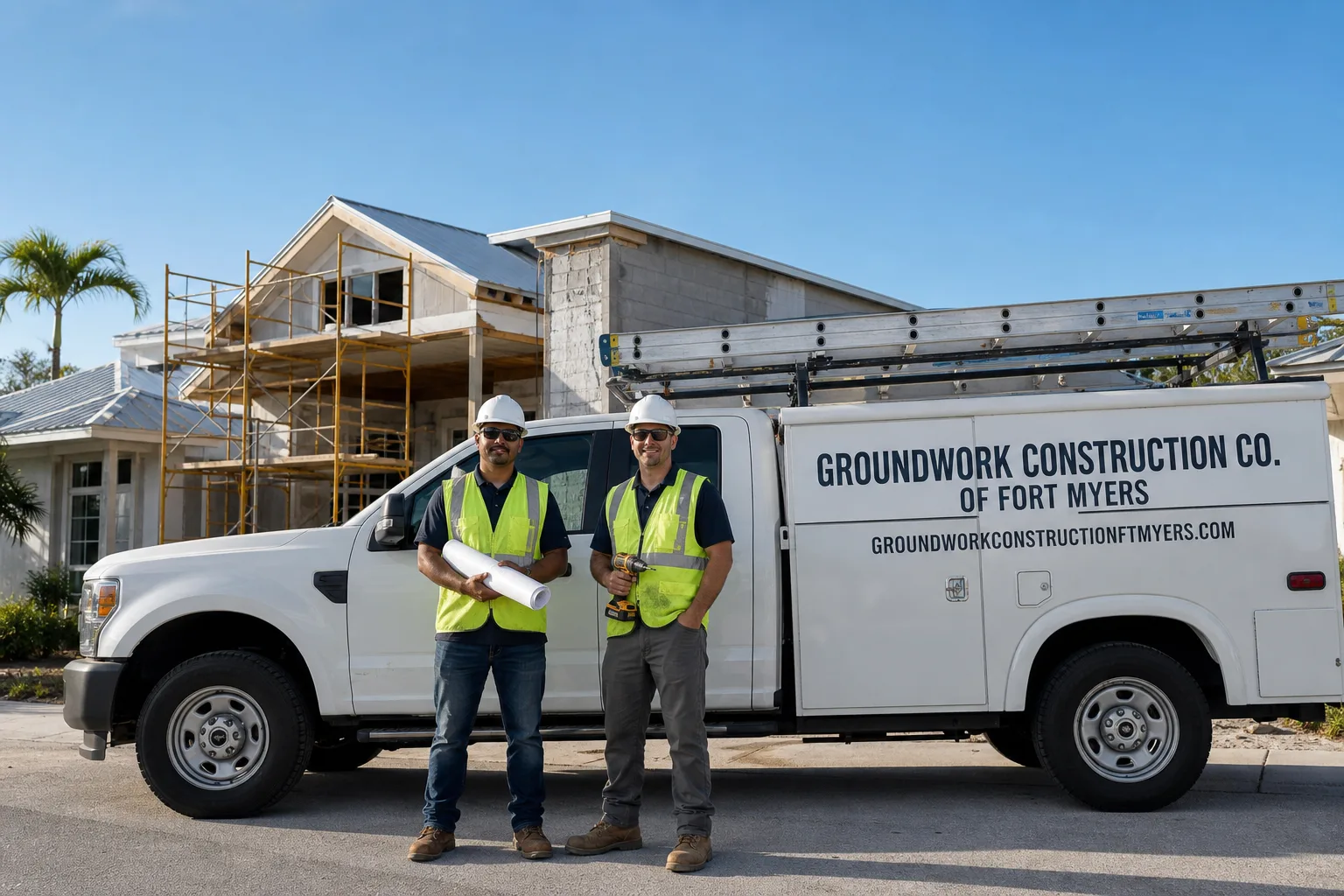
What Concrete Driveways & Concrete Work Looks Like in Gateway
A new concrete driveway in Gateway, FL typically costs between $4,500 and $12,000 and takes about five to seven days from demolition to drive-ready cure time. The job covers site prep, form setting, pouring, finishing, and a critical week-long curing window before you park on it. We handle the whole sequence, from pulling Lee County permits to coordinating with your community’s architectural review committee, so the pour date doesn’t slide. Call (844) 638-7249 to schedule a free on-site estimate and we’ll walk the property with you.
How We Pour a Driveway in Gateway, Step by Step
Day 1: Site Assessment, Permits, and Committee Review
Before any concrete hits the ground, we check the slope, drainage patterns, and existing soil compaction across your driveway footprint. In Gateway, the Community Development District requires architectural review approval ahead of Lee County building permits, so we prepare the submittal package with project dimensions, material specs, and a site plan that shows setback compliance. This step typically adds one to two weeks to the front end of the schedule, and it’s non-negotiable. Homeowners unfamiliar with the CDD workflow are often surprised by the extra lead time, so we set that expectation on the first call.
Day 2: Demolition and Base Prep
If there’s an existing slab, we saw-cut and remove it, then haul the debris. The subgrade gets excavated to the proper depth (usually 4-6 inches for a standard residential driveway) and compacted with a mechanical plate compactor. We add and grade a crushed limestone or aggregate base, then compact it again. Good compaction here prevents the settling cracks that show up two years later at the garage apron and street edge. Once the base passes inspection, we set the forms with dimensional lumber, reinforcing steel, and any required expansion material at the garage slab and sidewalk.
Day 3: Pour and Initial Finish
Concrete arrives in a ready-mix truck, placed directly into the forms. We use a minimum 3,000 PSI mix with air entrainment suited to Southwest Florida’s wet-dry cycles. The crew screeds, bull-floats, and edges the slab. Joints get cut the same day while the concrete is still green, spaced to control where cracking occurs. For Gateway homes with a longer approach or a side-load garage, we plan joint layout around turning radii so cracks don’t wander across the most visible sections.
Day 4-5: Curing, Final Finish, and Sealing
After the pour, the concrete needs a continuous seven-day cure. We apply a curing compound or keep the slab damp with a fine mist in hot weather, which matters in Gateway, where afternoon heat can flash-set the surface if we’re not watching. The broom finish or exposed-aggregate finish gets locked in on day one, but we return to apply a penetrating silane sealer that protects against salt, oil, and the high water table moisture that seeps up through some of the older 1990s slabs we replace in the community.
Day 6-7: Final Walkthrough and the Cure Window
We walk the finished driveway with you, note where the joints fall, and give you the care card (no deicing salts, no heavy vehicles for the first week, avoid turning the wheel while stationary). Concrete reaches 70% of its design strength at seven days and full cure at 28 days. Light vehicle traffic is fine after seven days; we recommend waiting the full cure window before parking a heavy pickup or SUV on it daily.
The Concrete Choices You’ll Make Before We Pour
Every concrete driveway job involves a handful of real decisions that affect how it looks, how it wears, and what it costs. We’ll walk you through each one.
- Broom Finish vs. Exposed Aggregate. A broom finish is the standard slip-resistant surface most Gateway homes have from the original build. It’s cost-effective, predictable, and included in the base price. Exposed aggregate adds $2-$4 per square foot and reveals the stone mix beneath the surface, giving the driveway a higher-end look that complements the stucco-and-tile architecture common in the community. The tradeoff: exposed aggregate can feel rougher underfoot and shows tire marks less readily, for better or worse.
- Slab Thickness. The baseline is a 4-inch slab with reinforced wire mesh or rebar. For homeowners who regularly park a heavy work truck, an RV, or a boat trailer on the driveway, we step up to a 5- or 6-inch slab with #4 rebar on 18-inch centers. The material cost difference is real, roughly $1.50-$3 per square foot, and it avoids the crushing spider cracks we sometimes see along the edges of thinner pours after a few seasons of Southwest Florida rain saturation.
- Integral Color and Stamped Borders. Integral color is mixed into the concrete at the plant so the color runs through the full depth of the slab. It won’t peel or flake like a surface stain. We often pair a colored body with a stamped or textured border treatment along the driveway edges, which adds definition without committing to a full stamped-concrete surface. Expect color to add $4-$8 per square foot depending on the pigment load and complexity.
- Sealer Grade. A standard acrylic sealer runs about $0.50 per square foot and performs well for two to three years. A high-solids silane sealer costs roughly double that but penetrates deeper, lasts four to six years, and provides better protection against the tannin stains and mildew bloom that show up on light-colored concrete under Gateway’s canopy oak and palm landscaping.
- Drainage Swales and Channel Drains. Some Gateway lots slope gently toward the home or have a low spot right where the driveway meets the street. If the site assessment shows water pooling at the garage door during a heavy summer storm, we’ll design a shallow swale or a trench drain across the driveway throat. It’s cheap insurance (usually $400-$800) against the sill-rot and garage-floor efflorescence we see on homes where water was allowed to sit against the slab edge for years.
What Concrete Driveways & Concrete Work Costs in Gateway, FL
A concrete driveway in Gateway falls between $4,500 on the low end and $12,000 on the high end, with most two-car residential pours landing around $7,000-$9,000. That’s a finished slab, broom-finish, 4-inch thickness, with standard wire mesh reinforcement and an acrylic sealer, on a flat lot without major demolition complications.
What pushes a job toward the top of that range:
- Square footage. The single biggest cost driver. A standard two-car driveway is roughly 400-600 square feet. A three-car, circular, or extra-deep driveway can easily double the material and labor.
- Existing slab demolition and disposal. Removing and hauling an old, thick, or heavily reinforced slab adds $1,500-$3,000 depending on access and dump fees.
- Subgrade problems. If the old base is soft, saturated, or full of tree roots from the mature oaks common in Gateway, we’ll excavate deeper and import clean fill, which adds $800-$2,000.
- Finish upgrades. Exposed aggregate, integral color, or stamped borders each add $2-$8 per square foot to the slab price.
- Reinforcement upgrades. Stepping up from wire mesh to a rebar grid adds material and labor, particularly on larger pours where the rebar pattern gets denser.
Every estimate we write is a line-item quote. You’ll see the cost for demolition, base prep, concrete material, finish, sealer, and any site-specific work like drain installation. The permit fee line shows the actual Lee County permit cost, not a markup. No change orders get slipped in mid-pour unless the ground shows us something we couldn’t have seen during the walkthrough, and we’ll call you before we touch it. Our Driveway & Pavers in Gateway work follows the same upfront-pricing standard.
What Gateway Homes Specifically Do to This Job
Gateway’s master-planned structure changes the driveway conversation before the first shovel goes in the ground. Because nearly every residence sits within a Community Development District, you’ll need architectural review committee approval before Lee County will even accept a permit application for a new concrete pour. We prepare and submit that committee package as part of the estimate, including the finish spec, color sample if applicable, and a site plan that demonstrates the new driveway won’t alter drainage onto a neighboring lot. Contractors who skip this step or don’t know it exists end up with a stopped job and an embarrassed homeowner. We’ve been through it enough times that we can tell you, within a day or two, when you should expect the approval letter.
The housing stock itself also shapes what we find when we pull up an old slab. Most Gateway homes were built between 1990 and 2010, and many of those original driveways were poured with a thin 3.5-inch slab, minimal reinforcement, and no vapor barrier over the sandy native soil. After 20-30 years of seasonal saturation from afternoon thunderstorms and the high water table that sits just a few feet down across much of Lee County, the base erodes and the slab curls at the joints, creating the trip hazards and drainage dips you see walking through the neighborhood. When we demo a late-1990s slab, we almost always find the base course has thinned to near nothing at the edges. We compact a fresh six-inch base and install a moisture barrier before we pour, which gets the new slab out of that cycle.
Hurricane Ian also left its fingerprints here. While Gateway’s inland elevation kept homes out of the storm surge, the sustained wind damaged scores of screened enclosures and pool cages, and a lot of heavy debris sat on driveways for months during the rebuild backlog. That history means we now pay extra attention to surface prep where a heavily loaded debris trailer or a crane outrigger may have been parked on an adjacent slab, creating micro-fractures we don’t want telegraphing into the new pour. It’s a small thing, but it’s the kind of detail you pick up after working every corner of this community. For homeowners considering a broader property expansion while we’re already on site, our Garage Conversion ADU in Gateway and New Detached ADU in Gateway services often run concurrently with driveway work to save on mobilization costs. You can also see our full service area on the Gateway page.
Serving Gateway, FL - Our Local Coverage Area
We’re based in the Gateway area and know this community well. Use the map below to see our service coverage - if you’re nearby, we can almost certainly help.
Frequently Asked Questions About Concrete Driveways in Gateway
Light vehicle traffic is fine after seven days. Concrete hits about 70% of its design compressive strength in the first week. We recommend waiting the full 28-day cure cycle before parking a heavy truck, SUV, or boat trailer on the slab daily. In Gateway’s summer heat, we may extend the initial mist-cure window by a day or two, which doesn’t change the timeline much but does produce a harder surface over the long term. Call (844) 638-7249 and we’ll give you a project schedule that includes cure time so you can plan around it.
Yes, and you need two approvals, not one. Every new concrete driveway in Gateway requires Lee County building permits, and before the county will accept the application, your community’s architectural review committee must sign off on the project. We handle both submittals. If a contractor tells you a driveway doesn’t need a permit because it’s a flat slab, walk away. The county cares about lot coverage, setbacks, and drainage. The CDD cares about material consistency and streetscape appearance. Skipping either one is a code violation that can hold up a home sale later.
A finished concrete driveway in Gateway runs $4,500 to $12,000, with the typical two-car broom-finish pour landing around $7,000 to $9,000. Square footage is the largest cost variable, followed by slab thickness, reinforcement type, and any surface upgrades like exposed aggregate or integral color. Demolition and haul-away of an existing slab, if needed, adds to the total. Our estimates are line-item, so you’ll see exactly where each dollar is allocated. Call (844) 638-7249 for an exact quote, no cost and no commitment.
It shouldn’t, and with us, it doesn’t. Our quotes are built on a site walk and a measured takeoff. The only time a number adjusts is if the demo reveals a subgrade condition we couldn’t have seen from the surface (a buried stump, a collapsed irrigation main, undocumented fill that won’t compact) and we’ll stop, show you what we found, and give you a cost to address it before we proceed. You approve it or we don’t do it. No invoice surprises at the end.
We stand behind every concrete driveway we pour with our 730-Day Done Right Promise. If something isn’t done right, we make it right, full stop. Concrete is a site-poured material and hairline shrinkage cracks are normal, but structural settling, spalling, or drainage failures caused by our workmanship are covered. That’s one of the longest workmanship guarantees you’ll find in residential concrete, and it’s in writing. Our Driveway & Pavers crew has been delivering on this promise since Derek Hollenbeck founded the company.
Get a Free Concrete Driveway Estimate in Gateway
The best way to pin down a number and a timeline is to have us walk the property. We’ll measure the driveway footprint, check the slope and soil, look at your existing slab if there is one, and talk through the finish options that make sense for your home and your HOA’s expectations. Everything goes into a written, line-item quote, no cost and no pressure. Call (844) 638-7249 to schedule your free on-site estimate. A real person answers, any time of day. We’ll get you on the calendar and pour a driveway that holds up to Florida summers, CDD rules, and the next thirty years.
Written by Derek Hollenbeck, Owner at Groundwork Construction Co.