
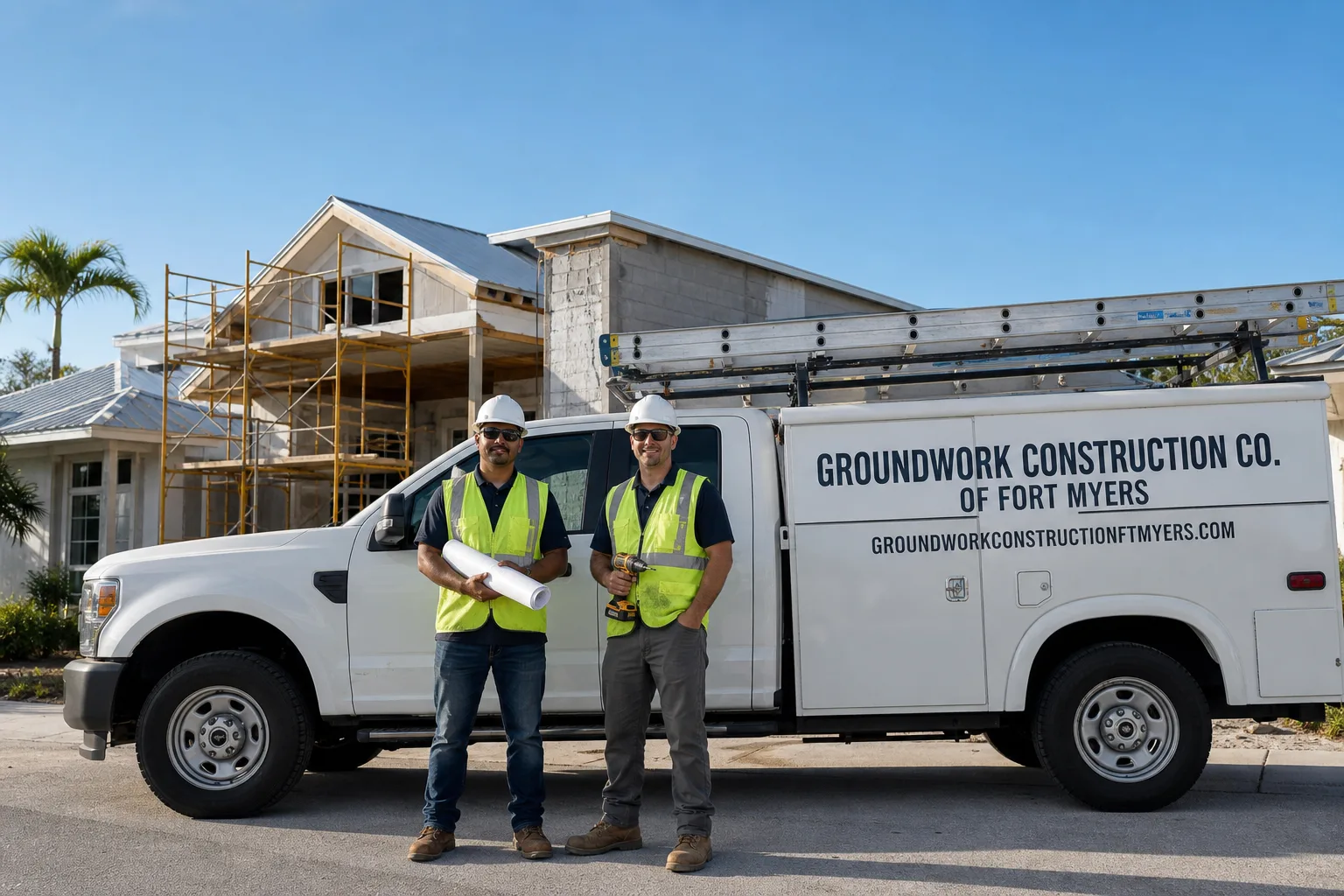
What Emergency & Storm Damage Costs and How Fast We Respond in Gateway
Emergency and storm damage repair in Gateway typically runs $400 to $1,800 for smaller targeted fixes like torn-off ridge caps or punctured underlayment, and $8,000 to $20,000 when a full replacement is the only safe path forward. Most of our Gateway calls start with a tarp and a same-day damage assessment. Call (844) 638-7249 right now if you’re looking at water coming through the ceiling. A live person answers 24/7, and we can have a background-checked, uniformed technician at your home to assess the damage and get temporary protection in place before the next rain band hits.
We’re not strangers to what a Florida afternoon thunderstorm or a tropical system can do in about twenty minutes. In Gateway the damage tends to follow a pattern we’ve seen hundreds of times since Hurricane Ian tore through Lee County. Barrel tile roofs lose their hip-and-ridge caps. Flat-tile sections that were installed before the current wind-mitigation code allow wind-driven rain straight into the underlayment. And the screened enclosures that nearly every Gateway home has take a beating on the frame connections. What makes this community different is what happens *after* the storm: the architectural review requirement that most homeowners don’t realize exists until their contractor tells them they can’t touch a shingle without committee approval. More on that in a minute.
If the damage is part of a larger pattern of roof deterioration, our Roofing in Gateway crew can fold the emergency repair into a full replacement scope so you’re not paying for the same work twice. When sudden storm damage exposes the fact that your 1998 tile roof has been on borrowed time, it’s often smarter and cheaper long-term to address the whole system at once.
How We Work Through Storm Damage, From First Call to Final Inspection
The process moves fast because water intrusion doesn’t wait for an architectural review committee to meet. Here’s the actual sequence we follow on every emergency and storm damage job in Gateway, and what you can expect at each step.
Stage 1: Immediate triage and temporary stabilization (day of call, usually within hours). Our first job is stopping the active leak. We arrive with heavy-duty tarps, poly sheeting, and the fasteners to secure them to concrete-block construction. For wind-damaged tile roofs, we inspect the underlayment integrity and nail down any loose battens that could become projectiles. You’ll get a candid assessment on the spot: can this wait for a planned repair, or do we need to move into emergency mode? We document everything with photos timed and dated for your insurance carrier, and we give you a straightforward recommendation, not a sales pitch.
Stage 2: Damage documentation and insurance coordination (day 1-2). The paperwork part matters enormously, especially in Gateway where Hurricane Ian claims are still winding through the system. We produce a detailed scope of loss that matches the format insurance adjusters expect: damaged areas quantified in squares, substrate condition noted, code-upgrade requirements flagged. If your carrier requires secondary water barrier documentation because your home’s original single-stage tile installation pre-dates the post-Andrew wind-mitigation code, we include that specification explicitly. You get a written, itemized estimate with line-by-line pricing. No lump-sum mystery number.
Stage 3: Architectural review and permitting (typically 3-10 business days, depending on committee schedule). This is the Gateway-specific step that catches out-of-area contractors and delays projects by weeks. Every exterior repair visible from the street, including roofing materials, must clear the community’s architectural review committee before Lee County will entertain your permit application. We handle the submission, and we know what gets approved because we’ve done it here for years. Tile color matching, roof profile consistency, and material-grade specifications all go into the package. We don’t submit and hope. We submit with a track record of what passes.
Stage 4: The repair or replacement work itself. For a targeted repair like a ridge-cap replacement or a section of underlayment, most jobs finish in a single day once permitting clears. A full Roofing replacement triggered by storm damage takes longer, typically 3-5 working days depending on the roof’s complexity and whether we’re also addressing the soffit and fascia damage that Gateway’s barrel-tile homes so often sustain in high-wind events. Our crew protects your landscaping, works clean, and does a magnetic sweep for fasteners at the end of each day.
Stage 5: Final walkthrough, close-out documentation, and warranty registration. We walk the entire roof with you if you’d like, show you exactly what was done, and confirm that every detail matches the scope we agreed on. You get a close-out packet with the permit sign-off, material warranties registered in your name, and our 730-Day Done Right Promise in writing. If anything isn’t right, we make it right within that two-year window. It’s one of the longest workmanship guarantees you’ll find in residential construction, and we put it on every single project.
The Roofing Decisions You’ll Make During a Gateway Storm Repair
When you’re dealing with emergency damage, some decisions get made faster than they would on a planned remodel. But you still have real choices, and understanding the trade-offs matters. Here are the primary options you’ll weigh, depending on the damage extent.
- Tile-to-tile repair vs. section replacement. If the damage is isolated to a few cracked or wind-displaced barrel tiles, we can often source matching replacements from the original manufacturer. The repair stays discreet and costs stay in the low hundreds. The trade-off: mortar-set tiles on a 20-year-old roof can loosen adjacent tiles during repair, and the color match on a field that’s been bleaching under the Florida sun for two decades won’t be perfect. A section replacement gives you uniform appearance but costs more up front.
- Underlayment grade. If wind-driven rain got past your tile and the underlayment is compromised, you’re choosing between standard #30 felt and a high-temperature self-adhered membrane. The latter costs roughly 40-60% more per square but provides a true secondary water barrier, which your insurance carrier may require on a post-1990s Gateway home anyway. If you carry a high wind-damage deductible, the membrane upgrade often pays for itself in premium reductions over three to five years.
- Fastener and attachment upgrades. Homes built in Gateway’s earliest phase (1990-1995) sometimes have 6d nails at 12-inch spacing on the decking. Current code calls for 8d ring-shank nails at 6-inch spacing. Bringing the existing decking up to code while the roof is open adds labor but dramatically improves uplift resistance, and skipping it on a storm-repair job leaves performance on the table that you’ll never access as cheaply again.
- Soffit and fascia repair coordination. Wind that lifts roof tiles nearly always damages the aluminum or vinyl soffit panels beneath the eaves, and in Gateway’s villa-style homes with continuous soffit runs, that damage can look worse than the roof itself. We can roll soffit replacement into the same permit and same crew schedule, which saves you a second mobilization charge down the road.
Many Gateway homeowners also choose to address Custom Windows & Doors in Gateway when storm damage reveals wider exterior vulnerabilities. It’s not uncommon for us to be replacing a wind-lifted roof section while noticing that the original single-pane windows are next in line for an upgrade, and we can coordinate the scopes so you’re not living through multiple construction events.
What Emergency & Storm Damage Costs in Gateway, FL
Real numbers, based on the jobs we’ve done throughout the community: a targeted storm repair like replacing dislodged ridge caps, re-bedding a handful of tiles, and sealing exposed underlayment runs $400 to $1,800. That covers isolated wind damage where the roof deck and the majority of the field tiles are still sound. On the other end, a full storm-triggered roof replacement on a typical Gateway concrete-block home, where we’re pulling off everything down to the decking, installing a self-adhered secondary water barrier, re-nailing the deck to current wind-mitigation standards, and laying new tile or architectural shingles, lands between $8,000 and $20,000.
The spread is driven by a handful of variables, and you deserve to know what they are before anyone gives you a number.
Roof square footage and geometry. A 1,800-square-foot single-story villa with a simple hip roof costs less than a 3,200-square-foot two-story with multiple valleys, dormers, and a steep pitch. Every valley and penetration adds labor hours.
Decking condition underneath. If the original OSB or plywood sheathing is water-damaged or was installed with inadequate fasteners, replacing sections of decking adds $2-$4 per square foot. This is the single most common cost variable on Gateway homes built between 1990 and 2000.
Material grade and tile matching. Basic three-tab shingles sit at the low end. Matching the existing barrel tile profile and color, which is mandatory under architectural review in most Gateway villages, pushes material costs higher. If the original tile is discontinued, we have to source a compatible alternative and submit it for approval, which adds procurement time but not necessarily cost.
Code-upgrade scope. Bringing fasteners, secondary water barrier, and drip-edge details up to current Florida Building Code requirements is not optional on a permitted replacement, but the extent varies by what was there originally. An early-1990s Gateway home typically needs more upgrade work than a 2008 build.
Permitting and HOA review fees. Gateway’s CDD structure means two review processes: the architectural committee and Lee County. The fees themselves are modest (a few hundred dollars total), but the timeline impact can be real if your contractor doesn’t know the submission sequence.
Every written estimate we provide is a fixed-price, line-item quote. We don’t issue a low number and hit you with change orders once the old roof comes off. If we find decking damage we couldn’t see from the exterior, we show you photos, explain the cost, and get your approval before we proceed. The number you see is the number you pay unless you authorize a change. That’s our upfront pricing commitment, and it applies to every emergency job even when the timeline is compressed.
Why Gateway’s HOA and CDD Structure Changes How This Job Gets Done
Gateway is not unincorporated Lee County. It’s a master-planned Community Development District where the architectural review committee has jurisdiction over every exterior material visible from the street, and roofing is the most visible of all. Before Lee County will issue a building permit for a roof repair or replacement, the committee must sign off on material type, color, and profile. A contractor who pulls a county permit without that approval first has just created a delay that can stretch into weeks while the committee reviews a retroactive submission. We’ve been through this workflow enough times to know the committee meeting calendar, the submission format they expect, and the specific tile colors and profiles that match each Gateway village. That institutional knowledge is what keeps your tarp from becoming a permanent fixture.
The housing stock here amplifies the importance of getting it right the first time. Gateway’s homes were built in a relatively narrow window (roughly 1990-2010), mostly concrete block with stucco exteriors and tile roofs. The 1995-2000 builds in particular often have original single-stage tile installations where the tiles were mortar-set directly to the underlayment with no secondary water barrier. When wind lifts even a few tiles on those roofs, water finds a direct path to the decking, and what looks like a small repair from the ground is often a much larger underlayment job once we open it up. Insurance carriers have caught on to this. Many Gateway homeowners are now receiving renewal notices that explicitly require documented secondary water barrier installation and deck re-nailing as a condition of continued coverage. A storm repair that only addresses the visible tile damage without touching the underlayment might satisfy the immediate leak but will leave you fighting your insurance company six months later.
The sustained rebuilding demand since Hurricane Ian also means that material lead times and subcontractor availability in the Gateway corridor still aren’t back to pre-2022 norms. Barrel tile in specific profiles can take two to three weeks if it’s not a stock item at local supply houses. We factor that into our scheduling conversations honestly. Some homeowners also use the storm-repair window to address Wood Fence in Gateway damage from the same wind event, since our crews are already mobilized and the permitting can be bundled.
Throughout all of Gateway, the homes we work on share a common set of failure modes: ridge caps that let go at the mortar joints, soffit panels that crumple inward when wind gets behind the eaves, and underlayment that degraded faster than the tiles covering it. Understanding that pattern means we can often spot developing problems before they become emergency calls next season.
Serving Gateway, FL - Our Local Coverage Area
We’re based in the Gateway area and know this community well. Use the map below to see our service coverage - if you’re nearby, we can almost certainly help.
Frequently Asked Questions About Emergency & Storm Damage in Gateway
We can typically have a crew at your home within a few hours of your call to (844) 638-7249 for a tarp and temporary stabilization. Our phones are answered by a live person 24 hours a day, seven days a week. We don’t route emergency calls to a voicemail box. If the damage is extensive, we’ll secure the entire affected area with heavy-duty poly sheeting and fasteners rated for concrete-block construction, which covers almost every home in Gateway. The temporary protection holds until permitting and architectural review clear, which in Gateway typically takes three to ten business days depending on the committee’s meeting schedule. Call (844) 638-7249 for an exact timeline based on your village’s current review calendar.
If the repair involves replacing structural roof components, underlayment, or more than a small number of like-for-like tiles, Lee County requires a building permit. But in Gateway specifically, the architectural review committee’s approval comes first. Even a repair that qualifies as maintenance under county rules may still trigger architectural review if the replacement materials are visible from the street and differ from the original in color or profile. We handle both submissions and we know which category your specific repair falls into. Trying to bypass the review to save time is not a path we recommend; the committee has enforcement authority, and non-compliant exterior work can result in a notice to correct at your expense.
Most Florida homeowner’s policies cover sudden, accidental storm damage, but your deductible for wind-related claims is typically separate and higher than your standard peril deductible. After Hurricane Ian, many Gateway policies carry a hurricane deductible of 2% to 5% of the dwelling coverage limit, which can mean $5,000 to $10,000 out of pocket before insurance pays anything on a claim. We provide the itemized documentation adjusters need, including photographs, scope of loss, and code-upgrade justification, so your claim is processed on the facts rather than an adjuster’s drive-by estimate. Call (844) 638-7249 and we can talk through whether filing makes sense for your specific damage or if paying out of pocket avoids a premium increase that costs more in the long run.
Once permitting and architectural review are approved, the physical work on a typical Gateway single-family home takes three to five working days. The variables that extend the timeline are the roof’s square footage and complexity, whether we discover decking replacement is needed once the old underlayment comes off, and the availability of your specific tile profile if it’s not a common stock item locally. We’ll give you a firm schedule at the contract stage and update you immediately if anything changes. The architectural review committee’s meeting cadence is usually the pacing factor, not our crew availability, so call (844) 638-7249 early in the process to get on the soonest submission cycle.
Every emergency and storm damage repair we perform in Gateway is backed by our 730-Day Done Right Promise. If anything about the workmanship isn’t right within two full years, we make it right at no additional cost to you. The material manufacturers, like GAF and CertainTeed, carry their own separate warranties that we register in your name at project close-out. That dual coverage, our workmanship and the manufacturer’s material warranty, means you’re protected on both fronts. No fine print that vanishes after 90 days.
Start With a Free Damage Assessment in Gateway
If your roof took a hit from a storm, don’t wait until water finds a path inside. Call (844) 638-7249 to schedule a free, no-pressure damage assessment. A background-checked, uniformed technician will walk the roof, document everything with photos, and give you a written, line-item estimate that spells out exactly what needs to happen and what it costs. There’s no charge for the visit, no obligation, and no high-pressure close. Just straight answers from a company that’s been doing this work honestly for over 42 years. Call (844) 638-7249 now. A live person answers.
Written by Derek Hollenbeck, Owner at Groundwork Construction Co., serving the Gateway community with storm damage repair and roof restoration.