
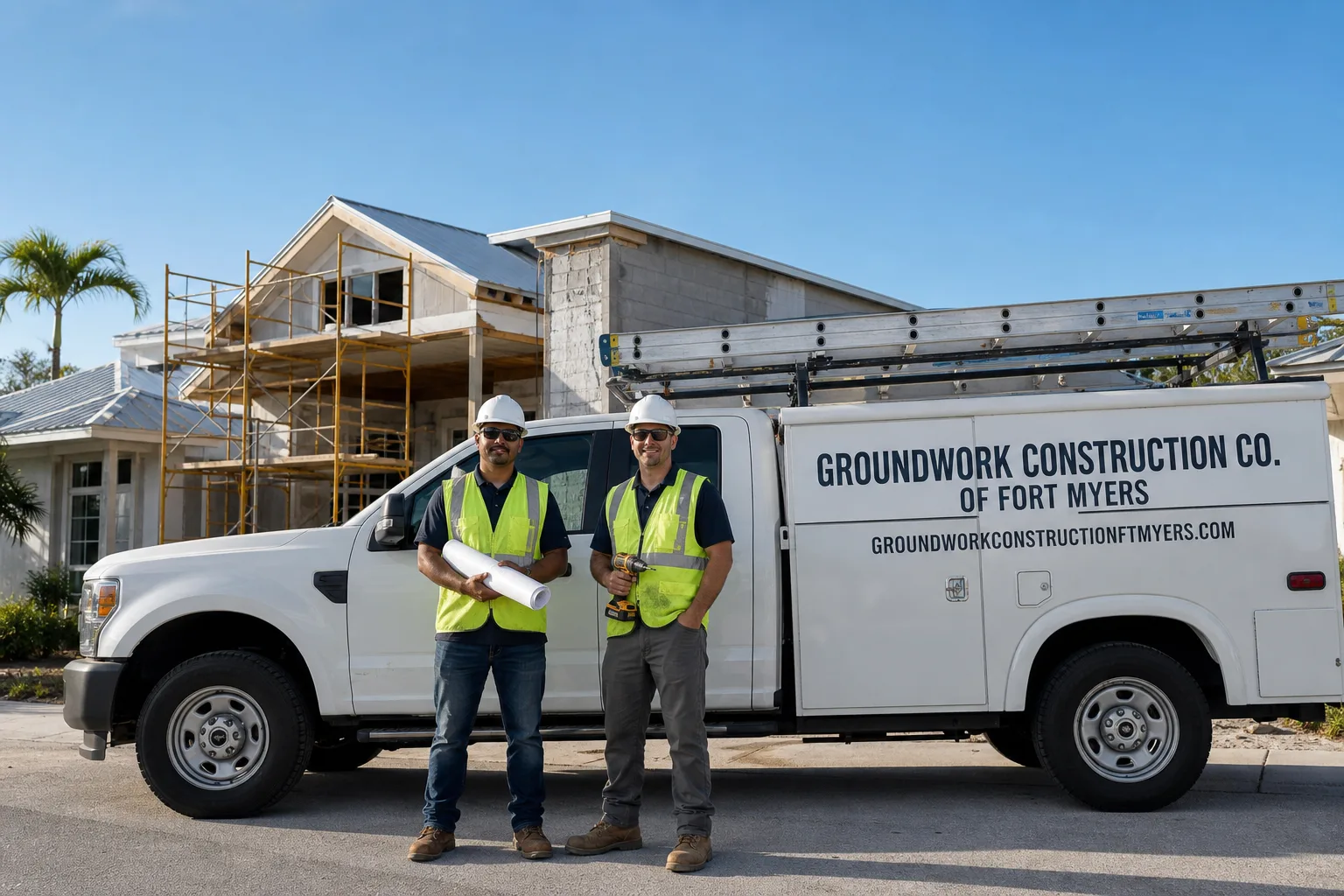
What ADU Site Prep & Utilities Actually Looks Like in Gateway
ADU site prep and utilities in Gateway typically runs $45,000 to $130,000 and takes six to ten weeks before framing begins. The job covers clearing and grading the build site, trenching and connecting water, sewer, and electrical service from the main house or street, pouring a reinforced foundation per Lee County wind codes, and passing all CDD and county inspections. Call (844) 638-7249 for a free on-site estimate with a written line-item breakdown - no vague allowances, exact numbers.
The Sequence: How We Move From Raw Ground to Ready Pad
Every site has its own personality, especially in a master-planned CDD like Gateway. But the sequence follows a logic that doesn’t change much, and knowing it helps you track the job. Here’s what happens, stage by stage.
Stage 1: Site Survey and Utility Locates (Days 1-3)
Before a shovel hits soil, our crew marks out the ADU footprint against your property survey, confirms setback compliance with CDD architectural review standards, and calls in Sunshine 811 for underground utility locates. This is non-negotiable in Gateway - many of the villa-style homes share buried electric and irrigation lines along lot lines you’d never suspect. If the architectural review committee already approved your plans, we pull the Lee County permit the same week. If not, we pause here until the CDD signs off. Expect three to five business days for that approval, longer if the committee meets monthly.
Stage 2: Clear, Grade, and Soil Compact (Days 3-7)
We remove sod, scrub palms, and any landscaping in the footprint, then cut the building pad to grade. Gateway’s soil is mostly sandy loam over limestone - it drains well but doesn’t compact on its own. We use a vibratory plate compactor and test a few spots with a penetrometer before laying a compacted base of crushed limestone or shell rock, which is standard across Lee County. If your lot backs up to one of Gateway’s retention ponds or wetland buffers, we may need additional muck removal and fill - that’s a common cost variable here.
Stage 3: Utility Trenching and Rough-In (Days 5-12)
This is the heart of the job. We trench from the nearest tie-in point - often the main house’s water meter, the electrical panel, and the sewer cleanout - to the new ADU slab location. In Gateway, many homes built between 1990 and 2010 have electrical panels at the far corner of the garage, which can mean a long trench run that adds $3,000 to $7,000 to the project. We bed water lines in sand, slope sewer laterals at a quarter-inch per foot per Florida Plumbing Code, and sleeve all conduit under the slab per Lee County’s wind-resilience amendments. County inspectors visit twice during this phase: once for the open trench before backfill, and once for the rough-in pressure test.
Stage 4: Form, Steel, and Pour the Slab (Days 8-18)
Florida’s 2023 building code requires a minimum 4-inch reinforced slab on grade with #4 rebar on 12-inch centers and a continuous vapor barrier underneath for habitable ADUs. We use Quikrete 3500 PSI mix, poured monolithically with thickened edges and #4 rebar dowels for tie-beam continuity. In Gateway, we also install hurricane straps in the wet concrete at anchor-bolt spacing tighter than the Florida Building Code minimum - insurance carriers here increasingly verify that during four-point inspections, and missing straps on an ADU can ding your entire policy. The slab cures for seven days before we strip forms.
Stage 5: Backfill, Final Grade, and Rough Inspection Sign-Off (Days 18-30)
We backfill around the slab edge with clean fill, grade the perimeter for positive drainage away from the structure, and install any required silt fencing if the lot is within 50 feet of a CDD-managed stormwater easement. A final rough-in inspection from Lee County clears plumbing, electrical, and foundation work before framing can legally start. At this point, the site is a clean, compacted pad with stubbed utilities - ready for framing to begin without delay. If you’re combining this with a Home Additions & ADU in Gateway project, this is where the vertical build starts.
The Choices That Shape Your ADU Site Package
Site prep sounds like raw dirt and pipes, but there are real decisions here that change cost, lifespan, and how your ADU performs long-term. Here are the ones we walk every homeowner through.
- Slab elevation vs. grade. Code minimum puts the finished floor 6 inches above the crown of the road. In Gateway, where lots are flat and stormwater ponds handle runoff, that’s often enough. But if your lot sits near the Timberwood Preserve drainage zone or a CDD canal, we recommend 12 to 18 inches of elevation for dry-floor insurance. The extra fill and formwork adds $4,000 to $9,000.
- Electrical service: subpanel vs. separate meter. Most Gateway homeowners pull a 100A or 125A subpanel feed from the main house panel. If your existing panel is maxed out - common in 1990s homes with original 150A service - you’ll need a new 400A meter-main and separate drop, which adds $5,000 to $8,000 including LCEC coordination.
- Sewer lateral: tie-in vs. dedicated cleanout extension. Tying into the existing house sewer is straightforward if the ADU sits within 40 feet of the main cleanout. Beyond that, we install a dedicated cleanout at the property line, per Lee County Health Department requirements, which adds $2,500 to $4,000.
- Foundation type: monolithic slab vs. stem-wall. Monolithic is standard and cost-effective on flat Gateway lots. Stem-wall construction (block stem walls poured on a footer, then a slab poured inside) makes more sense if the ADU is on a slope or near a retention area; it adds about $12,000 to $20,000 but simplifies future plumbing access.
- Under-slab insulation and vapor barrier upgrades. Code minimum is a 6-mil vapor barrier. We spec 10-mil reinforced poly and optional 1-inch rigid foam perimeter insulation for conditioned ADUs - it cuts slab-edge sweating in Florida humidity and drops cooling loads measurably. The upgrade adds $2,000 to $3,500.
What ADU Site Prep & Utilities Costs in Gateway, FL
You’ll see $45,000 to $130,000 as the working range, with most Gateway jobs landing between $55,000 and $85,000 for a standard 600-to-800-square-foot detached ADU on a flat lot with a short utility run. The variables that shift a project to the high or low end are specific and measurable.
Lot access is the first lever. A backyard ADU with 20 feet of clearance for a mini-excavator costs less than a tight side-yard build that requires hand-trenching and a concrete pump. Utility distance is the second: every additional 10 feet of trench beyond 40 feet adds roughly $800 to $1,200 in labor, conduit, and copper. Soil conditions matter here - Gateway’s limestone shelf sometimes requires rock saw cuts, which add $1,500 to $3,000 per trench day. CDD requirements are the wild card: some sub-neighborhoods require silt fencing, tree protection, and a construction access plan that adds $2,000 to $5,000 before we dig a single hole. Finally, your existing panel capacity determines whether you need a simple subpanel feed or a full service upgrade and separate meter, which is a $5,000 to $8,000 swing.
Our written estimates include every line item: clearing, grading, compaction, trenching, water and sewer laterals, conduit and subpanel, concrete formwork and reinforcement, vapor barrier, county permit fees, CDD application costs, and the rough inspection package. What’s not included - and we flag it upfront - are landscape restoration beyond the immediate work zone, any upgrade your HOA mandates beyond code minimums, and any LCEC or Lee County Utilities impact fees that get billed directly to the property owner. No change orders, no surprises. That’s the Home Additions & ADU way we run every job.
Why Gateway’s CDD Process Changes the Game
Gateway isn’t unincorporated Lee County. It’s a Community Development District with its own architectural review committee that must approve every ADU - even a backyard one - before a county permit application is accepted. That’s backwards from how contractors in Gateway usually work in Fort Myers or Cape Coral, where you file with the city first and deal with HOA sign-off separately. Here, the CDD comes first, and if you skip that step, you lose weeks re-filing and rescheduling locates and inspections.
The housing stock plays into this, too. Most Gateway homes are concrete-block construction from the 1990s and 2000s, with original single-pane windows and electrical panels that weren’t sized for an accessory dwelling. When we trench utilities for an ADU in the Timber Creek or Hampton Park neighborhoods, we’re often digging alongside irrigation lines and buried cable that were installed when the home was built and never mapped. Combine that with the fact that many 1990s-era tile roofs in Gateway are hitting end-of-underlayment life at the same time, and we’ll sometimes coordinate with a re-roof from our Full Bathroom Remodeling in Gateway team if the main house needs envelope work before tying in the ADU. It’s all connected - and that’s the local reality that a generic site-prep crew won’t see coming.
Serving Gateway, FL - Our Local Coverage Area
We’re based in the Gateway area and know this community well. Use the map below to see our service coverage - if you’re nearby, we can almost certainly help.
Frequently Asked Questions - ADU Site Prep & Utilities in Gateway
Six to ten weeks from the day we start clearing to the day the slab passes its final rough inspection. The CDD architectural review step adds one to three weeks that don’t exist in unincorporated areas, and that’s baked into our timeline. Weather delays are rare on site-prep work - we can trench and pour in rain if needed - but LCEC coordination for a separate meter can add two weeks if a new drop is required.
Yes - a Lee County building permit is required, and the Gateway CDD architectural review must approve the project before the county processes the application. We handle both submissions on your behalf, including all site plans, utility diagrams, and structural drawings. Call (844) 638-7249 and we’ll walk you through the approval sequence specific to your sub-community.
No, and trying to shortcut this is what gets permits rejected. An ADU requires its own water service lateral, its own sewer connection (or a shared lateral with a dedicated cleanout), and its own electrical subpanel fed from a properly sized circuit. The only exception is a junior ADU that shares the main house’s systems, but those have their own square-footage and egress rules. For a detached ADU, there’s no way around full utility trenching and connection.
It covers the full site-prep and utility package: site clearing and grading, soil compaction, utility trenching with water, sewer, and electrical rough-in, a code-compliant reinforced concrete slab with vapor barrier, all county permit and CDD review fees, and the rough inspection close-out. The low end assumes a small ADU close to the main house with ample panel capacity and easy machine access. The high end covers long trench runs, a separate electrical service and meter, rock-saw cutting through limestone, and a stem-wall foundation on a tricky lot.
All site-prep and utility work is covered under our 730-Day Done Right Promise. If a settlement crack appears, a sewer lateral backs up due to improper slope, or a conduit separates, we fix it - full stop, no deductible, no argument. The county also requires hold-back inspections at 180 days and one year for foundation and utility sign-off, which we schedule and walk with the inspector.
Get a Free On-Site Estimate for ADU Site Prep in Gateway
We’ll walk your lot, measure the run distances, check your panel, and give you a written estimate with real line items, not a single vague number. It takes about an hour, and you’ll have the numbers the same day. If you’re also planning interior finish work, ask about pairing this with our Small & Partial Kitchen Remodels in Gateway crew. Call (844) 638-7249 - a live person answers, 24/7, no voicemail runaround.
Written by Derek Hollenbeck, Owner at Groundwork Construction Co., providing full-scope home construction with transparent pricing and the 730-Day Done Right Promise.