
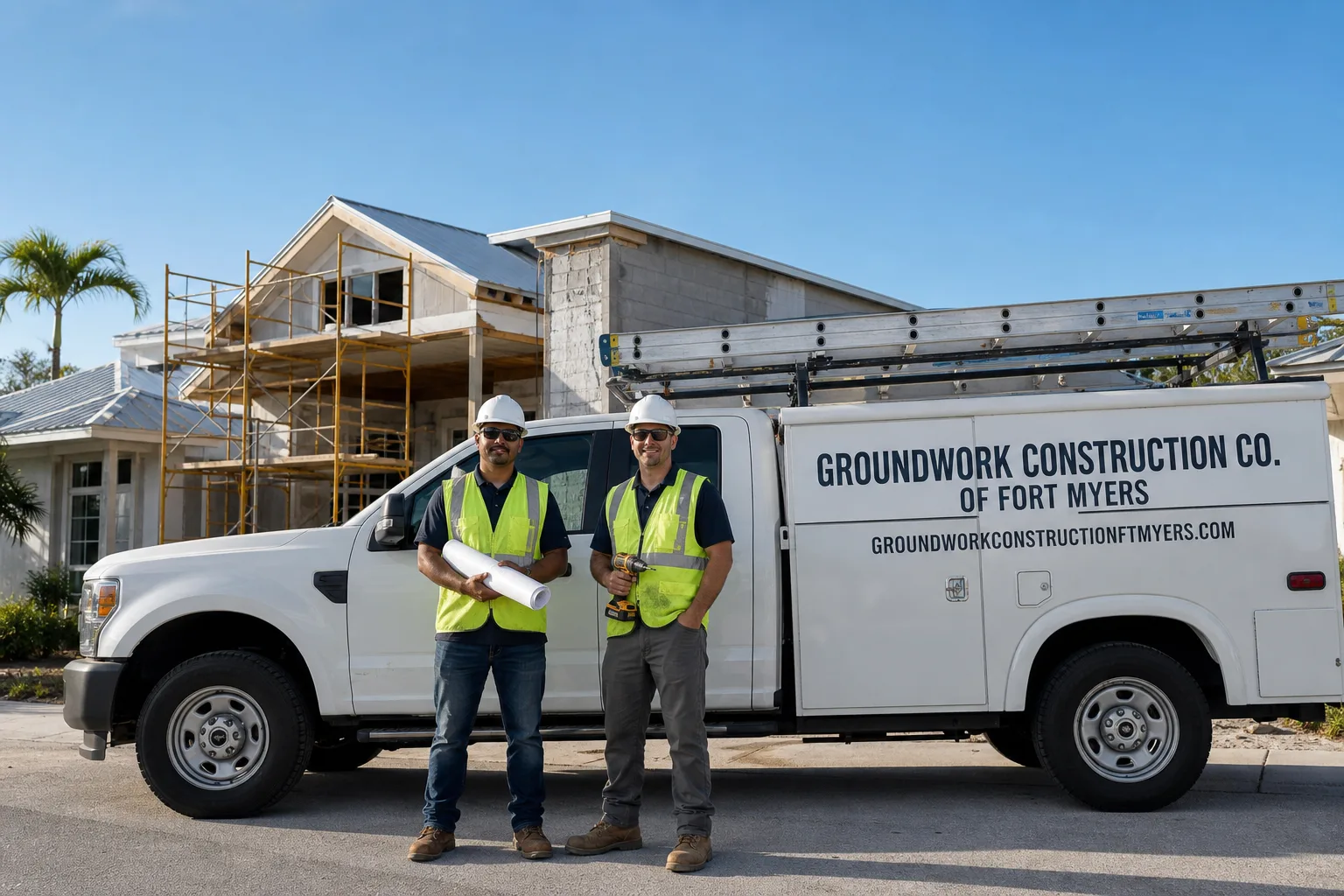
What Tile Roofing in Marco Costs and How the Project Works
Tile roof repair in Marco typically runs $600-$2,500, and a full replacement on an existing home often lands between $18,000 and $40,000 depending on the tile profile and what the underlayment and flashing look like once we get the old material off. Most jobs take five to eight working days from tear-off to final inspection. Call us at (844) 638-7249 and we can give you a line-item price for your roof, not a rough guess.
How Groundwork Takes a Marco Tile Roof From Old to Storm-Ready
Tile roofing is not a one-day job done by a crew in a rush. There is a sequence that has to be followed if the roof is going to hold up through the next hurricane season, and skipping steps in Marco is how you end up with a roof that leaks six months after you paid for it. Here is the actual process we use.
Stage one: The pre-construction walk and permit set. Before we order a single tile we spend about an hour on your roof and in your yard. We check whether the existing underlayment is a single layer or double, whether the battens are spaced right, and whether past repairs left hidden problems. Collier County requires a roofing permit with wind-load calculations showing the assembly meets the ~150 mph ultimate design speed for this zone, so we pull that from the start. Homeowner decision: tile profile and color. This takes one to two days.
Stage two: Tear-off and deck inspection. The old tile comes off, then the old underlayment. This is typically two days on an average Marco ranch. Once the deck is bare we inspect every sheet of plywood for rot or delamination - salt air and the humidity here eat decking faster than people expect, especially near the canals. If we find soft spots, we replace the affected sheets. Homeowner decision: deck repair scope. The estimate already includes a per-sheet allowance, but you approve any extra before we cut.
Stage three: Underlayment, flashing, and secondary water barrier. This stage usually runs two days. We install a high-grade synthetic underlayment - two layers in high-wind areas per current code - followed by peel-and-stick membrane at all valleys, eaves, and penetrations. All flashing is replaced, not reused. Old flashing is a common failure point on Marco roofs because salt corrosion thins the metal even where the tile still looks fine. No homeowner decisions here; this is all spec.
Stage four: Tile, ridge, and hip installation. Another two to three days. Tile is laid in the pattern and profile you chose, with stainless steel fasteners (coated steel does not hold up on this island). Ridge caps and hip tiles are set in a high-bond mortar bed. Homeowner decision: none, unless we spot a vent configuration worth upgrading.
Stage five: Final walk, cleanup, and city inspection. Half a day. We walk the roof with you, point out how the flashing terminates, show you the ridge venting, and confirm the tile alignment. Then the Collier County inspector comes out to sign off. We do not ask for final payment until the inspection passes.
What You Choose When You Choose a Tile Roof in Marco
Tile roofing is not one product picked from a catalog. You are choosing a profile, a material, a color, and an attachment system, and each choice has a direct effect on cost, longevity, and how well the roof handles a storm. Here are the decisions we walk every Marco homeowner through.
- Concrete tile vs. clay tile. Concrete tile is heavier but costs less per square and is widely available in wind-rated profiles. Clay tile is lighter and more resistant to salt-air fading, but it costs more and requires a more careful installation to avoid breakage. For most Marco homes we recommend high-quality concrete tile from brands like Oldcastle - it meets the wind-load requirements without the premium of imported clay.
- Flat profile vs. barrel (S-tile) profile. Flat tile gives a cleaner, more modern look and sheds wind-driven rain well when the overlap is right. Barrel tile - what many people picture when they think of a Florida tile roof - creates deeper shadow lines and moves water through the pan channels, but it requires precise alignment at the hips and valleys. Both perform; it comes down to the architecture of the house.
- Attachment method: nail vs. adhesive-set vs. mechanical clip. In a high-wind zone like Marco, mechanical clips or a combination of screws and adhesive give the best uplift resistance. A nail-only attachment costs less up front but is more likely to loosen over twenty years of storm cycles. We spec mechanical attachment as a default on any roof within half a mile of the Gulf.
- Underlayment grade. This is the layer you never see and never want to think about again. A self-adhered, high-temperature synthetic underlayment costs more than basic felt but is the difference between a roof that stays dry during a three-day storm and one that soaks through. In a Roofing in Marco project this is never the place to save money.
- Color and solar reflectance. Lighter tile colors reflect more heat and keep your attic cooler, which matters on an island where July afternoons sit in the low 90s. Darker profiles absorb heat and can raise cooling costs, but some HOAs in Marco have color restrictions, so we always check before ordering.
What Tile Roofing Costs in Marco, FL
On an average 2,000-square-foot Marco home, a complete tile roof replacement - tear-off, deck repair, new underlayment, new flashing, and new tile - typically falls between $18,000 and $40,000. A repair on a single section where the tile is cracked or the flashing failed runs $600 to $2,500. Every job is quoted as a fixed price with no change orders unless the scope changes at your request.
What pushes a job toward the high end: steep roof pitch, a two-story home requiring more staging, extensive deck rot from years of undetected leaks, clay tile instead of concrete, and a location right on the water where wind-load requirements bump up the fastener count. What keeps it lower: a simple single-story ranch with easy access, concrete tile in a standard profile, and a deck in solid shape with no surprises after tear-off.
Our written estimate includes all materials, labor, the permit, the dumpster, full cleanup, and the structural inspection. What it does not include - and we tell you this up front - is the unknown decking replacement beyond the standard allowance, which is priced per sheet if we find rot during tear-off. You get a firm per-sheet number before we start, so there is no blank check.
Why a Marco Roof Demands More Than a Mainland Roof
Marco Island is a different build environment than even Naples or Fort Myers, and we say that because we work in all three. The island was largely developed by Deltona starting in 1962, which means most original homes are concrete-block ranches on slabs poured before modern wind codes existed. When we open up a roof on one of these houses, we regularly find undersized fasteners, single-layer felt that has turned to dust, and flashing that looks intact until you touch it and the corroded edge crumbles. Tile that still looks decent from the curb can hide a water barrier that is ten years past its useful life.
Collier County now requires a wind-load calculation on every roofing permit, and the ultimate design speed for Marco sits around 150 to 160 mph depending on the exposure category. That calculation drives how many fasteners per tile, which attachment method is approved, and whether you need a secondary water barrier. A roof spec that passes in Golden Gate Estates will not necessarily pass on Marco, and we do not take shortcuts on the engineering.
Salt air is the other variable nobody talks about on the mainland. Homes within a quarter mile of the Gulf or on canal lots get constant brackish exposure that accelerates fastener corrosion. We use stainless steel fasteners as a default on these properties because galvanized will not hold over a full roof cycle, and we have seen the nails rusted through on roofs less than fifteen years old. When you pair the wind requirement with the corrosion variable, the fastener spec alone makes a Marco tile roof a different job - and more expensive - than the same roof ten miles inland.
We also work around the reality that many Marco homeowners are already weighing a full teardown under the county’s substantial improvement rule. If your renovation costs exceed 50% of the structure’s assessed value, you trigger mandatory flood-compliance elevation. We have walked into Marco homes for what looked like a straightforward re-roof and realized the smarter play was to address the roof as part of a full Roofing and elevation plan. We do not push you into more work than you need, but we do tell you what the math says, because hiding from it costs you more later.
Some homeowners pair a tile roof replacement with Impact Windows & Doors in Marco to bring the whole envelope up to current wind code in one project cycle. Others combine it with Sliding & Patio Doors in Marco for the same reason - it is more efficient to do the structural upgrades together than to come back and open walls twice. We sequence it so the roof goes on first, then the openings, which keeps the interior protected through every phase.
Serving Marco, FL - Our Local Coverage Area
We’re based in the Marco area and know this community well. Use the map below to see our service coverage - if you’re nearby, we can almost certainly help.
Frequently Asked Questions About Tile Roofing in Marco
Yes. Collier County requires a roofing permit for any tile roof replacement and for repairs that affect the structural deck or more than a small section of tile. We pull the permit ourselves, and the job is not closed until the county inspector has signed off. A re-roof without a permit puts you at risk with your insurer, especially in a flood and wind zone like Marco.
Concrete tile itself can last fifty years or more, but the underlayment beneath it typically needs replacement every twenty to twenty-five years. In Marco, where humidity and salt air are constant, we often see underlayment degrade closer to the twenty-year mark. If your tile is in good shape but the roof leaks, the problem is almost always the underlayment or the flashing, not the tile.
Only if we find rotted decking that was impossible to see before tear-off. Our estimate includes a standard deck repair allowance, and we price any additional replacement at a fixed per-sheet rate disclosed before we begin. You approve any extra work before we do it. No surprises, no change orders you did not authorize.
In most cases yes. We source through Oldcastle and other major manufacturers who keep extensive color and profile archives, and we have matched tile on Deltona-era ranches across Marco where the original product was discontinued twenty years ago. If an exact match is impossible, we will show you the closest available option and let you decide before we install a single piece.
Every tile roof we install in Marco is covered by the manufacturer’s material warranty on the tile itself and by our 730-Day Done Right Promise on workmanship. If something is not done right, we make it right. That means two full years to find and fix any installation issue at no cost to you, which is one of the longest workmanship guarantees in residential construction in this area.
Get a Free Tile Roofing Estimate in Marco
If you need tile roof repair or a full replacement in Marco, call us at (844) 638-7249 for a free on-site estimate. We will come out, walk the roof, take the measurements, and give you a written price broken down by line item - tile, underlayment, flashing, permit, and labor - so you know exactly what you are paying for and why. There is no pressure and no sales pitch, just a real number from someone who has done this work on this island.
Written by Derek Hollenbeck, Owner at Groundwork Construction Co., serving Marco homeowners with fixed-price roofing estimates and a 730-day workmanship guarantee.