
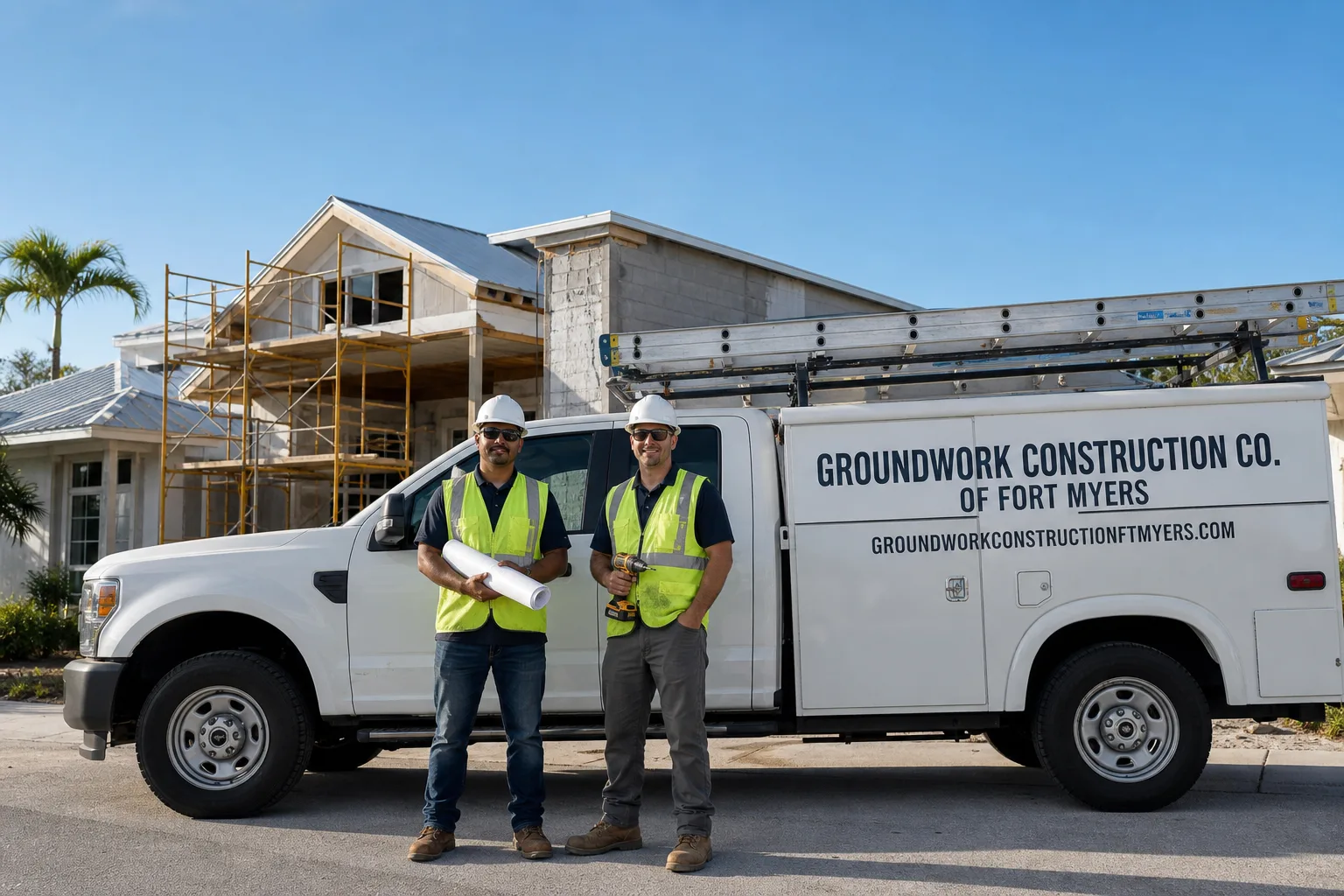
What a New Concrete Driveway in Sanibel Actually Costs and How Long It Takes
A new concrete driveway in Sanibel, FL typically runs $4,500-$12,000 for a standard residential pour, with most jobs finished in 5 to 9 working days once excavation begins. That range accounts for a typical two-car driveway with basic broom finishing on a prepared subgrade. Factors like tear-out of an existing slab, paver borders, decorative stamping, or the elevated-piling access common to post-Ian Sanibel homes can push pricing higher. Call (844) 638-7249 for a line-item written estimate built around your specific lot and elevation requirements.
How We Build a Concrete Driveway on Sanibel, Start to Finish
Concrete work follows a sequence you can set your watch to. No mystery, no crew disappearing for three days mid-job. Here is how it goes on the island.
Day 1 - Demolition and site survey. If an old slab is coming out, we saw-cut and break it, then haul the debris off-island (dumpster logistics across the causeway are planned in advance, not improvised). While that happens, we shoot final grades using a laser level. On Sanibel lots where the finished floor elevation has been raised post-Ian, the driveway approach has to tie into the new elevation without creating a ramp that violates FEMA flood-zone rules. We flag that before a single form stake goes in.
Day 2-3 - Subgrade prep and formwork. We excavate to 6-8 inches below finish grade, compact the native soil with a vibratory plate compactor, then add and compact a 4-inch gravel base in lifts. In Sanibel’s sandy coastal soil, base compaction is non-negotiable. Skipping it means the slab cracks within two years. Forms go up on day 3, and this is when the homeowner makes the final call on width, apron flare, and any curb returns.
Day 4 - Reinforcement and pre-pour inspection. We lay #4 rebar on 2-foot centers (or wire mesh on smaller pours, though we recommend rebar for anything facing salt air). Any required anchor bolts for future gate posts or pergola footings get set now. If the City of Sanibel’s building department requires a pre-pour inspection, it happens at this stage. Not every driveway triggers it, but anything within the Coastal Construction Control Line setback absolutely does.
Day 5 - Concrete pour and finishing. Concrete arrives as a 4,000-psi mix (minimum; we order 4,500 psi for driveways exposed to salt spray). We pour, screed, bull-float, and edge. The finish is your choice: broom finish for grip, smooth trowel for a cleaner look (though it gets slick when wet), or exposed aggregate. Control joints get tooled in while the concrete is still plastic, spaced every 10 to 12 feet to dictate where it will crack, because all concrete cracks eventually.
Day 6-9 - Curing, sealing, and clean-out. We apply a penetrating silane-siloxane sealer once the concrete has cured enough to accept it, usually 24 to 48 hours after the pour. That sealer is the single most important defense against Sanibel’s chloride-laden air. Without it, surface spalling begins in as little as three years. We strip forms on day 7, backfill edges, and grade the surrounding soil to shed rainwater away from the slab. The driveway is usable for foot traffic after 48 hours and for vehicles after a full 7 days.
Finishes and Options Worth Choosing Up Front
A driveway slab is not just a slab. These are the choices that change how it looks, how it wears, and what it costs.
- Broom finish. The standard, and for good reason. A stiff-bristle broom dragged across wet concrete leaves a non-slip texture that holds up to decades of sun, rain, and tire traffic. Lowest cost, lowest maintenance, and what we recommend for 80% of Sanibel driveways unless you have strong aesthetic reasons to go another direction.
- Smooth trowel. A slick, modern look that photographs beautifully. It is also dangerously slippery when wet, which matters on a barrier island that gets 55 inches of rain a year. If you want a smooth finish, we suggest a light broom or a sealer with a grit additive to restore some friction.
- Exposed aggregate. After the pour, we wash away the surface paste to reveal the stone beneath. The look is upscale and the texture is naturally slip-resistant. The trade-off: it costs $2-$4 more per square foot and salt air can etch the exposed stone faces over time without annual re-sealing. Homeowners near West Gulf Drive and the beachfront side of the island who choose this finish should budget for that maintenance.
- Integral color vs. surface stain. We mix iron-oxide pigment into the concrete at the truck for true integral color that runs through the full slab thickness. Surface-applied stains are cheaper up front but fade unevenly in Florida UV within 2-3 years. If you are paying for color, go integral.
- Paver borders and aprons. Many Sanibel homeowners pair a concrete driveway field with a paver border or a paver apron approach. We stock Belgard and Tremron pavers that match the island’s coastal palette, and our Driveway & Pavers in Sanibel crew can tie them into the pour seamlessly.
What Concrete Driveways & Concrete Work Costs in Sanibel, FL
A standard concrete driveway pour in Sanibel lands between $4,500 and $12,000. At the low end, that is a straightforward single-car slab with broom finish on a flat lot with no demolition. At the high end, that is a large two-car driveway with tear-out of an old slab, integral color, an exposed aggregate finish, and a paver apron tying into an elevated home.
Five variables move the number the most:
- Driveway size and thickness. Concrete is priced by the square foot at a standard 4-inch thickness. Going to 6 inches for heavier vehicles or a steeper approach adds roughly 20-30% to the material cost.
- Tear-out of existing concrete. Removing and hauling an old slab off Sanibel adds $1,500-$3,000, mostly in dumpster fees, causeway tolls, and labor. If the old slab is post-tensioned, that number climbs because the cables complicate saw-cutting.
- Site access and elevation tie-ins. Post-Ian homes elevated on pilings require the driveway to transition from street grade up to a higher finished-floor elevation. That often means a longer approach, retaining walls, or multiple steps in the pour. These lots, especially around the East End and Middle Gulf Drive, add $2,000-$5,000 over a flat-lot pour.
- Finish choice. Broom finish is the baseline. Exposed aggregate adds $2-$4/sq ft. Integral color adds $0.75-$1.50/sq ft. A stamped pattern adds $3-$6/sq ft. These stack quickly on a 600-square-foot driveway.
- Permit and inspection fees. Sanibel requires its own city permit for any new driveway or full replacement, separate from Lee County. Expect $200-$500 in filing fees depending on the scope, and budget for at least one inspection visit.
Our written estimate includes the complete scope: demolition, base prep, reinforcement, concrete, finish, sealer, cleanup, and the 730-Day Done Right Promise, which covers the workmanship on your driveway for two full years. We do not send change orders mid-job unless you ask us to add scope. The number you see is the number you pay. Call (844) 638-7249 for an exact quote; it is free and it takes about 20 minutes on site.
What Sanibel Specifically Does to Concrete Work
Salt air eats everything on this island, and concrete driveways are no exception. We see it most in the first three years after a pour on slabs that were never sealed or that were sealed with a cheap acrylic product that breaks down under Florida UV. The chloride ions penetrate the surface, reach the rebar, and corrosion begins. From there, you get internal expansion, hairline cracks, and eventually spalling that pops chunks out of the surface. On pre-Ian homes along Periwinkle Way and the bayside canals, we still find driveways where uncoated steel reinforcement was used 30 years ago and the slab is now splitting apart from the inside out.
Sanibel’s post-Ian reconstruction wave has also changed how we pour. So many homes have been elevated to meet new advisory base flood elevations that the old flat-slab driveway approach no longer works. The driveway must transition from street elevation to a finished floor that is now 3 to 5 feet higher, often crossing a FEMA VE or AE flood zone in the process. That triggers the City of Sanibel’s own building department review, and if the lot sits within the Coastal Construction Control Line, Florida DEP permits come into play. Those permit queues add lead time. We coordinate with the city’s inspection calendar from day one so the pour is not waiting on a sign-off.
Every truckload of concrete, every loader, every dumpster crosses the Sanibel Causeway. During season (January through April), causeway backup can add 45 minutes to a round trip. Our scheduling accounts for that, and we batch material deliveries to minimize trips. That is not a detail a mainland contractor thinks about until their pour gets delayed. We think about it before we bid.
Serving Sanibel, FL - Our Local Coverage Area
We’re based in the Sanibel area and know this community well. Use the map below to see our service coverage - if you’re nearby, we can almost certainly help.
Frequently Asked Questions About Concrete Driveways & Concrete Work in Sanibel
A properly poured, sealed, and maintained concrete driveway in Sanibel lasts 25 to 30 years before significant cracking or spalling demands replacement. The key variable is the sealer. A silane-siloxane penetrating sealer applied every 2-3 years keeps chlorides out of the pore structure. Without it, we see surface degradation start in as little as 5 years. Our 730-Day Done Right Promise covers the workmanship, and we walk every customer through a re-sealing schedule at handoff.
Yes. The City of Sanibel requires a permit for any new concrete driveway or full replacement. Simple resurfacing or sealing does not trigger it, but a full tear-out and re-pour does. If your lot falls within the Coastal Construction Control Line, the review may involve Florida DEP coordination as well. We pull all required permits and schedule the inspections as part of the job. Homeowners often find the permitting timeline surprising, so we recommend budgeting an extra 7 to 14 days for city review before any dirt moves.
Yes, and we do it frequently on Sanibel. The driveway needs to transition from street grade to the new elevated finished floor without creating a steep ramp that violates FEMA flood-zone elevation rules. That usually means a longer approach with a gentler slope, sometimes paired with low retaining walls or stepped landings. Each of these lots is different, so we walk the site with a laser level before we price anything. Call (844) 638-7249 to schedule that walk-through.
A concrete driveway is one continuous slab, poured in a single day. A paver driveway is thousands of interlocking units set on a compacted base, installed by our Driveway & Pavers crew. Concrete costs less up front but cracks are permanent. Pavers cost more but individual units can be lifted and replaced if the ground shifts, which matters on Sanibel’s sandy soil. Both handle the island’s climate fine when installed correctly. The choice usually comes down to budget and whether you prefer the monolithic look of concrete or the segmented look of pavers.
Foot traffic is fine after 48 hours. Vehicles should stay off for a full 7 days. Concrete reaches roughly 70% of its design strength in the first week, but it continues curing and gaining strength for 28 days. Driving on it too early causes surface scaling that cannot be repaired. We time every Sanibel pour so the curing window lands outside any rain forecast, and we coordinate with homeowners so vehicles have an alternate parking spot for the full week.
If your Sanibel property needs a new concrete driveway built for the realities of salt air, flood zones, and island logistics, call (844) 638-7249 for a free on-site estimate. We will walk the lot, take measurements, check the elevation tie-in, and hand you a written quote with a fixed price. No voicemail. A live person answers.
Written by Derek Hollenbeck, Owner at Groundwork Construction Co., serving Sanibel and the surrounding communities.