
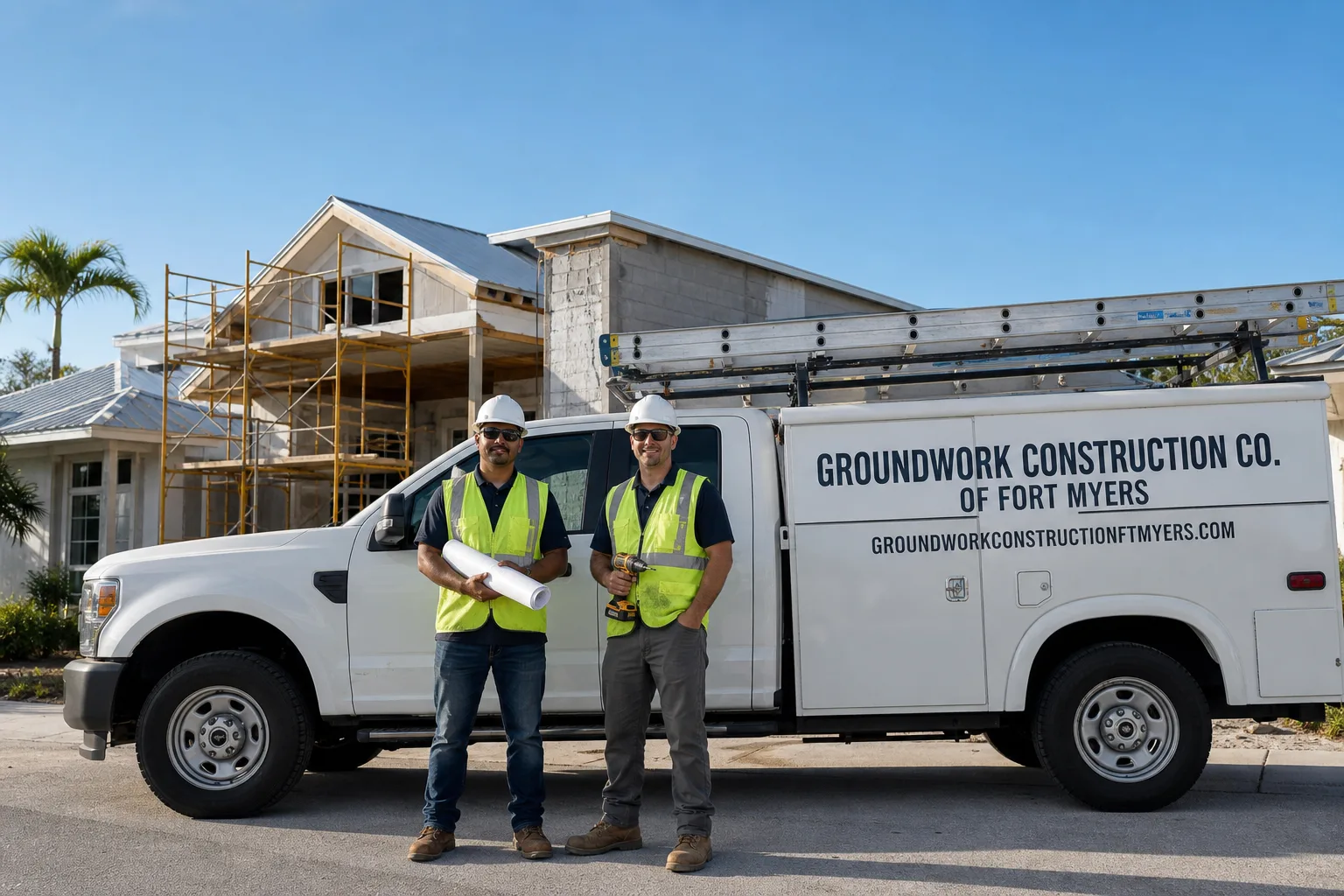
What Emergency & Storm Damage Repair Looks Like in Cypress Lake, FL
Emergency and storm damage repair in Cypress Lake runs anywhere from $1,800 for a tarp-and-mitigate call after a tree limb punches through, to $40,000-plus when a hurricane peels back half a roof and water gets into the trusses. Most jobs land between $8,000 and $20,000 once you factor in structural drying, sheathing replacement, and bringing the tie-downs up to Florida Building Code. If you need someone on-site tonight to stop the bleeding, call (844) 638-7249 - a real person answers, 24/7, and we roll a crew from our Fort Myers yard within hours.
How We Handle Storm Damage in Cypress Lake - Stage by Stage
Every storm job in Cypress Lake follows the same logic: stop the water, prove the damage, get the permit, do the work, and leave you with a wind-mitigation report your insurer will actually accept. The timeline depends on what Lee County’s permit office looks like that week, but we average three to seven days from first call to dried-in. Here’s how it plays out.
Stage 1: Emergency tarp and board-up (day of call, 2-4 hours). The minute we arrive we’re looking for active leaks, compromised sheathing, and wind-damaged panels or tracks on garage and entry doors. We tarp the roof with peel-and-stick underlayment, not blue poly that flaps off in the next squall, and we board any broken windows or doors with CDX plywood screwed into the buck. You pay nothing up front for the emergency call - we document everything for your carrier, then we quote the permanent repair.
Stage 2: Damage documentation and insurance alignment (day 1-2, 1-2 hours on-site). This is where a lot of Cypress Lake homeowners got burned after Ian by out-of-state chasers who wrote soft estimates and walked. We take hundreds of photos, shoot attic and crawl video, map every penetration and water stain, and build a line-item repair scope that mirrors what adjusters expect - Xactimate line codes, wind-mitigation inspection notes, and a separate narrative for any flood-zone elevation issues on your parcel. You get a copy of everything before it goes to your carrier.
Stage 3: Permit and engineering (1-5 days, behind the scenes). Cypress Lake sits in unincorporated Lee County, so permits run through the county building division. If the job involves more than 25% of the roof plane, current code requires bringing the entire roof deck’s nail pattern and tie-downs up to FBC wind-mitigation spec - that means an engineer-stamped detail sheet, not just a reroof affidavit. We pull the permit, we schedule the nailing inspection, and we don’t start structural work until the permit card is posted. Homeowners who skip this step find out the hard way at resale or renewal.
Stage 4: Structural dry-in and reinforcement (1-3 days on-site). Once the permit clears, we strip damaged sheathing, replace any water-damaged truss chords or top plates, install new CDX or ZIP System sheathing with 8d ring-shank nails at 6-inch spacing, and lay a full synthetic underlayment. On garage doors - a major failure point in Cypress Lake during wind events - we check tracks, panels, and spring assemblies and quote any reinforcement or roofing in Cypress Lake tie-in work needed to meet wind-load requirements. Doors that fail during a storm let the roof go.
Stage 5: Finish work, inspection, close-out (1-2 days). We install the finish roofing material, flash every penetration, button up the fascia and soffit, and walk the site with you to confirm every detail. The county inspector signs off, we run a final wind-mitigation report, and we hand you a close-out packet with photos, permits, warranties, and the 730-Day Done Right Promise in writing - if something isn’t right, we make it right. Most Cypress Lake homeowners also ask us to do a quick fence check while we’re there, since wood fence in Cypress Lake tends to get knocked around in the same storms that hit the roof.
The Materials and Choices That Actually Matter After a Storm
You make three real decisions on a storm repair in Cypress Lake, and we walk you through each one with samples and pricing so you know what you’re buying before we order a single bundle.
- Sheathing: CDX plywood vs. ZIP System. CDX is the budget standard - it’s what most 1970s and 1980s Cypress Lake homes already have, and it works fine when dried in fast. Zip System panels come with an integrated water-resistive barrier, which buys you an extra layer of leak protection during the storm season when the next squall can hit before we get the final roof on. ZIP adds roughly $1.50-$2.00 per square foot to the sheathing line item, and it’s worth it on low-slope roofs and homes in FEMA AE zones where any water intrusion turns into a much bigger problem.
- Underlayment: #30 felt vs. full synthetic. Felt meets code minimum and a lot of adjuster scopes price to it. We recommend synthetic - GAF FeltBuster or similar - because it’s lighter, lays flatter, has a better perm rating for our humidity, and doesn’t wrinkle up when it catches a little rain during install. The cost difference on an average Cypress Lake roof is $300-$600 total, and the performance difference in a wind-driven rain event is real.
- Garage-door wind reinforcement. Most pre-Andrew garage doors in Cypress Lake are unrated - they’ll buckle inward under 100-mph gusts and pressurize the whole house. We can retrofit posts, add horizontal struts, or replace the door with a wind-rated model depending on what the existing opening and tracks allow. A full replacement with a rated door starts around $2,800. A strut-and-brace retrofit runs $600-$1,200.
- Finish roofing material: matching vs. full replacement. If the damage is isolated, we can match your existing shingle, tile, or metal profile - but on 40-year-old Cypress Lake homes, matching often means putting new material next to end-of-life material, and you’ll be back in the same spot in two seasons. We show you the remaining service life on what’s still there, and we price both a patch match and a full plane replacement so you can make the call with real numbers.
What Emergency & Storm Damage Costs in Cypress Lake, FL
For Cypress Lake homes, emergency response with tarp, board-up, and full damage documentation runs $1,800-$4,500. A complete structural dry-in and reroof on one plane lands between $8,000 and $16,000. A full roof replacement with wind-mitigation upgrades, including any sheathing replacement and tie-down work, runs $12,000-$22,000 on a typical 1,800-square-foot CBS ranch built in the 1980s. Add $3,000-$6,000 if you’re replacing a garage door and upgrading to wind-rated at the same time.
The number moves on five variables. First, how much sheathing got wet - if water sat in the attic for two days before you caught it, we’re replacing a lot of OSB and possibly sistering truss chords. Second, whether your existing tie-downs pass a wind-mitigation inspection or need retrofit strapping from top plate to foundation. Third, flood-zone requirements - Cypress Lake parcels in AE zones can trigger elevation certificates and additional engineering, which adds $800-$1,500 to the permit and design phase. Fourth, material choice - matching 1980s flat concrete tile costs more than running architectural shingles across the whole plane. Fifth, the Lee County permit timeline - if we can pull over-the-counter, you’re dried in within the week; if it goes to plan review, add five to ten business days.
Every estimate from us is a written, line-item document - you see the material cost, the labor cost, the permit fee, and the waste factor broken out. No change orders unless you ask for something different mid-job, and if that happens we price it on paper before we touch it. For Cypress Lake homeowners navigating an insurance claim, we’ll sit with you and your adjuster’s scope and reconcile line by line so nothing gets missed.
What Cypress Lake Homes Specifically Do to This Job
Cypress Lake’s housing stock is almost entirely single-story concrete block stucco homes poured on slab in the 1970s and early 1980s - built solid but built before Florida’s post-Andrew code overhaul. The hip roofs on these ranches shed wind well in profile, but the original tie-down strapping and sheathing nail patterns are routinely undersized for current wind-load maps. We pull sheathing on a storm repair here and find 6d smooth-shank nails at 12-inch spacing where code now demands 8d ring-shank at 6 inches. That gap is the difference between a roof that stays on and one that peels. Every storm repair we do in Cypress Lake includes a wind-mitigation inspection and an upgrade to current nail patterns on any plane we touch - your insurer sees it on the report and often drops the wind premium, which can save hundreds a year.
The other Cypress Lake reality is Ian’s long shadow. Lee County’s permit office is still working through a backlog that stretches weeks on complex structural reviews, and a lot of the work done by storm-chaser crews right after the hurricane is now failing - bad tie-ins, mismatched shingle profiles, underlayment laid over wet sheathing. We spend a significant portion of our storm-repair days here undoing rushed post-Ian patches before we can start the permanent fix. If your home went through Ian and got a quick tarp-and-shingle job, get the attic inspected before the next named storm - moisture trapped under the underlayment rots sheathing from the inside out, and you won’t see it from the ground. We find it with a moisture meter in under five minutes.
Permitting-wise, expect the Lee County building division to require a full roof plan with wind-mitigation details any time the repair exceeds a 25% plane replacement. That’s not a county overreach - it’s Florida Building Code Section 706.1.1, and it means your job will need an engineer’s stamp, which adds a few hundred dollars and a few days. We handle all of it, and we don’t start swinging hammers until the permit card is on the wall. Homeowners in Cypress Lake who’ve been through the Ian rebuild cycle also tend to ask for our Lee County CGC license and proof of insurance before we walk the property - fair enough. Derek Hollenbeck carries both, and we show them at the door.
If the storm also took out a run of fencing or a side gate, our roofing crew can coordinate with our fence team so you aren’t managing two contractors. And for homeowners replacing windows after storm debris impact, we often line up custom windows and doors in Cypress Lake work alongside the roof repair - one permit pull, one crew coordinator, one warranty to track. For anything that falls outside the roof scope, our broader Cypress Lake team can pull together a combined quote.
Serving Cypress Lake, FL - Our Local Coverage Area
We’re based in the Cypress Lake area and know this community well. Use the map below to see our service coverage - if you’re nearby, we can almost certainly help.
Frequently Asked - Emergency & Storm Damage in Cypress Lake
Same day in nearly all cases - our Fort Myers yard stocks peel-and-stick underlayment, CDX, and fasteners, and we dispatch within two hours of your call to (844) 638-7249. The emergency tarp and board-up typically take two to four hours on-site, and we document everything for your insurance carrier before we leave. A live person answers the phone 24/7, so you won’t wait until Monday morning while water keeps coming in.
Most homeowners policies in Florida cover wind damage, but the deductible - often 2% to 5% of your dwelling coverage - is your responsibility. We work directly with your adjuster to make sure the scope includes every line item: emergency tarp, structural drying, sheathing replacement, tie-down upgrades, and any code-required wind-mitigation work. The key is documentation. If the adjuster’s scope misses something, we flag it with photos and code references. Call (844) 638-7249 and we’ll walk through your policy details before you commit to anything.
Yes, for anything beyond a minor shingle patch. Lee County requires a permit for any structural repair, any roof replacement over one square (100 square feet), and any work involving sheathing or truss repair. We pull the permit, schedule the inspections, and close it out - you never have to visit the county office. Skipping the permit saves a few hundred dollars today and costs you tens of thousands when you sell or when your insurer denies a future claim because of unpermitted work.
From emergency tarp to final inspection, most jobs run seven to fourteen days. The structural dry-in - sheathing, underlayment, and tie-downs - takes one to three days once the permit is in hand. The biggest variable is the Lee County permit queue; if your job qualifies for over-the-counter review, we’re dried in the same week. If the scope triggers plan review, add five to ten business days. We give you a real timeline at the estimate, not a best-case guess.
Every storm repair from Groundwork Construction Co. is backed by our 730-Day Done Right Promise: if something isn’t right, we make it right, no fine print and no runaround. The materials themselves carry manufacturer warranties - GAF shingles run 25 years to lifetime depending on the line, and synthetic underlayments typically carry 20- to 50-year warranties. We register every warranty in your name and include the paperwork in your close-out packet.
Get a Free Storm Damage Estimate in Cypress Lake
If your Cypress Lake home took wind, water, or debris damage, don’t wait for the next storm to find the weak spot. Call (844) 638-7249 - a real person answers day or night - and we’ll schedule a free on-site assessment. We walk the roof, the attic, the garage doors, and the fence line, give you a written line-item estimate, and sit with you and your adjuster’s scope so nothing gets missed. No pressure, no change orders, and the 730-Day Done Right Promise on everything we touch.
Written by Derek Hollenbeck, Owner at Groundwork Construction Co., serving Cypress Lake and greater Lee County with licensed, insured storm damage repair since 2014.