
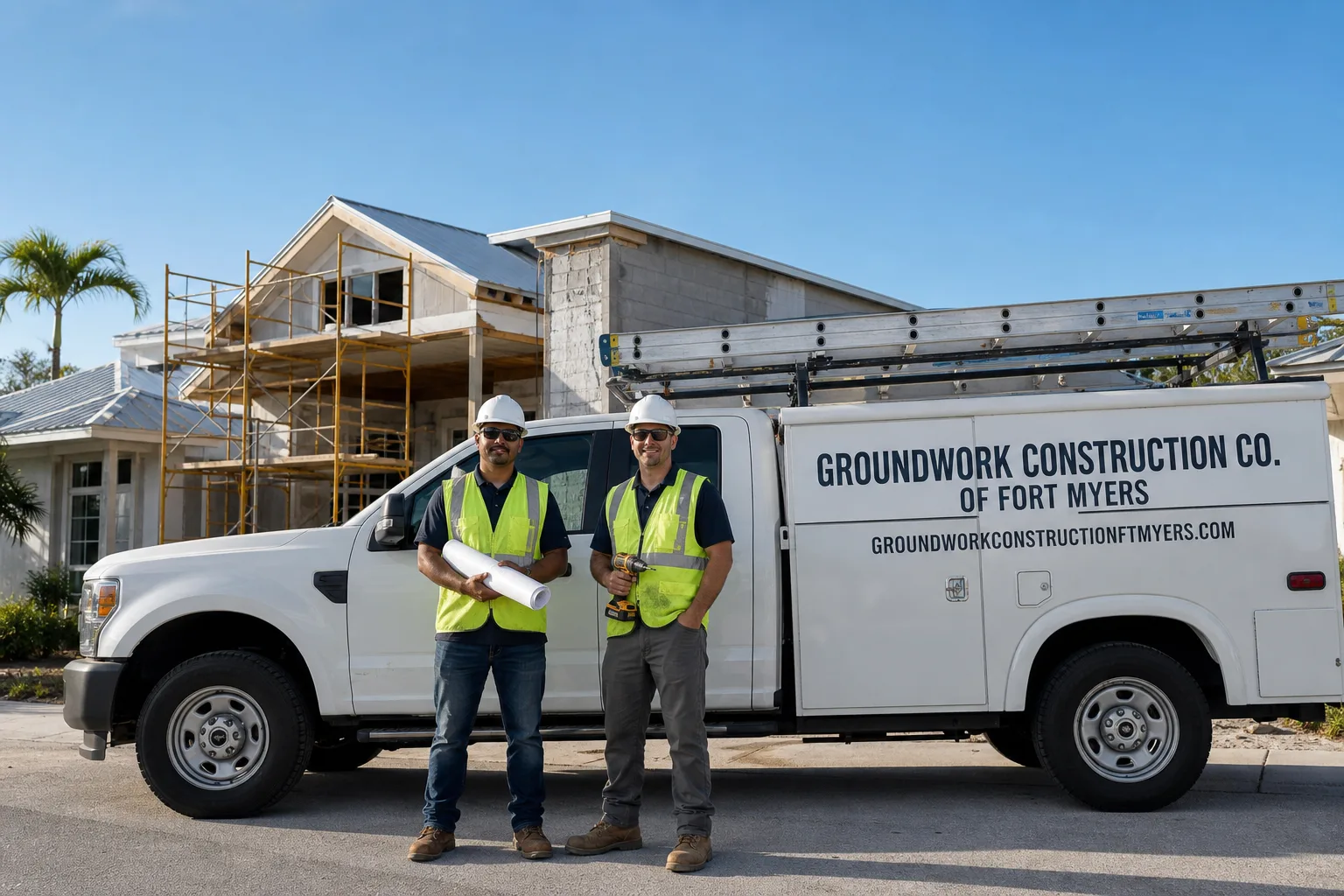
What ADU Site Prep & Utilities Actually Takes in Charlotte Park, FL
ADU site prep and utilities in Charlotte Park, FL typically runs $45,000 to $130,000 and the groundwork phase alone spans 3 to 6 weeks before vertical construction starts. This is not a quick trench-and-drop job. It means clearing and grading the build site, running new or upgraded water, sewer, and electrical service from the street or main house, pouring a code-compliant foundation at the correct flood elevation, and passing a rough-in inspection before a single wall goes up. Call (844) 638-7249 for a free on-site estimate where we walk the lot and give you a written scope and price, not a ballpark.
Newer master-planned communities around Florida often hand you a flat, pre-graded lot with utilities stubbed to the property line. Charlotte Park is the opposite. Canal-front and harbor-front parcels here were platted in the 1960s, and the ground hasn’t gotten any simpler since. We regularly open a site and find what the last contractor left behind: buried construction debris from the post-Charley rebuild, corroded shut-off valves, and electrical service panels that won’t carry the extra load an ADU demands. Our Home Additions & ADU in Charlotte Park work always begins with a realistic assessment of what’s underground, because that’s where the real cost lives.
How We Handle ADU Site Prep in Charlotte Park, Start to Finish
Every ADU site prep job follows five stages. Durations shift based on what we uncover, but the sequence holds. We’ll walk you through each one so you know exactly when decisions need to be made and when inspections gate the next step.
Stage 1: Site survey, soils test, and flood-zone verification (4-7 days)
We bring in a licensed surveyor to mark boundary lines, easements, and the FEMA flood zone designation for your parcel. Most Charlotte Park lots sit in AE or VE zones, which means the finished floor elevation of the ADU has to sit above the Base Flood Elevation pinned to your specific lot. You can’t guess at this. A soils test follows: the sandy-loam mix common along Charlotte Harbor drains well but shifts under load, so we need the bearing capacity number before we spec the foundation. If your property was rebuilt after Hurricane Charley in 2004, we also pull the original permit history at this stage. You’d be surprised how often the county records don’t match what’s actually in the ground.
Stage 2: Demolition, clearing, and root-zone protection (3-5 days)
This stage looks simple from the curb, but on a Charlotte Park canal lot it’s anything but. We clear the build footprint of vegetation, old pavers, shed slabs, and any non-compliant structures. If there’s a mature oak or gumbo limbo within the drip line of the ADU pad, we set up silt fencing and root-protection zones per Charlotte County code. We also mark the underground utility paths at this stage. Older Charlotte Park homes often have septic drain fields or undocumented irrigation lines crossing right through the proposed build area. Finding one now is a good day; finding one after the excavator bucket hits it is expensive and avoidable.
Stage 3: Utility trenching and service connections (7-14 days)
This is the invisible part of the job that makes or breaks the schedule. We dig trenches from the existing main house or the street tap to the ADU footprint for water, sewer, and electrical. In Charlotte Park, the water table sits high on canal-front lots, so trench shoring and dewatering pumps are standard, not optional. On the electrical side, most 1960s-era panels in the neighborhood are 100-amp units that can’t support an ADU plus the main house. You’re looking at a panel upgrade or a separate service drop from FPL. This is also the stage where we run conduit for data, cable, and any buried propane line if you’re opting for gas appliances. Everything stays exposed for the rough-in inspection.
Stage 4: Foundation form, pour, and cure (10-14 days)
Your ADU foundation in Charlotte Park will almost certainly be an elevated monolithic slab or a stem-wall foundation on concrete piers, depending on the flood-zone requirement. We form it, set the anchor bolts and hurricane-strap embeds per Florida Building Code 2023, and pour. The concrete mix includes a corrosion inhibitor in the admixture: salt air here chews through standard rebar faster than you’d believe. We use Quikrete or Sakrete high-strength bag mixes for smaller pours and order ready-mix from a local batch plant for full slabs. After the pour, the concrete needs 7 days of cure time before we can load it with framing. No shortcuts on that clock.
Stage 5: Rough-in inspection and backfill (2-3 days after cure)
With the foundation cured and all utilities stubbed up through the slab, Charlotte County building inspectors come out to sign off on the underground plumbing, electrical conduit, and foundation elevation. This is the gate. Pass, and we backfill the trenches, grade the site for drainage away from the slab, and hand the pad over to the framing crew. Fail, and we correct whatever the inspector flags, which is why our Home Additions & ADU team never schedules framing for the same week as the rough-in inspection.
What You’ll Decide During Site Prep: Options and Trade-Offs
ADU site prep isn’t a single-spec job. You’ll make at least four material and configuration choices that move the cost and the long-term durability of the structure. Here’s what you’re picking between:
- Foundation type: monolithic slab vs. stem-wall on piers. A slab is faster and cheaper upfront, but in a VE flood zone on a Charlotte Park canal lot, elevating on piers may be required by code. The stem-wall route adds $8,000 to $15,000 to the foundation line but keeps your ADU above storm surge. If your lot is in an AE zone with a BFE within 24 inches of grade, a thickened-edge slab with flood vents gets it done.
- Electrical service: panel upgrade vs. separate drop. If your main house panel is already 200 amps and has two open breaker slots, we can feed the ADU subpanel from it. If it’s the original 100-amp unit, you need a service upgrade or a second meter from FPL. The separate drop is cleaner long-term for rental ADUs but adds $3,500 to $6,000 in utility fees and trenching.
- Sewer: tie into existing lateral vs. new grinder pump. Gravity-fed sewer is simpler if the ADU sits uphill from the main house sewer line. On flat canal lots where the run is long or the grade is minimal, we install a grinder pump station with a force main. Figure $2,800 to $5,500 difference depending on the run length.
- Site retaining and drainage. Charlotte Park lots that slope toward the water often need a low retaining wall or a swale to direct runoff away from the ADU slab. We spec Oldcastle Belgard segmental blocks here: they hold up to salt mist better than poured concrete and don’t need painting. A 40-linear-foot wall adds roughly $4,000 to $7,000 to the site-work budget.
What ADU Site Prep & Utilities Costs in Charlotte Park, FL
A realistic budget for ADU site prep and utilities in Charlotte Park runs $45,000 to $130,000. The spread is wide because the site conditions on two adjacent lots can be completely different. One property might need a straightforward slab, a short trench run, and a panel upgrade. The one next door might need piers, dewatering during excavation, a full electrical service drop, and a 60-foot sewer force main through coral-ledge soil.
Here’s what pushes a job toward the low or high end:
- Foundation elevation requirements. The difference between an AE-zone slab and a VE-zone pier foundation can be $12,000 alone.
- Utility run distance and obstacles. A 30-foot trench through clean fill is one thing. A 110-foot trench that has to go under a driveway, around a pool cage, and through a root zone is another.
- Existing panel capacity. If your main service can’t carry the ADU load, the electrical budget jumps $3,500 to $6,000 for the upgrade or new drop.
- Soil and water-table conditions. Canal-lot dewatering and salt-corrosion-resistant concrete admixtures are Charlotte Park norms. They’re not optional line items.
- Permit scope and plan-review time. A straightforward ADU site permit clears in weeks. One that triggers a full FBC code-compliance audit on the existing house is a different animal, and we see that here often.
Every estimate we write includes a fixed-price line for each stage: survey and soils, clearing, utility trenching and connections, foundation, and inspection closeout. What it doesn’t include is the unknown inside the existing walls. If we open the main house’s electrical panel and find it’s a fire hazard, we’ll stop and hand you a change-order quote before we touch it. No surprises, just honesty. Our pricing is upfront and backed by the 730-Day Done Right Promise: if something we built fails due to our workmanship within two years, we fix it. That’s in writing.
What Charlotte Park Homes Specifically Do to This Job
We’ve done ADU site prep across Charlotte Park long enough to know the neighborhood doesn’t give you clean slates. The housing stock here is 1960s-to-1980s concrete block and wood frame, much of it on canal-front lots that were hammered by Hurricane Charley in August 2004 and rebuilt under a patchwork of insurance checks, rushed timelines, and varying permit diligence. When we pull the permit history for a property, we’re as likely to find gaps as we are complete records. That matters. A missing final inspection from 2006 can freeze the ADU permit until we can document that the existing structure meets current Florida Building Code, starting with the hurricane straps and working down to the fastener schedule on the sheathing.
Salt air is the second invisible cost driver. Positioned right on Charlotte Harbor, these lots see accelerated corrosion on buried steel and aluminum. We routinely dig up galvanized water lines that are paper-thin and main service conduits with rusted-out elbows. You can’t tie new copper or PEX into a failing galvanized riser and call it good. The ADU utility plan often has to include a full re-pipe stub-out at the main house to make the connection code-compliant and leak-proof. This is the kind of discovery that turns a $55,000 site-prep budget into an $80,000 job, and it happens here more than in newer inland communities. We flag it during the site walk so it’s on your radar from day one.
Homeowners in Charlotte Park who are adding an ADU often have a larger property vision. Some pair the ADU with a Small & Partial Kitchen Remodel in Charlotte Park in the main house while the crew is already mobilized. Others tie it into a Full Bathroom Remodeling in Charlotte Park so the whole compound is updated at once. If you’re thinking that way, tell us early. Coordinating site prep across multiple scopes saves you money on mobilization, trenching, and inspections compared to doing them separately.
Serving Charlotte Park, FL - Our Local Coverage Area
We’re based in the Charlotte Park area and know this community well. Use the map below to see our service coverage - if you’re nearby, we can almost certainly help.
Frequently Asked Questions About ADU Site Prep & Utilities in Charlotte Park
Plan on 3 to 6 weeks from the first day of surveying to the day the foundation passes its rough-in inspection. The biggest variable is the utility-trenching stage. If we hit a high water table on a canal lot and need to dewater continuously, that adds days. If the electrical service requires a new FPL drop with a transformer, the utility company’s schedule controls the timeline, not ours. We’ll give you a week-by-week calendar at the estimate so you know when each gate closes.
Yes. Site prep, foundation, and utility rough-in all require separate permits through Charlotte County Building Construction Services. You’ll also need a floodplain development permit if the parcel sits in an AE or VE zone, which most Charlotte Park canal-front lots do. We pull every permit for you and our team stands for the inspections. Nobody on your side of the table has to spend a morning at the county building.
Sometimes, but not often. If the ADU sits close to the main house and the existing sewer lateral has enough fall, we can tie into it with a wye connection. On flat canal lots where the ADU is farther back on the property, the grade just isn’t there for gravity flow. In those cases you need a grinder pump and force main. We’ll know which scenario applies after the surveyor shoots the lot elevations.
Everything we build is covered by the Groundwork Construction Co. 730-Day Done Right Promise. That includes the foundation, the utility connections, the grading and drainage, and all materials we supply. If something we built fails because of our workmanship within two years, we make it right at our cost. The manufacturer warranties on products like Quikrete and Oldcastle blocks run separately and we hand you those documents at completion.
The price on the line items we’ve scoped won’t move. If we quote you $14,000 for the foundation and the concrete plant raises its rates next week, we eat that, not you. What can change the total is something we couldn’t see when we wrote the estimate: a corroded main water line that needs replacing before we can stub out the ADU, or an electrical panel that fails a load calculation and has to be upgraded. We’ll stop, show you what we found, and give you a fixed-price change order before we spend a dollar. You decide. No work proceeds without your approval, and calls to our office are answered by a live person 24/7 if you have questions mid-project.
Get a Written Estimate for ADU Site Prep in Charlotte Park
If you’re planning an ADU on your Charlotte Park property, the smartest first move is a free on-site estimate where we walk the lot together, talk through what your specific parcel needs, and hand you a fixed-price scope of work with real numbers. No ballparks, no “we’ll see when we dig.” Call (844) 638-7249 to schedule yours. You’ll get a live person on the line, we’ll set a day that works for you, and you’ll have the numbers in writing before you commit to anything.
Written by Derek Hollenbeck, Owner at Groundwork Construction Co., serving Charlotte Park and surrounding communities with upfront pricing and the 730-Day Done Right Promise.